. 2015 Feb 27;43(4):2242-58.
doi: 10.1093/nar/gkv075. Epub 2015 Feb 4.

Yeast Kre33 and human NAT10 are conserved 18S rRNA cytosine acetyltransferases that modify tRNAs assisted by the adaptor Tan1/THUMPD1

Affiliations

Yeast Kre33 and human NAT10 are conserved 18S rRNA cytosine acetyltransferases that modify tRNAs assisted by the adaptor Tan1/THUMPD1

Sunny Sharma et al. Nucleic Acids Res. .

Abstract

The function of RNA is subtly modulated by post-transcriptional modifications. Here, we report an important crosstalk in the covalent modification of two classes of RNAs. We demonstrate that yeast Kre33 and human NAT10 are RNA cytosine acetyltransferases with, surprisingly, specificity toward both 18S rRNA and tRNAs. tRNA acetylation requires the intervention of a specific and conserved adaptor: yeast Tan1/human THUMPD1. In budding and fission yeasts, and in human cells, we found two acetylated cytosines on 18S rRNA, one in helix 34 important for translation accuracy and another in helix 45 near the decoding site. Efficient 18S rRNA acetylation in helix 45 involves, in human cells, the vertebrate-specific box C/D snoRNA U13, which, we suggest, exposes the substrate cytosine to modification through Watson-Crick base pairing with 18S rRNA precursors during small subunit biogenesis. Finally, while Kre33 and NAT10 are essential for pre-rRNA processing reactions leading to 18S rRNA synthesis, we demonstrate that rRNA acetylation is dispensable to yeast cells growth. The inactivation of NAT10 was suggested to suppress nuclear morphological defects observed in laminopathic patient cells through loss of microtubules modification and cytoskeleton reorganization. We rather propose the effects of NAT10 on laminopathic cells are due to reduced ribosome biogenesis or function.


Figures

Figure 1.
Figure 1.
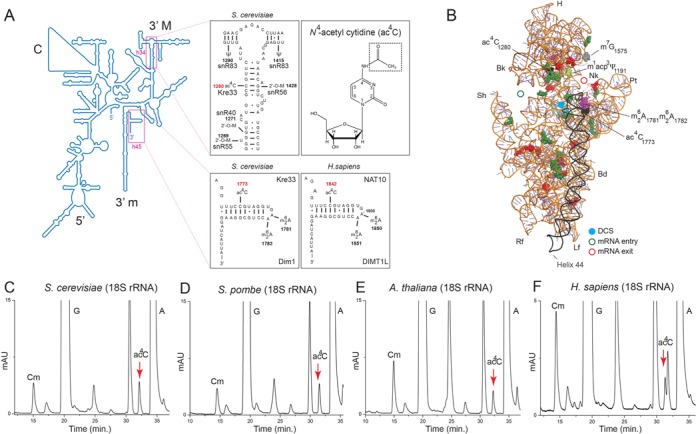
Yeast, plant and human 18S rRNA are acetylated. (A) Secondary structure of the 18S rRNA. The positions of ac4C introduced by Kre33 in yeast in helix 34 and at the base of helix 45 are indicated. The position equivalent to ac4C1773, modified by NAT10 in human, is shown (C1842). Adjacent modifications and factors involved are shown. The inset shows the chemical nature of the ac4C modification. The 5′ central (C), 3′ major (3′ M) and 3′ minor (3′ m) domains are indicated. 2′-O-M, 2′-O sugar methylation; Ψ, pseudouridine. (B) 3D representation of the small subunit based on the crystal structure of the yeast ribosome (PDB 3U5B), with post-transcriptional modifications highlighted. The decoding site (DCS, in cyan) at the base of helix 44 (in anthracite) and the mRNA entry (green circle) and exit (red circle) are indicated. Residues shown as green and red spheres are 2′-O methylated or pseudouridylated, respectively. H, head; Nk, neck; Pt; platform; Bd, body; Lf, left foot; Rf, right foot; Sh, shoulder; Bk, beak. Purified 18S rRNA from budding yeast (S. cerevisiae, (C)), fission yeast (S. pombe, (D)), plant (A. thaliana, (E)) and human cells (H. sapiens, (F)) was analyzed for the presence of ac4C by HPLC revealing the modification as a peak eluting at 32.5 min (see the Materials and Methods section and Supplementary Figure S1 for peak assignment).
Figure 2.
Figure 2.
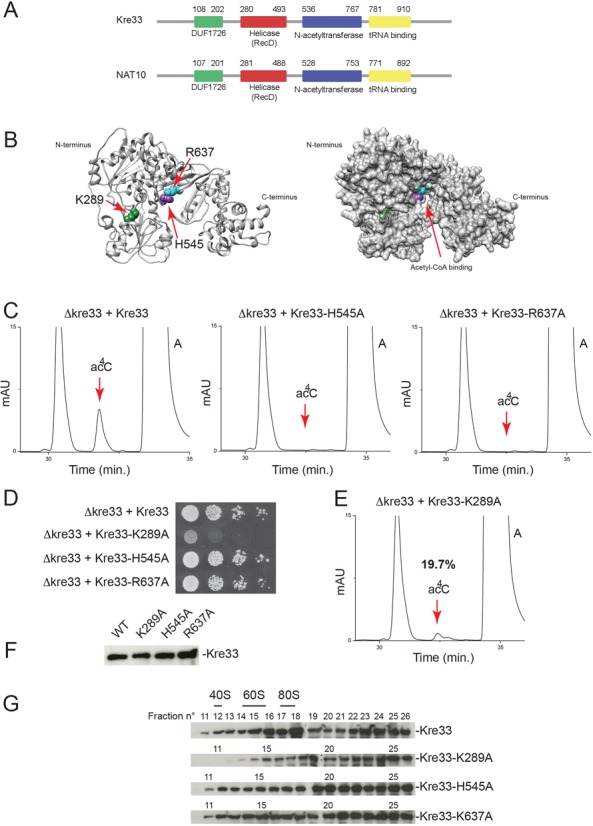
Yeast Kre33 is responsible for 18S rRNA acetylation and its helicase domain is required for efficient RNA modification. (A) Protein domain organization of yeast Kre33 and its human homolog NAT10: a conserved domain of unknown function (DUF1726) is flanked by a helicase domain (RecD), an acetyl-CoA binding domain (N-acetyltransferase) and a tRNA binding motif. (B) Left, ribbon representation of Kre33 (10–930) indicating residues mutated in this work. This model is based on PDB entry 2ZPA. Right: surface rendering highlighting the Acetyl-CoA binding pocket and residues shown to the left. (C) Mutating individual Kre33 residues lining the acetyl-CoA binding pocket leads to total loss of 18S rRNA acetylation. 18S rRNA purified from the indicated yeast strains was analyzed by HPLC for the presence of acetylation. (D) 18S rRNA acetylation is not essential to yeast cell growth in complete medium. Growth assay on plates, showing serial dilutions (1x to 103x from left to right) spotted on rich medium and incubated for 3 days at 30°C. (E) A functional Kre33 helicase domain is required for efficient 18S rRNA acetylation. 18S rRNA analyzed as in panel (C). (F) Metabolic stability of the protein constructs analyzed in this work. Identical amounts of total protein extracted from the indicated strains tested by western blotting with an anti-His antibody recognizing the tag present at the carboxy-terminal end of the constructs. (G) A functional Kre33 helicase domain is required for efficient association of the protein with pre-40S ribosomes. Total extracts of the yeast strains indicated were resolved on 10–50% sucrose gradients. Total protein was extracted from 26 fractions and tested by anti-His western blotting. Kre33 co-migrates with a large spectrum of pre-ribosomes, including early pre-90S precursors, detected in fractions heavier than 80S ribosomes (19 and above), as well as precursors of the small and large subunits (pre-40S and pre-60S), which migrate in fractions heavier than 40S (fractions 12–14) and 60S (fractions 15–17), respectively. The association of Kre33 with the pre-40S fraction is lost in the helicase-deficient mutant K289A.
Figure 3.
Figure 3.
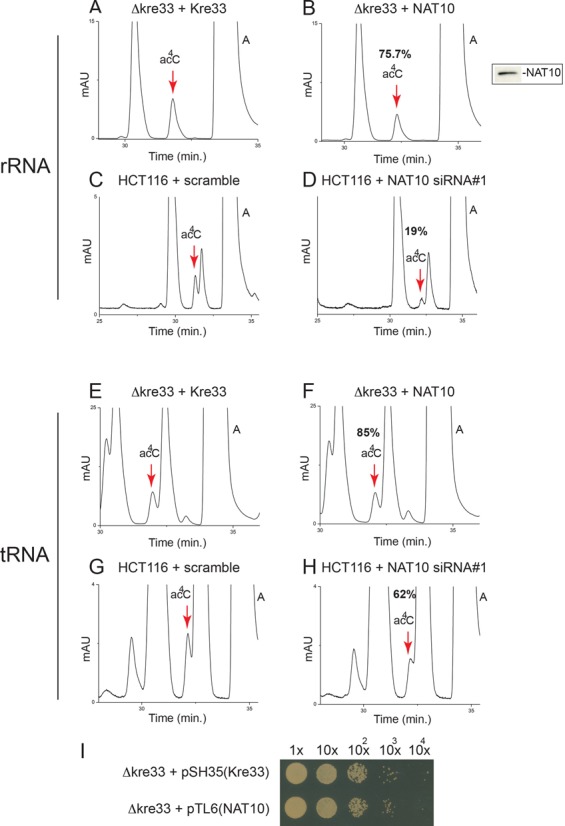
Human NAT10 is required for 18S rRNA and tRNA acetylation. (A, B and E, F) Human NAT10 substitutes for the function of yeast Kre33 in 18S rRNA and tRNA acetylation. The gene encoding NAT10 was expressed in kre33Δ cells, 18S rRNA (A, B) and tRNAs (E, F) were purified and analyzed by HPLC. Inset: western blotting with anti-NAT10 antibody established that the human construct is stably expressed in yeast cells. (C, D and G, H) NAT10 is responsible for 18S rRNA and tRNA acetylation in human cells: colon carcinoma cells (HCT116 p53+/+) transfected with an siRNA specific to NAT10 (siRNA#1) or with a non-targeting control (scramble) were incubated 72 h, 18S RNA (C, D) and tRNAs (G, H) were purified and analyzed by HPLC. (I) Human NAT10 complements growth of Δkre33 cells to the same extent as control wild-type yeast Kre33. Drop assay showing serial culture dilutions on synthetic medium incubated for 3 days at 30°C.
Figure 4.
Figure 4.
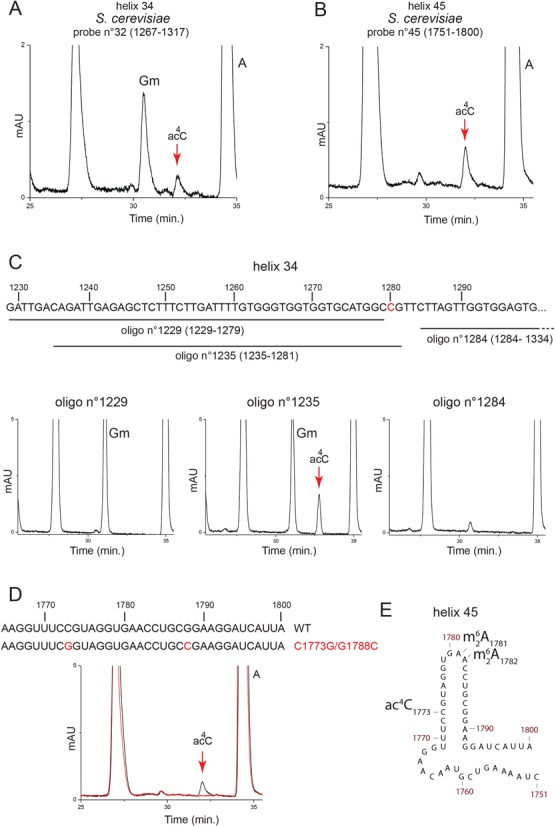
Yeast 18S rRNA is acetylated in helix 34 (3′ major domain) and in helix 45 (3′ minor domain). (A) Mung bean nuclease protection analysis. 18S rRNA was purified from wild-type budding yeast cells, hybridized with probe n°32, protecting residues 1267–1317 in helix 34 and digested with mung bean nuclease. The protected RNA fragment was gel-purified and analyzed by HPLC, revealing the presence of the acetylation. The Gm peak corresponds to Gm1271 modified by snR40 (Figure 1A). (B) Same analysis as in panel (A) but with probe n°45 complementary to a region encompassing nt 1751-to-1800 (helix 45). (C) Mapping the acetylated cytosine in helix 34 to position 1280 by differential Mung bean nuclease digestion. Purified 18S rRNA was processed as in panel (A) with probes spanning nt 1229–1279 (oligo n°1229), nt 1235–1281 (oligo n°1235) or nt 1284–1334 (oligo n°1284). The oligonucleotide n°1235 specifically protects cytosine 1280. (D) Mapping the acetylated cytosine in helix 45 to residue 1773. Yeast cells whose ribosomes contain the C1773G/G1788C mutation are not acetylated, demonstrating that C1773 is normally modified. Purified 18S rRNA was processed as in panel (A) with a probe spanning nt 1729–1779. Red HPLC trace, C1773G/G1788C mutant; black, isogenic wild-type control. (E) The secondary structure of budding yeast helix 45, at the 3′-end of 18S rRNA, with base modifications highlighted.
Figure 5.
Figure 5.
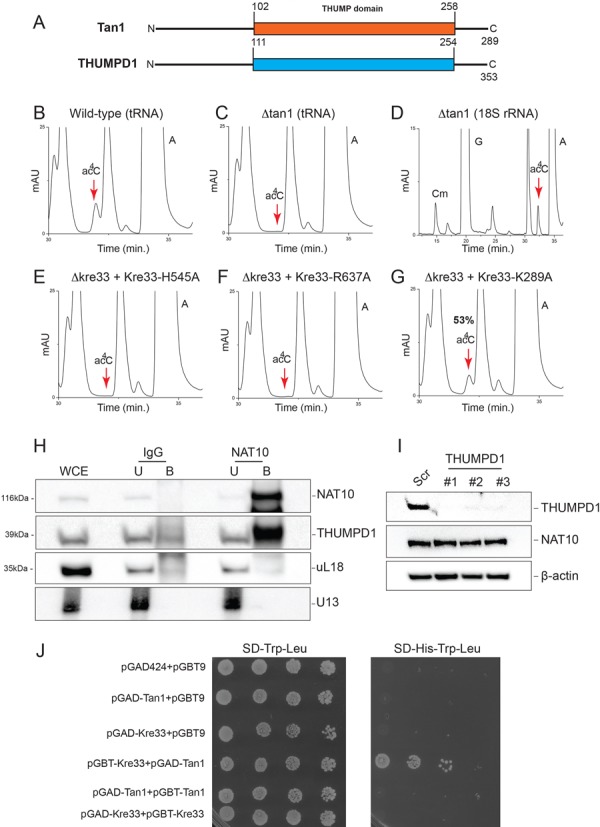
Kre33 is responsible for tRNA acetylation and Kre33 interacts in vivo with Tan1 and NAT10 with THUMPD1. (A) Yeast Tan1 and human THUMPD1 are homologous and carry a conserved tRNA binding domain (THUMP). (B–D) Tan1 is required for tRNA but not rRNA acetylation (see (47)). tRNAs (panels (B) and (C)) and 18S rRNA (panel (D)) purified from tan1Δ cells were analyzed by HPLC for the presence of ac4C. (E, F) Kre33 is required for tRNA acetylation. tRNAs purified from the indicated strains analyzed by HPLC. (G) A functional Kre33 helicase domain is required for optimal tRNA acetylation. (H) NAT10 interacts with THUMPD1 in human cells. HCT116 p53+/+ cell extracts were incubated with magnetic beads covalently linked to anti-NAT10 antibodies. The affinity-purified material was washed under stringent conditions (high salts) and analyzed by western blotting for the presence of NAT10, THUMPD1, and as a control, for ribosomal protein uL18. In parallel, RNA fractions were tested by northern blotting for the presence of U13. WCE, whole cell extract; U, unbound; B, bound. For the protein analysis, the material was loaded in a 1:0.4:10 ratio for WCE, U and B, respectively. For the RNA analysis, a 1:5:10 ratio was loaded. (I) Depletion of THUMPD1 has no impact on the metabolic stability of NAT10. Western blot analysis of total protein extract from HCT116+/+ cells transfected for 3 days with an siRNAs (#1, #2 or #3) specific to NAT10 mRNA or with a non-targeting control (Scr). The membrane was probed with antibodies against the proteins indicated on the right. (J) Kre33 and Tan1 interact in vivo in yeast cells. Kre33 and Tan1 were expressed in yeast cells, alone or in combination, from two-hybrid (2-H) assay constructs. A positive 2-H interaction between Kre33 and Tan1 reconstitutes a functional transcriptional activator (GAD and GBT domains), resulting in histidine (His) prototrophy. SD, synthetic dextrose medium. Trp, tryptophan; Leu, leucine.
Figure 6.
Figure 6.
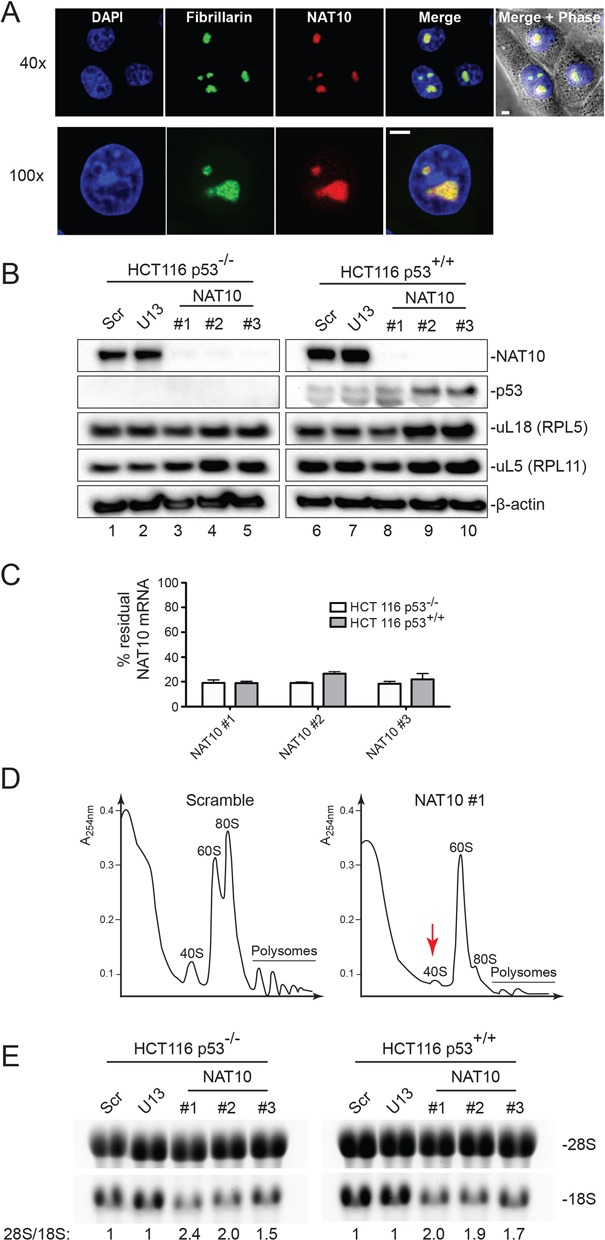
Human NAT10 is a nucleolar protein, which activates a p53-dependent nucleolar tumor surveillance pathway, and is required for 18S rRNA synthesis. (A) NAT10 is a nucleolar protein. Immunofluorescence with an antibody against NAT10 was performed in HeLa cells stably expressing a green fluorescent fibrillarin construct. DAPI, DNA stain. Images were acquired at 40× and 100× on an inverted Zeiss microscope illuminated with Cool LED and mounted with a Yokogawa spindisc head. Scale bar, 5 μm. (B) NAT10 depletion activates nucleolar surveillance, leading to p53 stabilization, and U13 depletion does not affect the metabolic stability of NAT10. Colon carcinoma cells (HCT116), expressing p53 or not, were transfected with an antisense silencer specific to U13 or NAT10 and incubated for 72 h. Three siRNAs were used for NAT10 (#1, #2 and #3); a single 2′-O modified phosphorothioate RNA/DNA hybrid antisense oligonucleotide was used for U13. As control, a non-targeting silencer (Scr) was used. Total protein was analyzed by western blotting for NAT10, p53, and the ribosomal proteins uL18(RPL5) and uL5(RPL11). β-actin was used as loading control. (C) siRNA-mediated depletion of NAT10 is efficient at the mRNA level. Total RNA extracted from HCT116 cells expressing p53 or not (p53+/+ or p53−/−), transfected with an siRNA specific to NAT10 (siRNA #1 to #3) and incubated for 72 h, was tested by qRT-PCR. (D) NAT10 is required for small ribosomal subunit accumulation. Polysomes analysis upon NAT10 depletion with siRNA #1. (E) NAT10 is required for 18S rRNA synthesis. Total RNA extracted upon U13 and NAT10 depletion was analyzed on denaturing agarose gels stained with ethidium bromide. 28S/18S ratio determined from Agilent Bioanalyzer electropherograms.
Figure 7.
Figure 7.
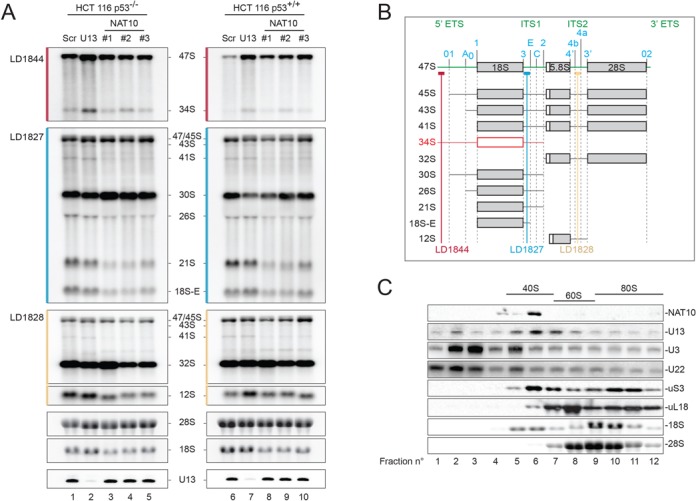
Human NAT10 is required for pre-rRNA processing, and it comigrates on velocity gradients with pre-40S ribosomes and the box C/D snoRNA U13. (A) Pre-rRNA processing analysis. Total RNA presented in Figure 6E was transferred to a nylon membrane and hybridized on northern blots with the probes indicated. The 18S and 28S were stained with ethidium bromide. U13 was detected by northern blotting with probe LD2684. (B) Major pre-rRNA processing intermediates detected by northern blot analysis, and probes used (LD1827, LD1828 and LD1844). Three out of four rRNAs are produced as a single RNA polymerase I transcript (47S). The 18S, 5.8S and 28S rRNAs are interspersed by non-coding spacer sequences (in green): the 5′ and 3′ external transcribed spacers (5′ and 3′ ETS) and internal transcribed spacers (ITS) 1 and 2. Cleavage sites (in cyan) are indicated above the 47S. (C) NAT10 and U13 strikingly comigrate with pre-40S ribosomes (fractions 6–7). Velocity gradient analysis: total HCT116+/+ cell extract was separated on a 10–50% sucrose gradient, 12 fractions were collected and analyzed by western and northern blotting for the targets indicated.
Figure 8.
Figure 8.
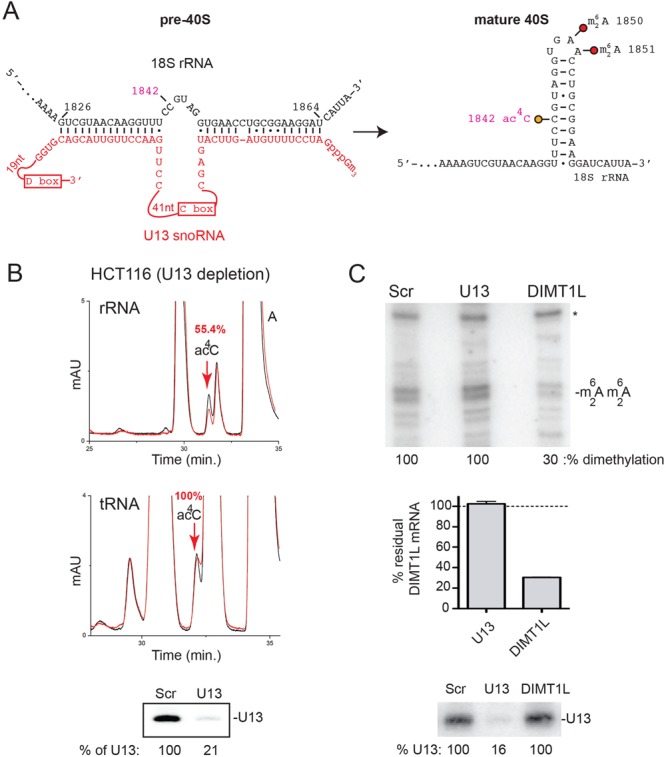
The box C/D snoRNA U13 is required for human 18S rRNA acetylation. (A) Diagrams depicting the predicted base-pairing between U13 and the 3′ end of 18S rRNA. The interaction is proposed to occur during subunit biogenesis, with substrate residue 1842 bulging out upon U13 binding. (B) U13 is required for efficient rRNA acetylation but not for tRNA acetylation. Top panel: 18S rRNA purified from HCT116 cells depleted of U13 for 72 h was analyzed by HPLC, revealing a 2-fold reduction in acetylation (in red). Control HPLC trace from unperturbed cells in black; middle panel, same analysis for purified tRNAs showing no reduction in acetylation; bottom panel, northern blot analysis of residual level of U13 (normalized with respect to the scramble control). (C) U13 is not required for DIMT1L-mediated 18S rRNA 3′ end dimethylation. Total RNA extracted from cells depleted of U13 or DIMT1L for 72 h was analyzed by primer extension to detect the formula image modification. The percentage of residual dimethylation was normalized with respect to a structural stop (*). The efficiencies of DIMT1L depletion (tested by qRT-PCR) and U13 depletion (tested by quantitative northern blot) are shown underneath.

References

    1. Motorin Y., Helm M. RNA nucleotide methylation. Wiley Interdiscip. Rev. RNA. 2011;2:611–631. - PubMed
    1. Cantara W.A., Crain P.F., Rozenski J., McCloskey J.A., Harris K.A., Zhang X., Vendeix F.A., Fabris D., Agris P.F. The RNA Modification Database, RNAMDB: 2011 update. Nucleic Acids Res. 2011;39:D195–D201. - PMC - PubMed
    1. Grosjean H. Nucleic acids are not boring long polymers of only four types of nucleotides: a guided tour. In: Grosjean H, editor. DNA and RNA Modification Enzymes: Structure, Mechanism, Function and Evolution. Austin, TX: Landes Bioscience; 2009. pp. 1–18.
    1. Decatur W.A., Fournier M.J. rRNA modifications and ribosome function. Trends Biochem. Sci. 2002;27:344–351. - PubMed
    1. Lestrade L., Weber M.J. snoRNA-LBME-db, a comprehensive database of human H/ACA and C/D box snoRNAs. Nucleic Acids Res. 2006;34:D158–D162. - PMC - PubMed

Publication types

MeSH terms