


Neuropsychiatric symptoms, APOE ε4, and the risk of incident dementia: a population-based study
- PMID: 25653291
- PMCID: PMC4351664
- DOI: 10.1212/WNL.0000000000001307
Neuropsychiatric symptoms, APOE ε4, and the risk of incident dementia: a population-based study
Abstract
Objective: To investigate the population-based interaction between a biological variable (APOE ε4), neuropsychiatric symptoms, and the risk of incident dementia among subjects with prevalent mild cognitive impairment (MCI).
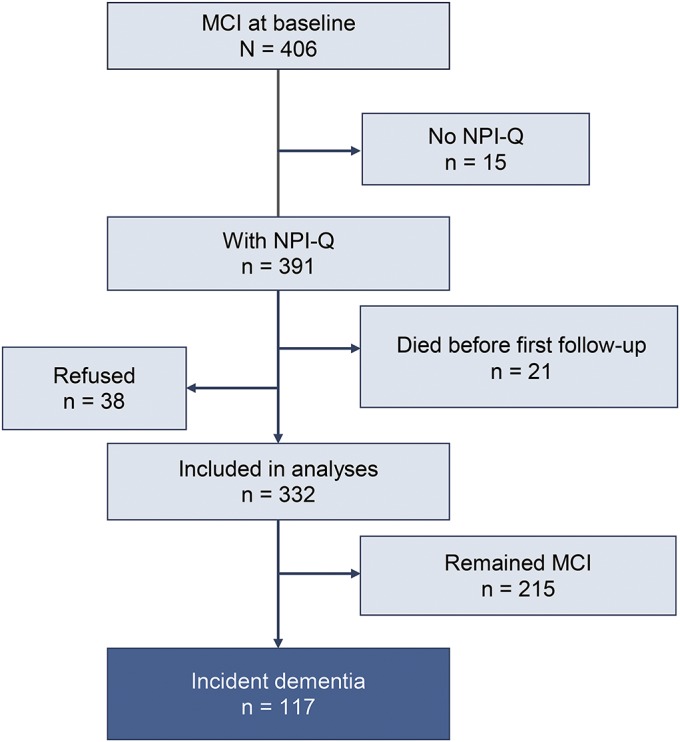
Methods: We prospectively followed 332 participants with prevalent MCI (aged 70 years and older) enrolled in the Mayo Clinic Study of Aging for a median of 3 years. The diagnoses of MCI and dementia were made by an expert consensus panel based on published criteria, after reviewing neurologic, cognitive, and other pertinent data. Neuropsychiatric symptoms were determined at baseline using the Neuropsychiatric Inventory Questionnaire. We used Cox proportional hazards models, with age as a time scale, to calculate hazard ratios (HRs) and 95% confidence intervals (CIs). Models were adjusted for sex, education, and medical comorbidity.
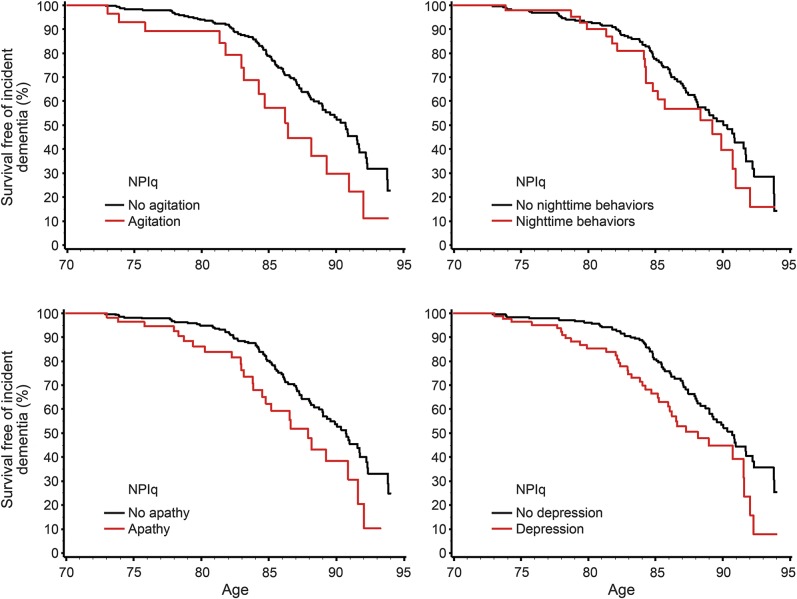
Results: Baseline agitation, nighttime behaviors, depression, and apathy significantly increased the risk of incident dementia. We observed additive interactions between APOE ε4 and depression (joint effect HR = 2.21; 95% CI = 1.24-3.91; test for additive interaction, p < 0.001); and between APOE ε4 and apathy (joint effect HR = 1.93; 95% CI = 0.93-3.98; test for additive interaction, p = 0.031). Anxiety, irritability, and appetite/eating were not associated with increased risk of incident dementia.
Conclusions: Among prevalent MCI cases, baseline agitation, nighttime behaviors, depression, and apathy elevated the risk of incident dementia. There was a synergistic interaction between depression or apathy and APOE ε4 in further elevating the risk of incident dementia.
© 2015 American Academy of Neurology.
Figures
References
-
- Alzheimer's Association. 2013 Alzheimer's disease facts and figures. Alzheimers Dement 2013;9:208–245. - PubMed
-
- Petersen RC. Clinical practice: mild cognitive impairment. N Engl J Med 2011;364:2227–2234. - PubMed
-
- Teng E, Lu PH, Cummings JL. Neuropsychiatric symptoms are associated with progression from mild cognitive impairment to Alzheimer's disease. Dement Geriatr Cogn Disord 2007;24:253–259. - PubMed
-
- Robert PH, Berr C, Volteau M, et al. Importance of lack of interest in patients with mild cognitive impairment. Am J Geriatr Psychiatry 2008;16:770–776. - PubMed
Publication types
MeSH terms
Substances
Grants and funding
LinkOut - more resources
Full Text Sources
Medical
Miscellaneous
