Diagnostic performance of body mass index using the Western Pacific Regional Office of World Health Organization reference standards for body fat percentage
- PMID: 25653487
- PMCID: PMC4310942
- DOI: 10.3346/jkms.2015.30.2.162
Diagnostic performance of body mass index using the Western Pacific Regional Office of World Health Organization reference standards for body fat percentage
Abstract
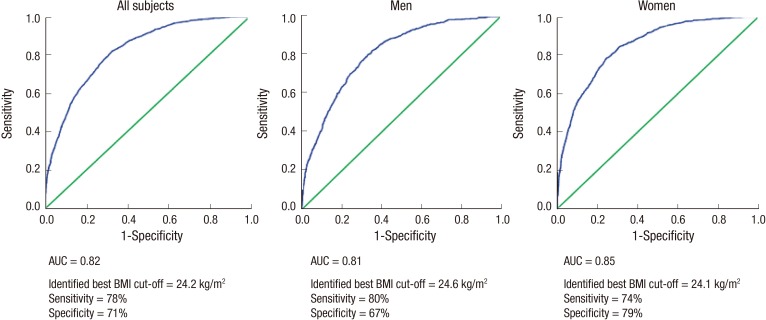
Associations between body mass index (BMI), body fat percentage (BF%), and health risks differ between Asian and European populations. BMI is commonly used to diagnose obesity; however, its accuracy in detecting adiposity in Koreans is unknown. The present cross-sectional study aimed at assessing the accuracy of BMI in determining BF%-defined obesity in 6,017 subjects (age 20-69 yr, 43.6% men) from the 2009 Korean National Health and Nutrition Examination Survey. We assessed the diagnostic performance of BMI using the Western Pacific Regional Office of World Health Organization reference standard for BF%-defined obesity by sex and age and identified the optimal BMI cut-off for BF%-defined obesity using receiver operating characteristic curve analysis. BMI-defined obesity (≥25 kg/m(2)) was observed in 38.7% of men and 28.1% of women, with a high specificity (89%, men; 84%, women) but poor sensitivity (56%, men; 72% women) for BF%-defined obesity (25.2%, men; 31.1%, women). The optimal BMI cut-off (24.2 kg/m(2)) had 78% sensitivity and 71% specificity. BMI demonstrated limited diagnostic accuracy for adiposity in Korea. There was a -1.3 kg/m(2) difference in optimal BMI cut-offs between Korea and America, smaller than the 5-unit difference between the Western Pacific Regional Office and global World Health Organization obesity criteria.
Keywords: Adiposity; Body Composition; Body Mass Index; Obesity.
Conflict of interest statement
The authors have no conflicts of interest to disclose.
Figures
References
-
- Pi-Sunyer FX. The obesity epidemic: pathophysiology and consequences of obesity. Obes Res. 2002;10(Suppl 2):97s–104s. - PubMed
-
- Korea Institute for Health and Social Affairs. Report of national health and nutrition survey 1998. Seoul: Korea Institute for Health and Social Affairs; 1999.
-
- WHO Expert Consultation. Appropriate body-mass index for Asian populations and its implications for policy and intervention strategies. Lancet. 2004;363:157–163. - PubMed
-
- World Health Organization. The Asia-Pacific perspective: redefining obesity and its treatment. Geneva: World Health Organization Western Pacific Regional Office; 2000.
-
- Deurenberg P, Yap M, van Staveren WA. Body mass index and percent body fat: a meta analysis among different ethnic groups. Int J Obes Relat Metab Disord. 1998;22:1164–1171. - PubMed
MeSH terms
LinkOut - more resources
Full Text Sources
Other Literature Sources
Medical
Miscellaneous