Review
. 2015:2015:296184.
doi: 10.1155/2015/296184. Epub 2015 Jan 8.

Intrathecal IgG synthesis: a resistant and valuable target for future multiple sclerosis treatments

Affiliations
Review

Intrathecal IgG synthesis: a resistant and valuable target for future multiple sclerosis treatments

Mickael Bonnan. Mult Scler Int. 2015.

Abstract

Intrathecal IgG synthesis is a key biological feature of multiple sclerosis (MS). When acquired early, it persists over time. A growing body of evidence suggests that intrathecal Ig-secreting cells may be pathogenic either by a direct action of toxic IgG or by locally secreting bystander toxic products. Intrathecal IgG synthesis depends on the presence of CNS lymphoid organs, which are strongly linked at anatomical level to cortical subpial lesions and at clinical level to the impairment slope in progressive MS. As a consequence, targeting CNS lymphoid lesions could be a valuable new target in MS, especially during the progressive phase. As intrathecal IgGs are end-products of these lymphoid lesions, intrathecal IgG synthesis may be considered as a specific marker of the persistence of these inflammatory lesions. Here we review the effect upon intrathecal IgG synthesis of all drugs ever used in MS. Except for steroids, all these therapeutic strategies, including rituximab, failed to decrease intrathecal IgG synthesis, with the exception of a questionable incomplete action of natalizumab. Thus, IgG synthesis is a robust marker of persistent intrathecal inflammation and its complete normalization should be one of the goals in future therapeutic strategies.


Figures
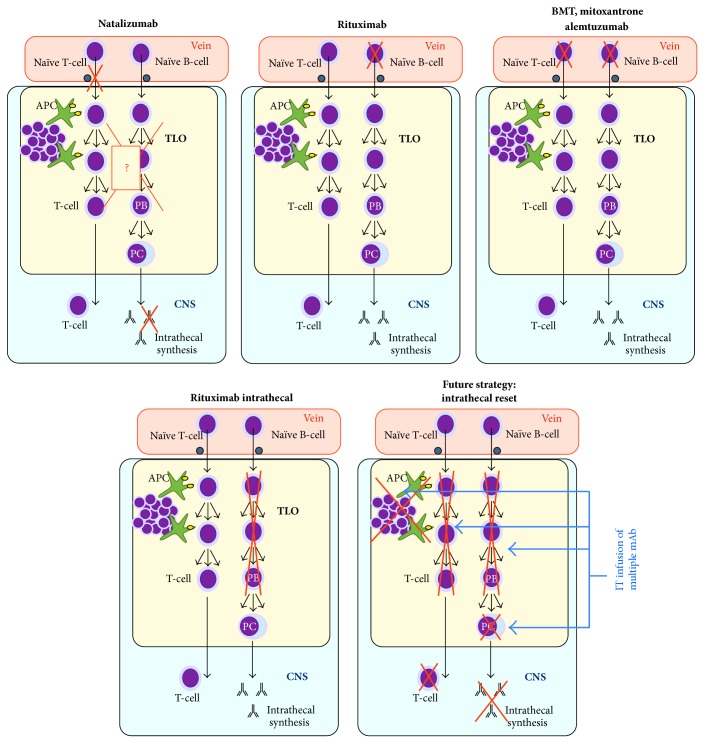
Figure 1
Figure 1
Schematic targets of MS treatments upon CNS compartmentalized inflammation, especially in tertiary lymphoid organs (TLO). Except for natalizumab (owing to unclear mechanisms), none of the treatments targeting blood B-cells have shown any action upon intrathecal IgG synthesis. Preliminary results suggest that rituximab also fails to reduce IgG synthesis. Future treatment strategies might be redirected to reset all the components of intrathecally compartmentalized inflammation. APC: antigen-presenting cells; BMT: bone marrow transplant; PB/PC: plasmablasts/plasma cells; TLO: tertiary lymphoid organs.

References

    1. Bonnan M. Intrathecal immune reset in multiple sclerosis: exploring a new concept. Medical Hypotheses. 2014;82(3):300–309. doi: 10.1016/j.mehy.2013.12.015. - DOI - PubMed
    1. Reiber H., Ungefehr S., Jacobi C. The intrathecal, polyspecific and oligoclonal immune response in multiple sclerosis. Multiple Sclerosis. 1998;4(3):111–117. doi: 10.1177/135245859800400304. - DOI - PubMed
    1. Kostulas V. K., Link H., Lefvert A. K. Oligoclonal IgG bands in cerebrospinal fluid. Principles for demonstration and interpretation based on findings in 1114 neurological patients. Archives of Neurology. 1987;44(10):1041–1044. doi: 10.1001/archneur.1987.00520220043014. - DOI - PubMed
    1. Ghezzi A., Pozzilli C., Liguori M., et al. Prospective study of multiple sclerosis with early onset. Multiple Sclerosis. 2002;8(2):115–118. doi: 10.1191/1352458502ms786oa. - DOI - PubMed
    1. Pohl D., Rostasy K., Reiber H., Hanefeld F. CSF characteristics in early-onset multiple sclerosis. Neurology. 2004;63(10):1966–1967. doi: 10.1212/01.wnl.0000144352.67102.bc. - DOI - PubMed

LinkOut - more resources
