


Point-of-care platelet function testing predicts bleeding in patients exposed to clopidogrel undergoing coronary artery bypass grafting: Verify pre-op TIMI 45--a pilot study
- PMID: 25655085
- PMCID: PMC6711068
- DOI: 10.1002/clc.22357
Point-of-care platelet function testing predicts bleeding in patients exposed to clopidogrel undergoing coronary artery bypass grafting: Verify pre-op TIMI 45--a pilot study
Abstract
Background: Guidelines recommend delaying coronary artery bypass grafting (CABG) for 5 days after discontinuing clopidogrel. However, platelet function may recover quicker in certain individuals.
Hypothesis: We hypothesized that perioperative measurement of platelet function with a point-of-care P2Y12 inhibitor assay could predict bleeding during CABG in patients exposed to clopidogrel.
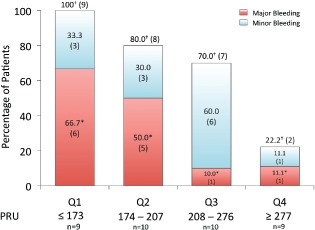
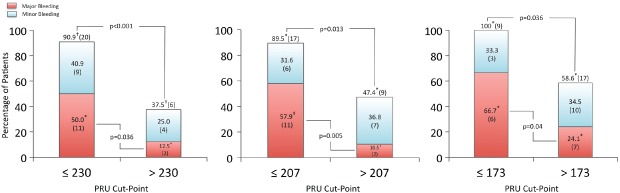
Methods: Verify Pre-Op TIMI 45 was a prospective pilot study of 39 patients on clopidogrel who subsequently underwent CABG. Preoperative on-treatment platelet reactivity was assessed with VerifyNow P2Y12 Reaction Units (PRU), with higher PRU indicating more reactive platelets. Outcomes were stratified by PRU quartiles, as well as prespecified cutpoints for the lowest quartile (PRU 173), a cutpoint for major bleeding determined by the Youden index using receiver operator curve analysis (PRU 207), and clopidogrel resistance (PRU 230).
Results: Patients in higher PRU quartiles experienced smaller decreases in hemoglobin and hematocrit (P < 0.05 for all comparisons), less major bleeding (P = 0.021), and less major or minor bleeding (P = 0.003). Patients above the PRU 207 and 230 cutpoints had less chest-tube output (P = 0.041 and P = 0.012, respectively), less major bleeding (P = 0.005 and P = 0.036, respectively), and less major or minor bleeding (P = 0.013 and P < 0.001, respectively). By receiver operator curve analysis, preoperative PRU ≤ 207 discriminated between patients with and without major bleeding during surgery (area under the curve: 0.76, 95% confidence interval: 0.59-0.94, P = 0.018).
Conclusions: In this pilot study, we found that point-of-care platelet function assessment could predict bleeding in patients recently exposed to clopidogrel undergoing CABG.
© 2015 Wiley Periodicals, Inc.
Figures
Comment in
-
Platelet Function Testing and Prediction of Bleeding in Patients Exposed to Clopidogrel Undergoing Coronary Artery Surgery.Clin Cardiol. 2015 Jul;38(7):443-4. doi: 10.1002/clc.22414. Epub 2015 May 22. Clin Cardiol. 2015. PMID: 25998754 Free PMC article. No abstract available.
-
Authors' Reply.Clin Cardiol. 2015 Jul;38(7):444-5. doi: 10.1002/clc.22413. Clin Cardiol. 2015. PMID: 26216006 Free PMC article. No abstract available.
References
-
- Mehta RH, Roe MT, Mulgund J, et al. Acute clopidogrel use and outcomes in patients with non–ST‐segment elevation acute coronary syndromes undergoing coronary artery bypass surgery. J Am Coll Cardiol. 2006;48:281–286. - PubMed
-
- Nijjer SS, Watson G, Athanasiou T, et al. Safety of clopidogrel being continued until the time of coronary artery bypass grafting in patients with acute coronary syndrome: a meta‐analysis of 34 studies. Eur Heart J. 2011;32:2970–2988. - PubMed
-
- Hillis LD, Smith PK, Anderson JL, et al. 2011. ACCF/AHA Guideline for Coronary Artery Bypass Graft Surgery: a report of the American College of Cardiology Foundation/American Heart Association Task Force on Practice Guidelines. Developed in collaboration with the American Association for Thoracic Surgery, Society of Cardiovascular Anesthesiologists, and Society of Thoracic Surgeons. J Am Coll Cardiol . 2011;58:e123–e210. - PubMed
-
- Thukkani AK, Fonarow GC, Cannon CP, et al. Get With the Guidelines Steering Committee and Investigators. Quality of care for patients with acute coronary syndromes as a function of hospital revascularization capability: insights from Get With the Guidelines‐CAD. Clin Cardiol. 2014;37:285–292. - PMC - PubMed
-
- Berger JS, Frye CB, Harshaw Q, et al. Impact of clopidogrel in patients with acute coronary syndromes requiring coronary artery bypass surgery: a multicenter analysis. J Am Coll Cardiol. 2008;52:1693–1701. - PubMed
Publication types
MeSH terms
Substances
LinkOut - more resources
Full Text Sources
Other Literature Sources
Medical
Miscellaneous
