


Explaining Disability Trends in the U.S. Elderly and Near-Elderly Population
- PMID: 25655273
- PMCID: PMC4600360
- DOI: 10.1111/1475-6773.12284
Explaining Disability Trends in the U.S. Elderly and Near-Elderly Population
Abstract
Objective: To examine disability trends among U.S. near-elderly and elderly persons and explain observed trends.
Data source: 1996-2010 waves of the Health and Retirement Study.
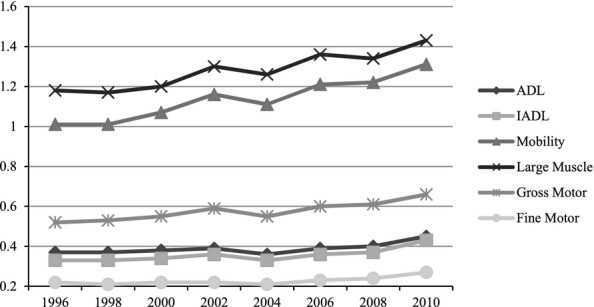
Study design: We first examined trends in Activities of Daily Living and Instrumental Activities of Daily Living limitations, and large muscle, mobility, gross motor, and fine motor indexes. Then we used decomposition analysis to estimate contributions of changes in sociodemographic composition, self-reported chronic disease prevalence and health behaviors, and changes in disabling effects of these factors to disability changes between 1996 and 2010.
Principal findings: Disability generally increased or was unchanged. Increased trends were more apparent for near-elderly than elderly persons. Sociodemographic shifts tended to reduce disability, but their favorable effects were largely offset by increased self-reported chronic disease prevalence. Changes in smoking and heavy drinking prevalence had relatively minor effects on disability trends. Increased obesity rates generated sizable effects on lower-body functioning changes. Disabling effects of self-reported chronic diseases often declined, and educational attainment became a stronger influence in preventing disability.
Conclusions: Such unfavorable trends as increased chronic disease prevalence and higher obesity rates offset or outweighed the favorable effects with the result that disability remained unchanged or increased.
Keywords: Disability; elderly; mobility; near-elderly; obesity.
© Health Research and Educational Trust.
References
-
- Alley DE. Chang VW. The Changing Relationship of Obesity and Disability, 1988-2004. Journal of the American Medical Association. 2007;298(17):2020–7. - PubMed
-
- Anderson G, Herbert R, Zeffiro T. Johnson N. Chronic Conditions: Making the Case for Ongoing Care. 2004. , and. “ ” [accessed on January 14, 2015]. Available at http://www.partnershipforsolutions.org/DMS/files/chronic_book2004.pdf.
-
- Aranovich G, Bhattacharya J, Garber AM. MaCurdy TE. Coping with Chronic Disease? Chronic Disease and Disability in Elderly American Population 1982–1999. Cambridge, MA: National Bureau of Economic Research; 2009. , and. NBER Working Paper Series Number w14811.
-
- Autor DH. Duggan MG. The Growth in the Social Security Disability Rolls: A Fiscal Crisis Unfolding. Journal of Economic Perspective. 2006;20(3):71–96. - PubMed
Publication types
MeSH terms
LinkOut - more resources
Full Text Sources
Other Literature Sources
Medical
