Review
. 2015 Feb;199(2):281-91.
doi: 10.1534/genetics.114.173633.

Genomic insights into the Saccharomyces sensu stricto complex

Affiliations
Review

Genomic insights into the Saccharomyces sensu stricto complex

Anthony R Borneman et al. Genetics. 2015 Feb.

Abstract

The Saccharomyces sensu stricto group encompasses species ranging from the industrially ubiquitous yeast Saccharomyces cerevisiae to those that are confined to geographically limited environmental niches. The wealth of genomic data that are now available for the Saccharomyces genus is providing unprecedented insights into the genomic processes that can drive speciation and evolution, both in the natural environment and in response to human-driven selective forces during the historical "domestication" of these yeasts for baking, brewing, and winemaking.

Keywords: Saccharomyces; genomics; industrial fermentation; yeast.


Figures

Figure 1
Figure 1
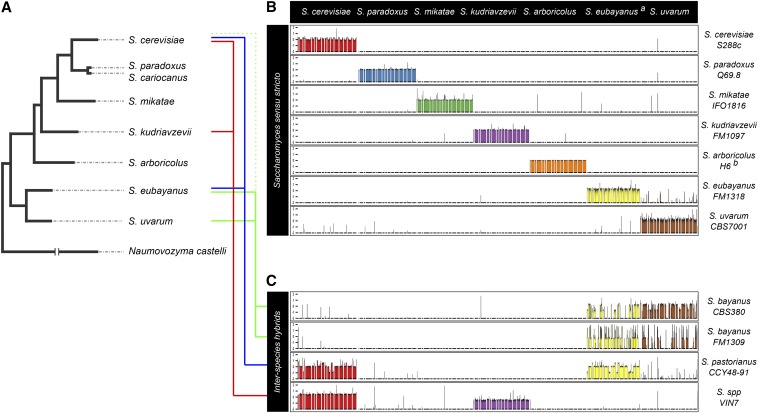
The Saccharomyces sensu stricto clade. (A) A schematic representation of the phylogenic structure of the Saccharomyces sensu stricto members, with Naumovozyma castelli as an outgroup. (B) Genomic representation of the Saccharomyces sensu stricto clade. Short read sequencing data from individual strains (as indicated to the left of the plot) were aligned to a common reference sequence composed of ordered, chromosomal-based scaffolds for each of the seven Saccharomyces sensu stricto species (listed at the top of the plot). The log2 ratio of sequence coverage compared to the genome-wide average across this reference is shown for 10-kb sliding sequence windows. For each “pure” species, sequence reads primarily map to the expected single reference genome, with an even level of coverage indicating equal relative chromosomal copy number. Small, isolated regions of coverage may be indicative of small-scale introgression events between species in individual strains. (C) Genomic representation of Saccharomyces interspecific hybrids, including the hybrid “species” S. bayanus and S. pastorianus. Sequencing data from individual hybrid strains were analyzed as in B. Each hybrid strain displays sequence reads that map to large portions of chromosomes from multiple distinct pure species. In addition, uneven sequence coverage indicates genomic copy number variation due to aneuploidy or chromosomal rearrangement. The S. eubayanus reference genome was estimated from the S. eubayanus portion of the S. pastorianus genome and therefore lacks several genomic loci that have been lost in this strain.
Figure 2
Figure 2
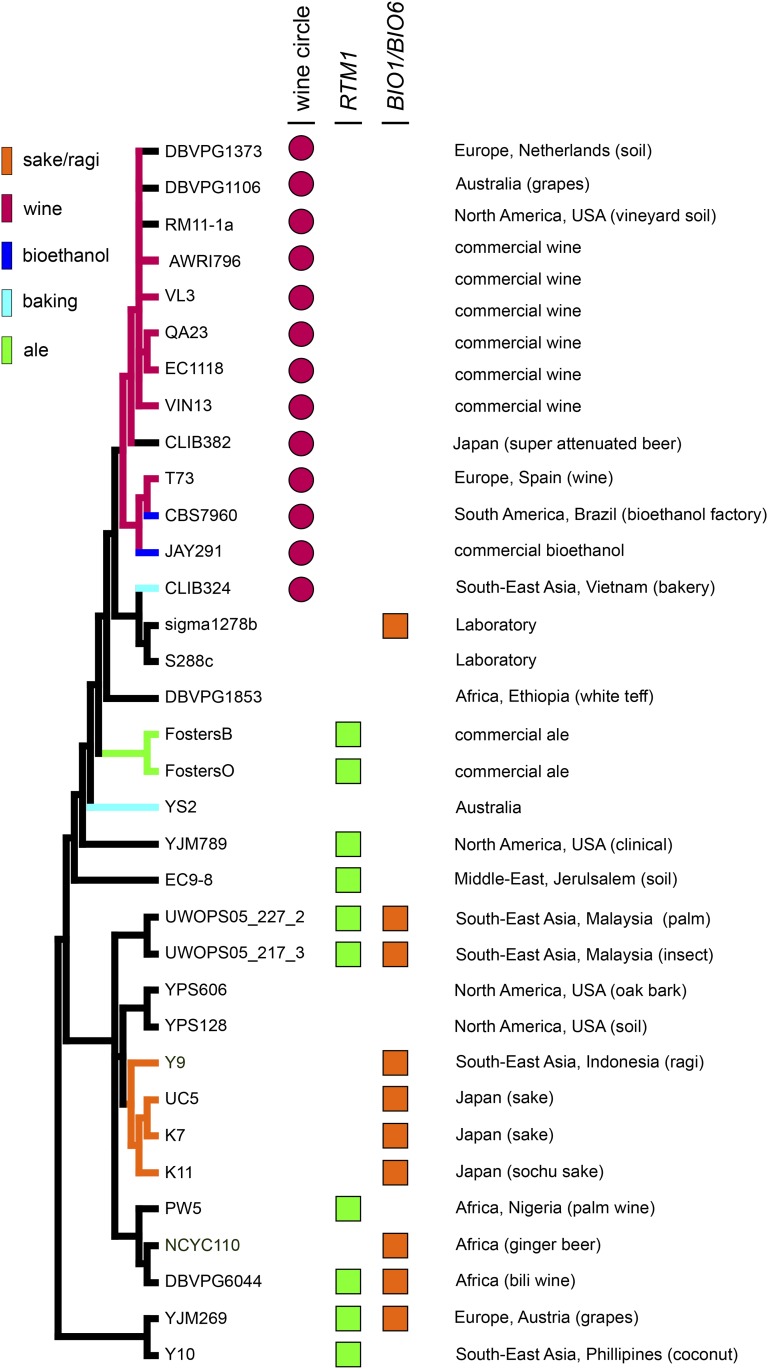
Genomic comparison of various strains of S. cerevisiae. A maximum-likelihood phylogeny was constructed for a variety of S. cerevisiae strains for which whole-genome sequence data are available. Branches involving industrial strains are shaded according to their documented use (sake/ragi, grape-based wine, bioethanol, baking, or ale production). The presence of three strain-specific genomic loci (wine circle, RTM1 cluster, and BIO1/BIO6) and their source of isolation are also indicated for each strain.

References

    1. Akao T., Yashiro I., Hosoyama A., Kitagaki H., Horikawa H., et al. , 2011. Whole-genome sequencing of sake yeast Saccharomyces cerevisiae Kyokai no. 7. DNA Res. Int. J. Rapid Publ. Rep. Genes Genomes 18: 423–434. - PMC - PubMed
    1. Argueso J. L., Carazzolle M. F., Mieczkowski P. A., Duarte F. M., Netto O. V. C., et al. , 2009. Genome structure of a Saccharomyces cerevisiae strain widely used in bioethanol production. Genome Res. 19: 2258–2270. - PMC - PubMed
    1. Bellon J. R., Eglinton J. M., Siebert T. E., Pollnitz A. P., Rose L., et al. , 2011. Newly generated interspecific wine yeast hybrids introduce flavour and aroma diversity to wines. Appl. Microbiol. Biotechnol. 91: 603–612. - PubMed
    1. Bellon J. R., Schmid F., Capone D. L., Dunn B. L., Chambers P. J., 2013. Introducing a new breed of wine yeast: interspecific hybridisation between a commercial Saccharomyces cerevisiae wine yeast and Saccharomyces mikatae. PLoS ONE 8: e62053. - PMC - PubMed
    1. Bergström A., Simpson J. T., Salinas F., Barré B., Parts L., et al. , 2014. A high-definition view of functional genetic variation from natural yeast genomes. Mol. Biol. Evol. 31: 872–888. - PMC - PubMed

Publication types

LinkOut - more resources