Accuracy of visual assessment by school teachers in school eye screening program in delhi
- PMID: 25657511
- PMCID: PMC4317979
- DOI: 10.4103/0970-0218.149269
Accuracy of visual assessment by school teachers in school eye screening program in delhi
Abstract
Background: Although school eye screening is a major activity of the National Program for Control of Blindness, inadequate evidence exists about accuracy of school teachers in screening.
Objectives: Compare quality of referral for subnormal vision by school teachers and primary eye care workers (PECW) in school children and to establish appropriate cutoff for identification of subnormal vision in school going children.
Materials and methods: This was a cross-sectional study involving school children studying in classes 1 to 9 in different schools of Delhi evaluated for sub-normal vision. Vision was recorded by the teacher and a primary eye care worker especially trained for the study using the optotypes of Early treatment Diabetic Retinopathy Survey (ETDRS) vision chart with standard lighting.
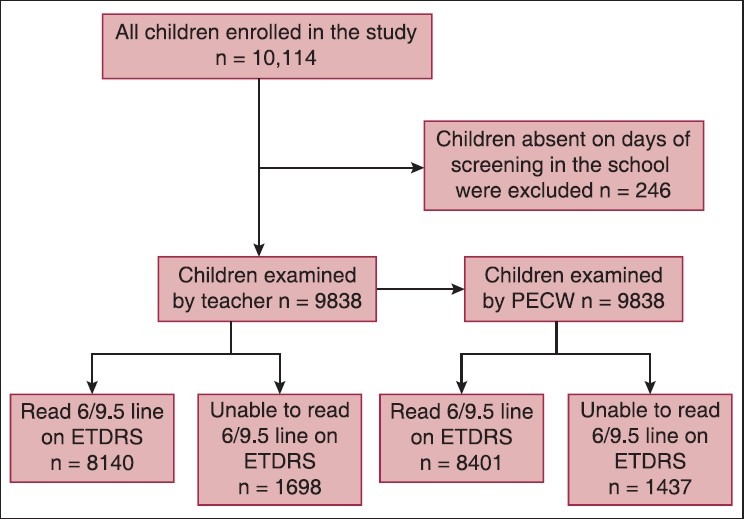
Results: The total number of children enlisted in the 20 selected schools was 10,114. Of these, 9838 (97.3%) children were examined in the study. The mean age of children enrolled in the study was 11.6 ± 2.19 years with 6752 (66.9%) males. The sensitivity and specificity of teachers in comparison to PECW using 6/9.5 vision level as cutoff for referral was 79.2% and 93.3%, respectively compared to 77.0% and 97.1%, respectively on using the 6/12 optotype. The results showed significantly higher sensitivity and lower specificity for private schools against government schools and for older against younger children.
Conclusions: Our results show that the use of teachers and shift to use of the 6/12 sized "E" for the school eye screening (SES) program is appropriate and would substantially reduce the work of eye care providers while improving its overall efficiency.
Keywords: Accuracy; national program for control of blindness; refractive errors; school eye screening; sensitivity and specificity.
Conflict of interest statement
Figures
Similar articles
-
School-based vision screening in Quetta, Pakistan: a qualitative study of experiences of teachers and eye care providers.BMC Public Health. 2021 Feb 16;21(1):364. doi: 10.1186/s12889-021-10404-9. BMC Public Health. 2021. PMID: 33593327 Free PMC article.
-
Vision Screening of School Children by Teachers as a Community Based Strategy to Address the Challenges of Childhood Blindness.J Clin Diagn Res. 2016 Apr;10(4):NC09-14. doi: 10.7860/JCDR/2016/18939.7628. Epub 2016 Apr 1. J Clin Diagn Res. 2016. PMID: 27190849 Free PMC article.
-
Assessing the inclusion of primary school children in vision screening for refractive error program of India.Indian J Ophthalmol. 2018 Jul;66(7):935-939. doi: 10.4103/ijo.IJO_1036_17. Indian J Ophthalmol. 2018. PMID: 29941735 Free PMC article.
-
Agreement and diagnostic accuracy of vision screening in children by teachers, community eye-health workers and vision technicians.Clin Exp Optom. 2018 Jul;101(4):553-559. doi: 10.1111/cxo.12559. Epub 2017 Jun 28. Clin Exp Optom. 2018. PMID: 28657122
-
Sensitivity and specificity of teachers for vision screening among primary school children in South India.Oman J Ophthalmol. 2019 May-Aug;12(2):88-93. doi: 10.4103/ojo.OJO_55_2016. Oman J Ophthalmol. 2019. PMID: 31198293 Free PMC article.
Cited by
-
School-based vision screening in Quetta, Pakistan: a qualitative study of experiences of teachers and eye care providers.BMC Public Health. 2021 Feb 16;21(1):364. doi: 10.1186/s12889-021-10404-9. BMC Public Health. 2021. PMID: 33593327 Free PMC article.
-
Vision for the Future Project: Screening impact on the prevention and treatment of visual impairments in public school children in São Paulo City, Brazil.Clinics (Sao Paulo). 2021 Oct 1;76:e3062. doi: 10.6061/clinics/2021/e3062. eCollection 2021. Clinics (Sao Paulo). 2021. PMID: 34614115 Free PMC article.
-
Approaches for delivery of refractive and optical care services in community and primary care settings.Cochrane Database Syst Rev. 2024 May 29;5(5):CD016043. doi: 10.1002/14651858.CD016043. Cochrane Database Syst Rev. 2024. PMID: 38808577 Free PMC article.
-
Vision Screening of School Children by Teachers as a Community Based Strategy to Address the Challenges of Childhood Blindness.J Clin Diagn Res. 2016 Apr;10(4):NC09-14. doi: 10.7860/JCDR/2016/18939.7628. Epub 2016 Apr 1. J Clin Diagn Res. 2016. PMID: 27190849 Free PMC article.
-
Applicability of the Smart Vision Screening Instrument among Chinese Primary School Students.Iran J Public Health. 2021 Jan;50(1):111-120. doi: 10.18502/ijph.v50i1.5077. Iran J Public Health. 2021. PMID: 34178769 Free PMC article.
References
-
- Murthy GV, Gupta SK, Ellwein LB, Muñoz SR, Pokharel GP, Sanga L, et al. Refractive error in children in an urban population in New Delhi. Invest Ophthalmol Vis Sci. 2002;43:623–31. - PubMed
-
- Dandona R, Dandona L, Srinivas M, Sahare P, Narsaiah S, Muñoz SR, et al. Refractive error in children in a rural population in India. Invest Ophthalmol Vis Sci. 2002;43:615–22. - PubMed
-
- Limburg H, Vaidyanathan K, Dalal HP. Cost-effective screening of schoolchildren for refractive errors. World Health Forum. 1995;16:173–8. - PubMed
LinkOut - more resources
Full Text Sources
Other Literature Sources