Perioperative prostate specific antigen levels among coronary artery bypass grafting patients: Does extracorporeal circulation and body temperature induce prostate specific antigen levels alterations?
- PMID: 25657546
- PMCID: PMC4310119
- DOI: 10.4103/0974-7796.148619
Perioperative prostate specific antigen levels among coronary artery bypass grafting patients: Does extracorporeal circulation and body temperature induce prostate specific antigen levels alterations?
Abstract
Purpose: The purpose of this study is to compare the perioperative total prostate specific antigen (tPSA) levels among coronary artery bypass grafting (CABG) patients with and without extracorporeal circulation (ECC), to investigate the changes overtime of tPSA in each group separately and to determine the effect of body core temperature on tPSA levels.
Materials and methods: A prospective study was conducted. Our sample was allocated to: (a) Seven patients who underwent off pump CABG (Group I) and (b) 16 CABG patients with ECC (Group II). The levels of tPSA were measured preoperatively (baseline), intra-operatively and at the 4(th) postoperative day. We compared the two groups on their tPSA levels and we investigated the changes of tPSA overtime in each group separately.
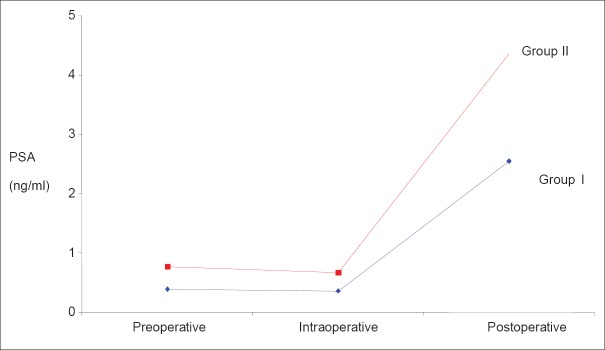
Results: Intra-operative serum samples were obtained in significantly lower body temperature in patients of Group II than in those of Group I (31°C vs. 36.9°C, P < 0.001). In each group separately, postoperative tPSA levels were increased significantly compared to the baseline values (2.55 ng/ml vs. 0.39 ng/ml for Group I, P = 0.005 and 4.36 ng/ml vs. 0.77 for Group II, P < 0.001). CABG patients with ECC had significantly lower intra-operative tPSA levels than the baseline values (0.67 ng/ml vs. 0.77 ng/ml, P = 0.008). We did not observe significant differences of tPSA levels between the two groups.
Conclusions: CABG surgery affects similarly the perioperative tPSA independently the involvement of ECC. Although all patients had significantly higher early postoperative tPSA levels, only those who underwent CABG with ECC had exceeded normal values and significantly decreased intra-operative tPSA. Hypothermia seems to be the causal factor of tPSA reduction.
Keywords: Cardiopulmonary bypass; coronary artery bypass; hypothermia; off-pump; prostate; prostate-specific antigen.
Conflict of interest statement
Figures
References
-
- Hagood PG, Parra RO, Rauscher JA. Nontraumatic elevation of prostate specific antigen following cardiac surgery and extracorporeal cardiopulmonary bypass. J Urol. 1994;152:2043–5. - PubMed
-
- Parlaktas BS, Naseri E, Uluocak N, Elalmis AO, Erdemir F, Etikan I. Comparison of the effects of on-pump versus off-pump coronary artery bypass surgery on serum prostate-specific antigen levels. Int J Urol. 2006;13:234–7. - PubMed
-
- Koller-Strametz J, Fritzer M, Gwechenberger M, Geppert A, Heinz G, Haumer M, et al. Elevation of prostate-specific markers after cardiopulmonary resuscitation. Circulation. 2000;102:290–3. - PubMed
-
- Patanè S, Marte F. Prostate-specific antigen and acute myocardial infarction: A possible new intriguing scenario. Int J Cardiol. 2009;134:e147–9. - PubMed
-
- Patanè S, Marte F, Sturiale M, Dattilo G. ST-segment elevation and diminution of prostate-specific antigen in a patient with coronary spasm and without significant coronary stenoses. Int J Cardiol. 2011;148:e31–3. - PubMed
LinkOut - more resources
Full Text Sources
Other Literature Sources