Evaluation of the cytotoxicity of fiber reinforced composite bonded retainers and flexible spiral wires retainers in simulated high and low cariogenic environments
- PMID: 25657987
- PMCID: PMC4314835
- DOI: 10.4103/2278-0203.149610
Evaluation of the cytotoxicity of fiber reinforced composite bonded retainers and flexible spiral wires retainers in simulated high and low cariogenic environments
Abstract
Objectives: The aim of this study was to evaluate the cytotoxic effects of fiber reinforced composite bonded retainers in comparison with flexible spiral wires (FSWs) under high and low cariogenic-simulated environments using human oral fibroblasts.
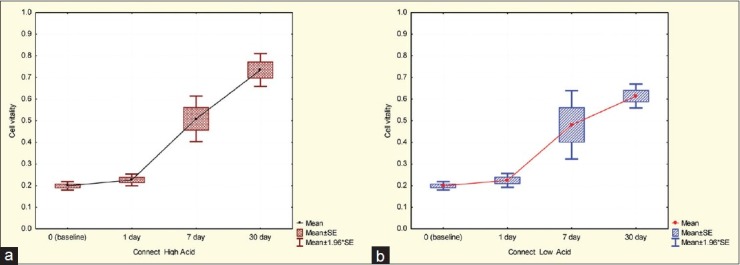
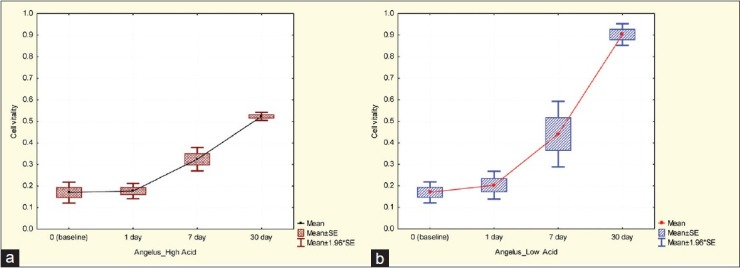
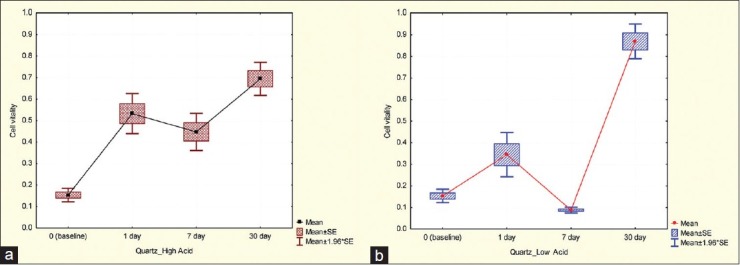
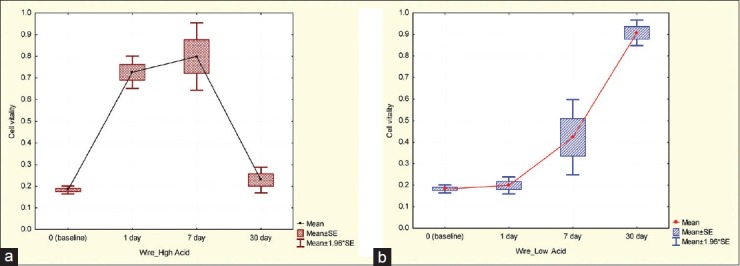
Materials and methods: Four types of bonded retainers were evaluated: (1) reinforced with glass fibers: Interlig (Angelus), (2) reinforced with polyethylene fibers: Connect (Kerr), (3) reinforced with quartz fibers: Quartz Splint UD (RTD), and (4) FSW. Twenty specimens of each sample group were prepared with the same surface area and halved. Next, half of them were placed in a high cariogenic environment 60 min in 10% lactic acid 3 times a day and remained in Fusayama Meyer artificial saliva for the rest of the day) and the other half were placed in a low cariogenic environment 20 min in 10% lactic acid 3 times a day and remained in Fusayama Meyer artificial saliva for the rest of the day) for 1, 7 and 30 days. Cell viability was assessed by MTT assay. Data were analyzed using SPSS software (α =0.05).
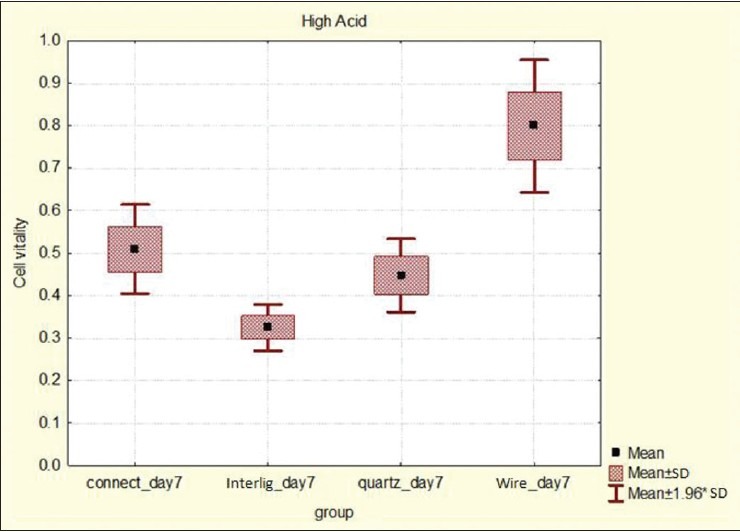
Results: During the 1(st) month, cytotoxicity reduced gradually. In the low cariogenic-simulated environment, the cytotoxicity of all of the groups were reported to be mild at day 30 and the difference between them was significant (P = 0.016). In the same period in the high cariogenic-simulated environment, the cytotoxicity of Connect and Quartz Splint was mild, and they had lower cytotoxicity than the other groups. Meanwhile, Interlig had moderate (52%) and FSW had severe cytotoxicity (22%) and the difference between the groups was also significant (P = 0.000).
Conclusions: FSW retainers are not recommended in those at high-risk for dental caries. However, in those at low-risk, there is no difference from the standpoint of cytotoxicity.
Keywords: Cell viability; cytotoxicity; fiber reinforced composite; retainer.
Conflict of interest statement
Figures
References
-
- Graber TM, Vanarsdall V. Orthodontics: Current Principles and Techniques. 4th ed. St. Louis: Elsevier Inc; 2005. p. 1144.
-
- Brauchli L, Pintus S, Steineck M, Lüthy H, Wichelhaus A. Shear modulus of 5 flowable composites to the everstick ortho fiber-reinforced composite retainer: An in-vitro study. Am J Orthod Dentofacial Orthop. 2009;135:54–8. - PubMed
-
- Schwarze J, Bourauel C, Drescher D. Tooth mobility of lowerincisors after direct bonding of lingual retainers. J Orofac Orthop. 1995;56:25–33. - PubMed
-
- Hanks CT, Wataha JC, Sun Z. In vitro models of biocompatibility: A review. Dent Mater. 1996;12:186–93. - PubMed
-
- Tunçel A, Ozdemir AK, Sümer Z, Hürmüzlü F, Polat Z. Cytotoxicity evaluation of two different composites with/without fibers and one nanohybrid composite. Dent Mater J. 2006;25:267–71. - PubMed
LinkOut - more resources
Full Text Sources
Other Literature Sources