The emergence of resistance to the benzimidazole anthlemintics in parasitic nematodes of livestock is characterised by multiple independent hard and soft selective sweeps
- PMID: 25658086
- PMCID: PMC4319741
- DOI: 10.1371/journal.pntd.0003494
The emergence of resistance to the benzimidazole anthlemintics in parasitic nematodes of livestock is characterised by multiple independent hard and soft selective sweeps
Abstract
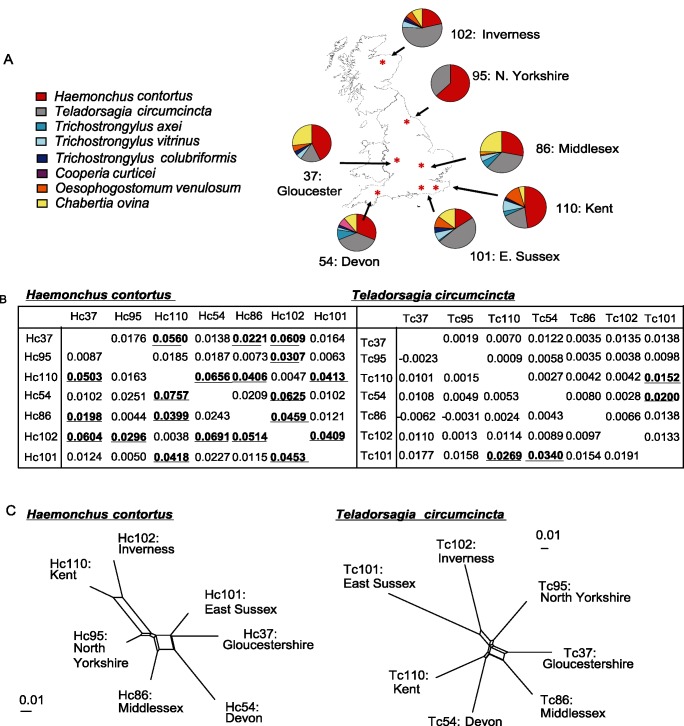
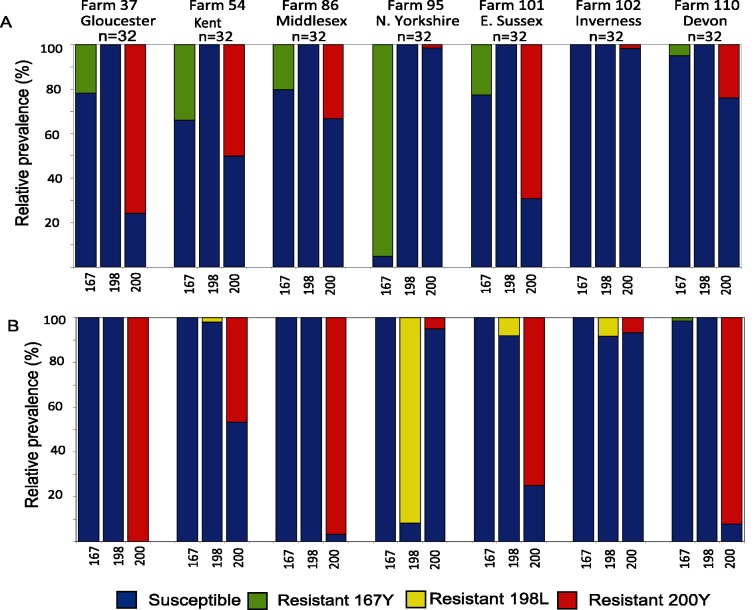
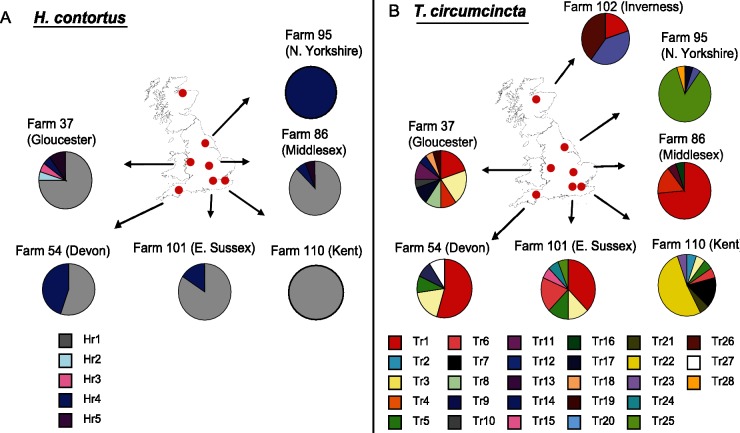
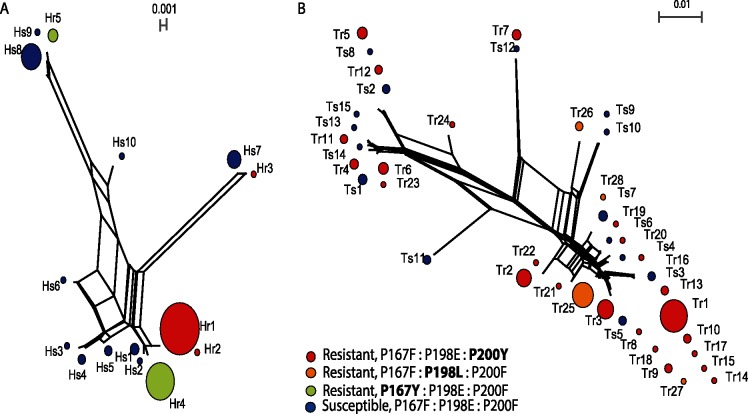
Anthelmintic resistance is a major problem for the control of parasitic nematodes of livestock and of growing concern for human parasite control. However, there is little understanding of how resistance arises and spreads or of the "genetic signature" of selection for this group of important pathogens. We have investigated these questions in the system for which anthelmintic resistance is most advanced; benzimidazole resistance in the sheep parasites Haemonchus contortus and Teladorsagia circumcincta. Population genetic analysis with neutral microsatellite markers reveals that T. circumcincta has higher genetic diversity but lower genetic differentiation between farms than H. contortus in the UK. We propose that this is due to epidemiological differences between the two parasites resulting in greater seasonal bottlenecking of H. contortus. There is a remarkably high level of resistance haplotype diversity in both parasites compared with drug resistance studies in other eukaryotic systems. Our analysis suggests a minimum of four independent origins of resistance mutations on just seven farms for H. contortus, and even more for T. circumincta. Both hard and soft selective sweeps have occurred with striking differences between individual farms. The sweeps are generally softer for T. circumcincta than H. contortus, consistent with its higher level of genetic diversity and consequent greater availability of new mutations. We propose a model in which multiple independent resistance mutations recurrently arise and spread by migration to explain the widespread occurrence of resistance in these parasites. Finally, in spite of the complex haplotypic diversity, we show that selection can be detected at the target locus using simple measures of genetic diversity and departures from neutrality. This work has important implications for the application of genome-wide approaches to identify new anthelmintic resistance loci and the likelihood of anthelmintic resistance emerging as selection pressure is increased in human soil-transmitted nematodes by community wide treatment programs.
Conflict of interest statement
The authors have declared that no competing interests exist.
Figures
References
-
- Elard L, Comes A, Humbert J (1996) Sequences of beta-tubulin cDNA from benzimidazole-susceptible and—resistant strains of Teladorsagia circumcincta, a nematode parasite of small ruminants. Mol Biochem Parasitol 79: 249–253. - PubMed
-
- Elard L, Humbert J (1999) Importance of the mutation of amino acid 200 of the isotype 1 beta-tubulin gene in the benzimidazole resistance of the small ruminant parasite Teladorsagia circumcincta. Parasitol Res 85: 452–456. - PubMed
-
- Ghisi M, Kaminsky R, P M (2007) Phenotyping and genotyping of Haemonchus contortus isolates reveals a new putative candidate mutation for benzimidazole resistance in nematodes. Vet Parasitol 144: 313–320. - PubMed
-
- Kwa M, Veenstra J, Roos M (1994) Benzimidazole resistance in Haemonchus contortus is correlated with a conserved mutation at amino acid 200 in beta-tubulin isotype 1. Mol Biochem Parasitol 63: 299–303. - PubMed
Publication types
MeSH terms
Substances
Associated data
- Actions
- Actions
- Actions
- Actions
- Actions
- Actions
- Actions
- Actions
- Actions
- Actions
- Actions
- Actions
- Actions
- Actions
- Actions
- Actions
- Actions
- Actions
- Actions
- Actions
- Actions
- Actions
- Actions
- Actions
- Actions
- Actions
- Actions
- Actions
- Actions
- Actions
- Actions
- Actions
- Actions
- Actions
- Actions
- Actions
- Actions
- Actions
- Actions
- Actions
- Actions
- Actions
- Actions
- Actions
- Actions
- Actions
- Actions
- Actions
- Actions
- Actions
- Actions
- Actions
- Actions
- Actions
- Actions
- Actions
- Actions
- Actions
Grants and funding
LinkOut - more resources
Full Text Sources
Other Literature Sources