


How the brain processes different dimensions of argument structure complexity: evidence from fMRI
- PMID: 25658635
- PMCID: PMC4336802
- DOI: 10.1016/j.bandl.2014.12.005
How the brain processes different dimensions of argument structure complexity: evidence from fMRI
Abstract
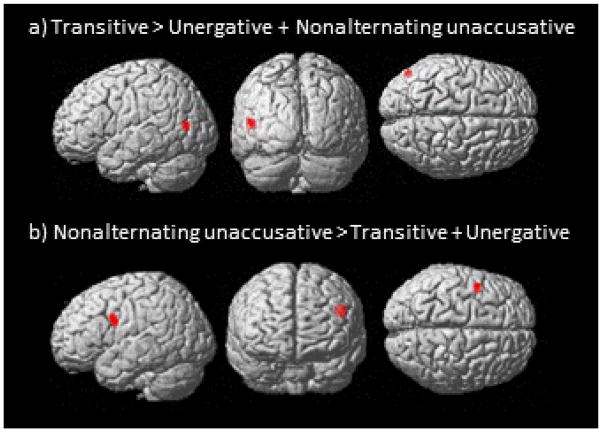
Verbs are central to sentence processing, as they encode argument structure (AS) information, i.e., information about the syntax and interpretation of the phrases accompanying them. The behavioral and neural correlates of AS processing have primarily been investigated in sentence-level tasks, requiring both verb processing and verb-argument integration. In the current functional magnetic resonance imaging (fMRI) study, we investigated AS processing using a lexical decision task requiring only verb processing. We examined three aspects of AS complexity: number of thematic roles, number of thematic options, and mapping (non)canonicity (unaccusative vs. unergative and transitive verbs). Increased number of thematic roles elicited greater activation in the left posterior perisylvian regions claimed to support access to stored AS representations. However, the number of thematic options had no neural effects. Further, unaccusative verbs elicited longer response times and increased activation in the left inferior frontal gyrus, reflecting the processing cost of unaccusative verbs and, more generally, supporting the role of the IFG in noncanonical argument mapping.
Keywords: Alternating verbs; Argument structure; Inferior frontal gyrus; Intransitive verbs; Reaction times; Syntactic movement; Transitive verbs; Unaccusative verbs; Unergative verbs; fMRI.
Copyright © 2015 Elsevier Inc. All rights reserved.
Figures
References
-
- Baayen RH, Davidson DJ, Bates DM. Mixed-effects modeling with crossed random effects for subjects and items. Journal of Memory and Language. 2008;59:390–412.
-
- Babyonyshev M, Ganger J, Pesetsky D, Wexler K. The maturation of grammatical principles: Evidence from Russian unaccusatives. Linguistic Inquiry. 2001;32:1–44.
-
- Barbieri E, Aggujaro S, Molteni F, Luzzatti C. Does argument structure complexity affect reading? A case study of an Italian agrammatic patient with deep dyslexia. Applied Psycholinguistics. 2013 http://dx.doi.org/10.1017/S0142716413000337. - DOI
-
- Barbieri E, Luzzatti C, den Ouden DB, Thompson CK. A cross-linguistic study of the Argument Structure Complexity Hypothesis (ASCH): Implications for the interplay between semantic and syntactic processing submitted.
-
- Bastiaanse R, van Zonneveld R. Sentence production with verbs of alternating transitivity in agrammatic Broca’s aphasia. Journal of Neurolinguistics. 2005;18:57–66.
Publication types
MeSH terms
Grants and funding
LinkOut - more resources
Full Text Sources
Other Literature Sources
Medical
Research Materials
