. 2015 Feb 6;10(2):e0117103.
doi: 10.1371/journal.pone.0117103. eCollection 2015.

Genetic evolution of Mycobacterium bovis causing tuberculosis in livestock and wildlife in France since 1978

Affiliations

Genetic evolution of Mycobacterium bovis causing tuberculosis in livestock and wildlife in France since 1978

Amandine Hauer et al. PLoS One. .

Abstract

To study the dynamics of bovine tuberculosis (bTB) in France, 4,654 M. bovis strains isolated mainly from livestock and wildlife since 1978 were characterized by spoligotyping and MLVA based on MIRU-VNTR. In our study spoligotyping allowed the discrimination of 176 types although 3 spoligotypes are predominant and account for more than half of the total strain population: SB0120 (26%), SB0134 (11%) and SB0121 (6%). In addition, 11% of the isolates, principally from Southern France, showing close spoligotypes and MIRU-VNTR types have been gathered in a family designated as the "F4-family". MLVA typing allowed extensive discrimination, particularly for strains with predominant spoligotypes, with a total of 498 genotypes, several of which were highly regionalized. The similarity of the strains' genetic relationships based on spoligotyping and MIRU-VNTR markers supports the co-existence of different clonal populations within the French M. bovis population. A genetic evolution of the strains was observed both geographically and in time. Indeed, as a result of the reduction of bTB due to the national control campaigns, a large reduction of the strains' genetic variability took place in the last ten years. However, in the regions were bTB is highly prevalent at present, cases in both livestock and in wildlife are due to the spread of unique local genotype profiles. Our results show that the highly discriminating genotyping tools used in this study for molecular studies of bTB are useful for addressing pending questions, which would lead to a better insight into the epidemiology of the disease, and for finding proper solutions for its sustainable control in France.


Conflict of interest statement

Competing Interests: The authors have declared that no competing interests exist.

Figures

Fig 1
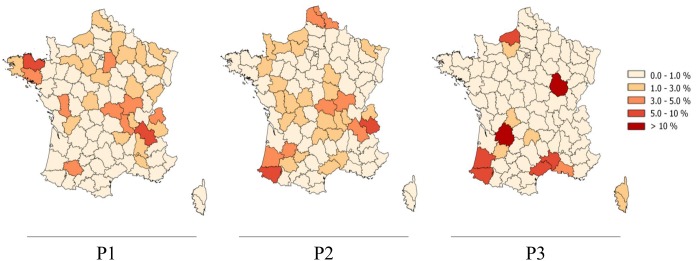
Fig 1. Geographical distribution of endemic outbreaks of bovine tuberculosis in France.
Color intensity reflects the percentage of M. bovis strains isolated in each “department” compared to the totality of M. bovis isolated in the whole territory for the given period of time. The first map represents the 377 M. bovis strains isolated in France from 1978 to 1990. The second map represents the 1,176 M. bovis strains isolated in France from 1991 to 2000. The third map represents the 3,101 M. bovis isolated in France from 2001 to 2013.
Fig 2
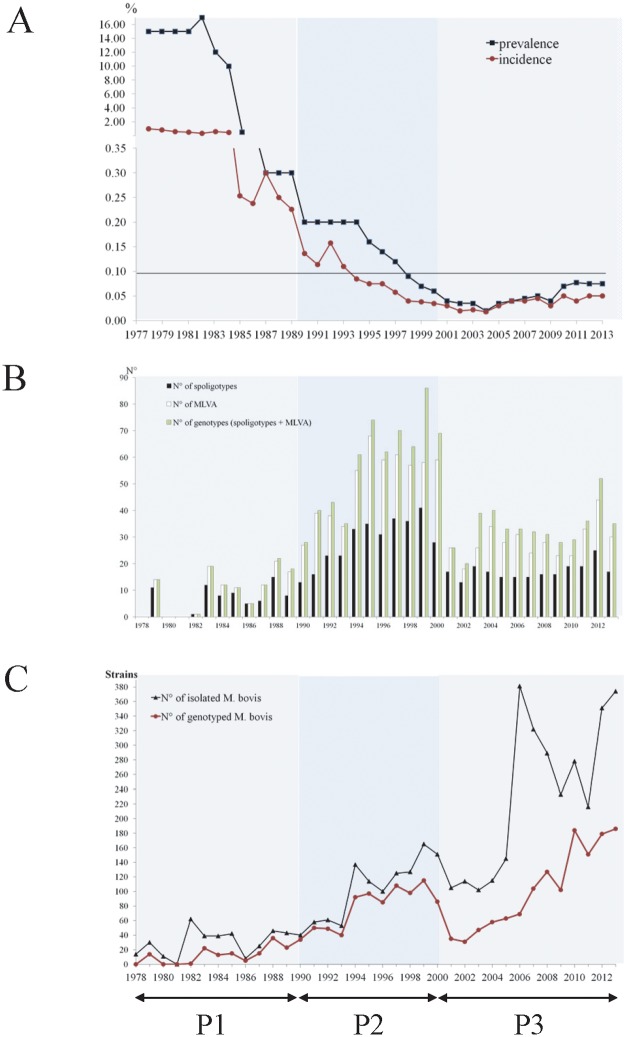
Fig 2. Evolution of the prevalence and the incidence rate of bTB (A), of the different strain profiles number (B) and yearly evolution of the strain collection (C) of M. bovis in France from 1978 to 2013.
A: On the abscissa are represented the years, on the ordinate, the percentage of incidence (◼) and prevalence (●). Black line cutting the ordinate axe at 0.1% represents the limit under which an EU country is considered free of bTB. Below the graph, three lines (P1; P2; P3) represent the three periods studied. B: In black bars, spoligotypes, in white bars, MLVA profiles, in green bars, the association of both methods. C: Yearly evolution of the number of strains collected (Black) and spoligotype-MLVA identification (Pink) of the 4,654 M. bovis strains received in the National Reference laboratory between 1978 and 2013. For both graphs, lines represent the three studied periods (P1; P2; P3).
Fig 3
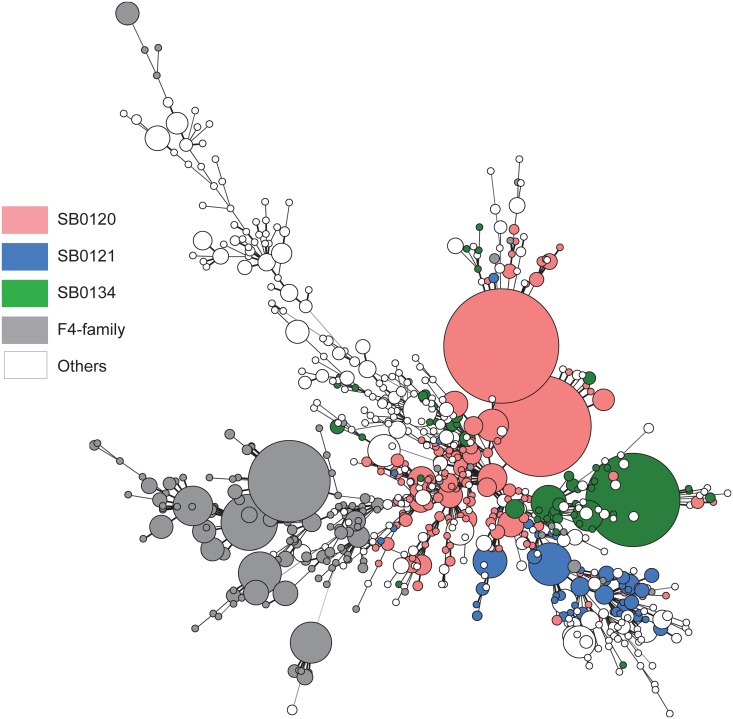
Fig 3. Minimum spanning tree (MST) of the 2,332 Mycobacterium bovis isolates between 1978 and 2013.
706 genotypes were obtained by combination of spoligotyping and VNTR typing. The colored nodes show the principal families of M. bovis, SB0120 (Pink), SB0121 (Blue), SB0134 (Green) and “F4-family” (Grey). Distances between nodes represent distances between profiles.
Fig 4
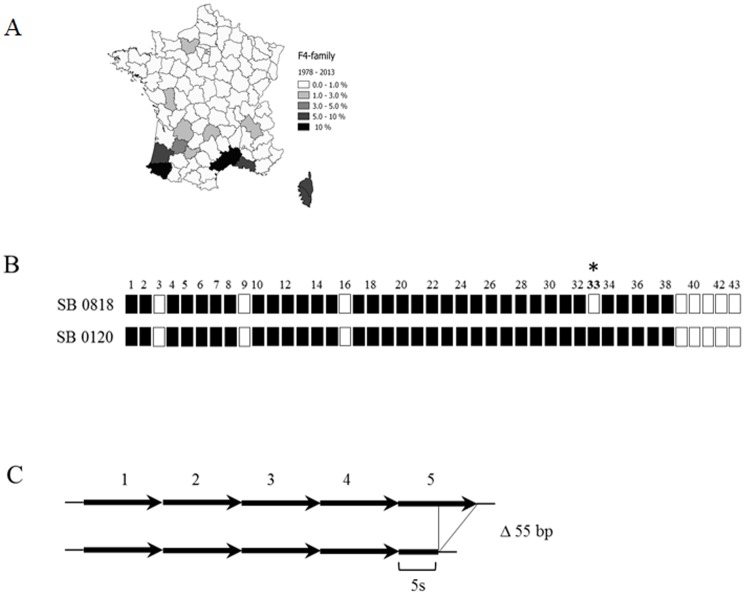
Fig 4. Definition of “F4-family”.
(A) Geographical location: in the map, shades of grey indicate the percentage of isolates of the“F4 family” spoligotypes from the total M. bovis population, showing a principal localization in the South of France. (B) Spoligotype particularity: the chosen spoligotype, SB0818, the likely common ancestor of this family, is characterized by classic M. bovis missing spacers 3, 9, 16, and 39 to 43 plus the absence of the spacer 33, specific to the “F4-family”. (C) VNTR characteristics: “F4-family” possesses a truncated repetition (30 bp instead of 56 bp) in locus 4052, which is counted for the allele definition. In the example, other strains possess five repetitions but in the case of “F4 family”, the fifth repetition is truncated and is represented as a “5s”.

References

    1. Amanfu W (2006) The situation of tuberculosis and tuberculosis control in animals of economic interest. Tuberculosis (Edinb) 86: 330–335. - PubMed
    1. Cosivi O, Grange JM, Daborn CJ, Raviglione MC, Fujikura T, et al. (1998) Zoonotic tuberculosis due to Mycobacterium bovis in developing countries. Emerg Infect Dis 4: 59–70. - PMC - PubMed
    1. Michel AL, Muller B, van Helden PD (2010) Mycobacterium bovis at the animal-human interface: a problem, or not? Vet Microbiol 140: 371–381. 10.1016/j.vetmic.2009.08.029 - DOI - PubMed
    1. Smith NH, Gordon SV, de la Rua-Domenech R, Clifton-Hadley RS, Hewinson RG (2006) Bottlenecks and broomsticks: the molecular evolution of Mycobacterium bovis. Nat Rev Microbiol 4: 670–681. - PubMed
    1. Palmer MV, Thacker TC, Waters WR, Gortazar C, Corner LA (2012) Mycobacterium bovis: A Model Pathogen at the Interface of Livestock, Wildlife, and Humans. Vet Med Int 2012: 236205 10.1155/2012/236205 - DOI - PMC - PubMed

Publication types