


Effects of exercise and milk fat globule membrane (MFGM) supplementation on body composition, physical function, and hematological parameters in community-dwelling frail Japanese women: a randomized double blind, placebo-controlled, follow-up trial
- PMID: 25659147
- PMCID: PMC4319727
- DOI: 10.1371/journal.pone.0116256
Effects of exercise and milk fat globule membrane (MFGM) supplementation on body composition, physical function, and hematological parameters in community-dwelling frail Japanese women: a randomized double blind, placebo-controlled, follow-up trial
Abstract
Objective: To investigate the combined and separate effects of exercise and milk fat globule membrane (MFGM) supplementation on frailty, physical function, physical activity level, and hematological parameters in community-dwelling elderly Japanese women.
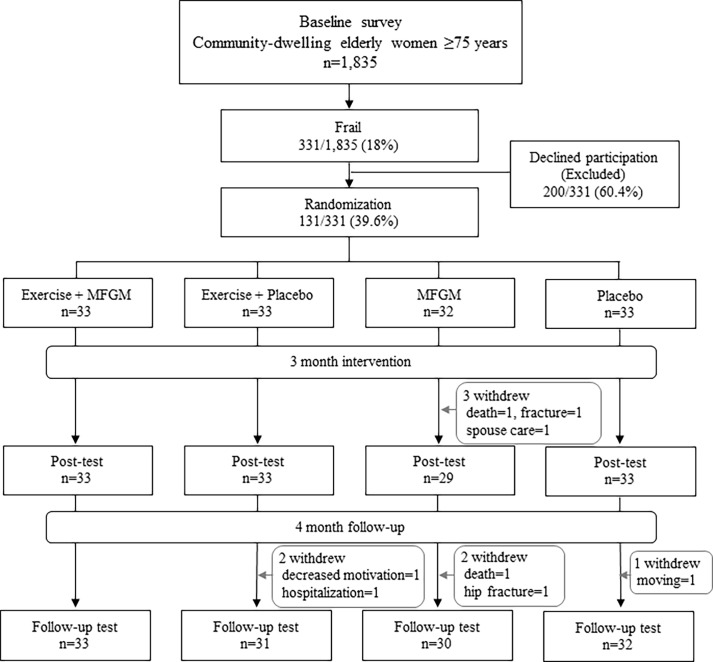
Methods: A total of 131 frail, elderly women over 75 years were randomly assigned to one of four groups: exercise and MFGM supplementation (Ex+MFGM), exercise and placebo (Ex+Plac), MFGM supplementation, or the placebo group. The exercise group attended a 60-minute training program twice a week for three months, and the MFGM group ingested 1g of the MFGM supplement in pill form, daily for 3 months. The primary outcome measure was change in frailty status based on Fried's frailty phenotype. Secondary outcome measures included body composition, physical function and hematological parameters, and interview survey components assessing lifestyle factors. Participants were followed for 4 months post-intervention.
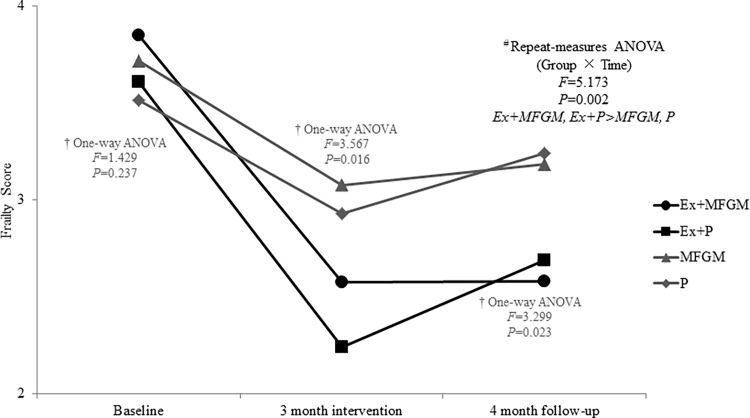
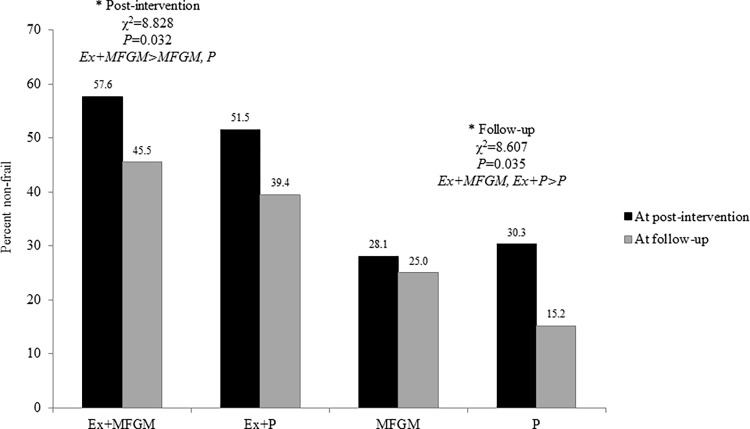
Results: Significant group × time interactions were observed for usual walking speed (P = 0.005), timed up & go (P<0.001), and insulin-like growth factor-binding protein 3/insulin-like growth factor 1 ratio (P = 0.013). The frailty components revealed that weight loss, exhaustion, low physical activity, and slow walking speed were reversed, but low muscle strength did not significantly changed. Frailty reversal rate was significantly higher in the Ex+MFGM (57.6%) than in the MFGM (28.1%) or placebo (30.3%) groups at post-intervention (χ2 = 8.827, P = 0.032), and at the follow-up was also significantly greater in the Ex+MFGM (45.5%) and Ex+Plac (39.4%) groups compared with the placebo (15.2%) group (χ2 = 8.607, P = 0.035). The exercise+MFGM group had the highest odds ratio (OR) for frailty reversal at post-intervention and follow-up (OR = 3.12, 95% confidence interval (CI) = 1.13-8.60; and OR = 4.67, 95% CI = 1.45-15.08, respectively).
Conclusion: This study suggests that interventions including exercise and nutrition can improve frailty status. Statistically significant additive effects of MFGM with exercise could not be confirmed in this population, and further investigation in larger samples is necessary.
Trial registration: The Japan Medical Association Clinical Trial Registry (JMACCT)JMA-IIA00069.
Conflict of interest statement
Figures
References
-
- Fried LP, Tangen CM, Walston J, Newman AB, Hirsch C, et al. (2001) Frailty in older adults: evidence for a phenotype. Journals of Gerontology Series A, Biological Sciences and Medical Sciences 56: M146–156. - PubMed
-
- Woods NF, LaCroix AZ, Gray SL, Aragaki A, Cochrane BB, et al. (2005) Frailty: emergence and consequences in women aged 65 and older in the Women's Health Initiative Observational Study. Journal of the American Geriatrics Society 53: 1321–1330. - PubMed
Publication types
MeSH terms
Substances
LinkOut - more resources
Full Text Sources
Other Literature Sources
Medical
