


A cost minimisation and Bayesian inference model predicts startle reflex modulation across species
- PMID: 25660056
- PMCID: PMC4371795
- DOI: 10.1016/j.jtbi.2015.01.031
A cost minimisation and Bayesian inference model predicts startle reflex modulation across species
Abstract
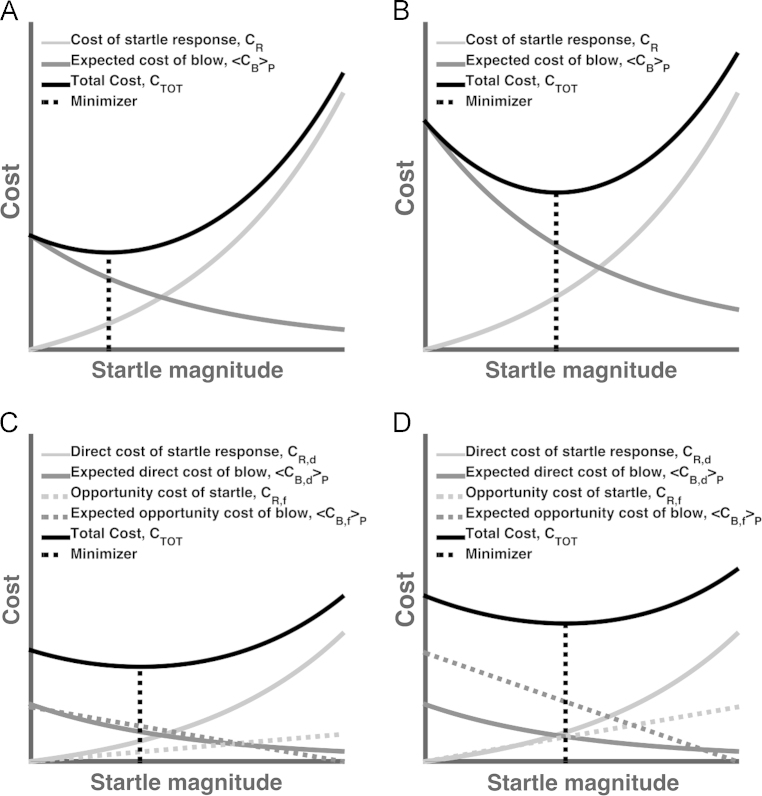
In many species, rapid defensive reflexes are paramount to escaping acute danger. These reflexes are modulated by the state of the environment. This is exemplified in fear-potentiated startle, a more vigorous startle response during conditioned anticipation of an unrelated threatening event. Extant explanations of this phenomenon build on descriptive models of underlying psychological states, or neural processes. Yet, they fail to predict invigorated startle during reward anticipation and instructed attention, and do not explain why startle reflex modulation evolved. Here, we fill this lacuna by developing a normative cost minimisation model based on Bayesian optimality principles. This model predicts the observed pattern of startle modification by rewards, punishments, instructed attention, and several other states. Moreover, the mathematical formalism furnishes predictions that can be tested experimentally. Comparing the model with existing data suggests a specific neural implementation of the underlying computations which yields close approximations to the optimal solution under most circumstances. This analysis puts startle modification into the framework of Bayesian decision theory and predictive coding, and illustrates the importance of an adaptive perspective to interpret defensive behaviour across species.
Keywords: Emotion; Fear; Motivational priming.
Copyright © 2015 The Author. Published by Elsevier Ltd.. All rights reserved.
Figures
References
-
- Bradley M.M., Cuthbert B.N., Lang P.J. Startle reflex modification: emotion or attention? Psychophysiology. 1990;27(5):513–522. - PubMed
-
- Bradley M.M., Codispoti M., Cuthbert B.N., Lang P.J. Emotion and motivation i: defensive and appetitive reactions in picture processing. Emotion. 2001;1(3):276–298. - PubMed
-
- Brown J.S., Kalish H.I., Farber I.E. Conditioned fear as revealed by magnitude of startle response to an auditory stimulus. J. Exp. Psychol. 1951;41(5):317–328. - PubMed
Publication types
MeSH terms
Grants and funding
LinkOut - more resources
Full Text Sources
Other Literature Sources
