


Impact of depression on quality-adjusted life expectancy (QALE) directly as well as indirectly through suicide
- PMID: 25660550
- PMCID: PMC4590980
- DOI: 10.1007/s00127-015-1019-0
Impact of depression on quality-adjusted life expectancy (QALE) directly as well as indirectly through suicide
Abstract
Purpose: To estimate quality-adjusted life expectancy (QALE) loss among US adults due to depression and QALE losses associated with the increased risk of suicide attributable to depression.
Method: We ascertained depressive symptoms using the eight-item Patient Health Questionnaire (PHQ-8) on the 2006, 2008, and 2010 Behavioral Risk Factor Surveillance System (BRFSS) surveys. We estimated health-related quality of life (HRQOL) scores from BRFSS data (n = 276,442) and constructed life tables from US Compressed Mortality Files to calculate QALE by depression status. QALE loss due to depression is the difference in QALE between depressed and non-depressed adults. QALE loss associated with suicide deaths is the difference between QALE from only those deaths that did not have suicide recorded on the death certificate and QALE from all deaths including those with a suicide recorded on the death certificate.
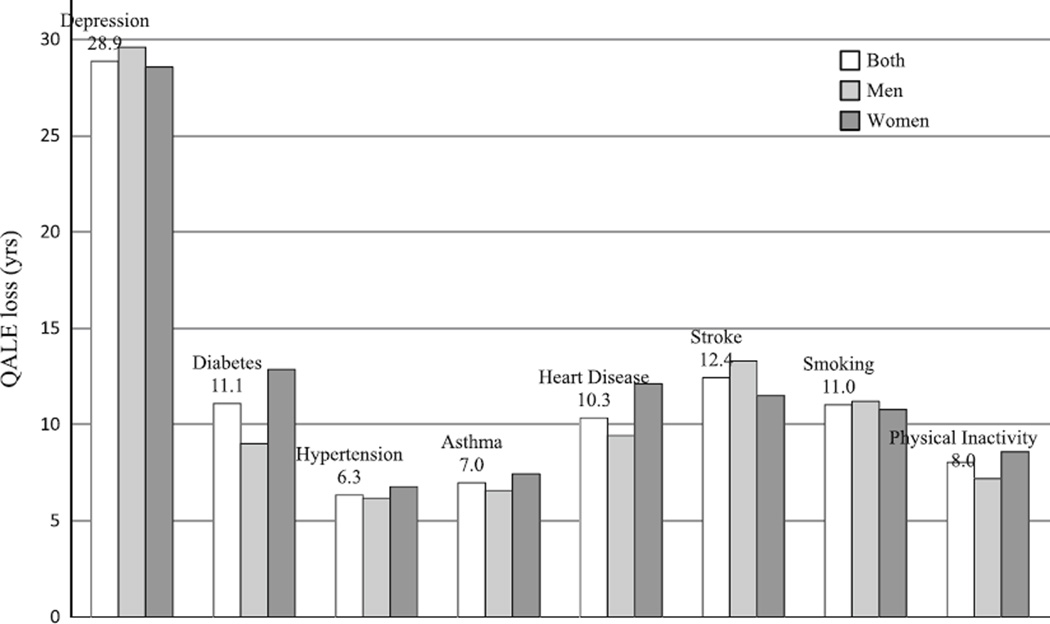
Results: At age 18, QALE was 28.0 more years for depressed adults and 56.8 more years for non-depressed adults, a 28.9-year QALE loss due to depression. For depressed adults, only 0.41 years of QALE loss resulted from deaths by suicide, and only 0.26 years of this loss could be attributed to depression.
Conclusion: Depression symptoms lead to a significant burden of disease from both mortality and morbidity as assessed by QALE loss. The 28.9-year QALE loss at age 18 associated with depression markedly exceeds estimates reported elsewhere for stroke (12.4-year loss), heart disease (10.3-year loss), diabetes mellitus (11.1-year loss), hypertension (6.3-year loss), asthma (7.0-year loss), smoking (11.0-year loss), and physical inactivity (8.0-year loss).
Conflict of interest statement
Figures
References
-
- Goodwin FK, Jamison KR. Manic-depressive illness: bipolar disorders and recurrent depression. 2nd edn. New York: Oxford University Press; 2007.
-
- Kessler RC, Berglund P, Demler O, et al. Lifetime prevalence and age-of-onset distributions of DSM-IV disorders in the National Comorbidity Survey Replication. Arch Gen Psychiatry. 2005;62(6):593–602. - PubMed
-
- Reeves WC, Strine TW, Pratt LA, et al. Mental illness surveillance among adults in the United States. MMWR Surveill Summ. 2011;60(Suppl 3):1–29. - PubMed
-
- Krishnan KR, Delong M, Kraemer H, et al. Comorbidity of depression with other medical diseases in the elderly. Biol Psychiatry. 2002;52(6):559–588. - PubMed
-
- Kupfer DJ, Frank E. Comorbidity in depression. Acta Psychiatr Scand. 2003;(Suppl Suppl 418):57–60. - PubMed
Publication types
MeSH terms
Grants and funding
LinkOut - more resources
Full Text Sources
Other Literature Sources
Medical
