. 2015 Apr 15;6(4):681-92.
doi: 10.1021/acschemneuro.5b00020. Epub 2015 Feb 20.

Identification of G protein-biased agonists that fail to recruit β-arrestin or promote internalization of the D1 dopamine receptor

Affiliations

Identification of G protein-biased agonists that fail to recruit β-arrestin or promote internalization of the D1 dopamine receptor

Jennie L Conroy et al. ACS Chem Neurosci. .

Abstract

The D1 dopamine receptor (D1R) has been implicated in numerous neuropsychiatric disorders, and D1R-selective ligands have potential as therapeutic agents. Previous studies have identified substituted benzazepines as D1R-selective agonists, but the in vivo effects of these compounds have not correlated well with their in vitro pharmacological activities. A series of substituted benzazepines, and structurally dissimilar D1R-selective agonists, were tested for their functional effects on D1R-mediated cAMP accumulation, D1R-promoted β-arrestin recruitment, and D1R internalization using live cell functional assays. All compounds tested elicited an increase in the level of cAMP accumulation, albeit with a range of efficacies. However, when the compounds were evaluated for β-arrestin recruitment, a subset of substituted benzazepines, SKF83959, SKF38393, SKF82957, SKF77434, and SKF75670, failed to activate this pathway, whereas the others showed similar activation efficacies as seen with cAMP accumulation. When tested as antagonists, the five biased compounds all inhibited dopamine-stimulated β-arrestin recruitment. Further, D1R internalization assays revealed a corroborating pattern of activity in that the G protein-biased compounds failed to promote D1R internalization. Interestingly, the biased signaling was unique for the D1R, as the same compounds were agonists of the related D5 dopamine receptor (D5R), but revealed no signaling bias. We have identified a group of substituted benzazepine ligands that are agonists at D1R-mediated G protein signaling, but antagonists of D1R recruitment of β-arrestin, and also devoid of agonist-induced receptor endocytosis. These data may be useful for interpreting the contrasting effects of these compounds in vitro versus in vivo, and also for the understanding of pathway-selective signaling of the D1R.

Keywords: D1 receptor; Dopamine; G protein; benzazepine; biased agonism; functional selectivity; β-arrestin.


Conflict of interest statement

The authors declare no competing financial interest.

Figures
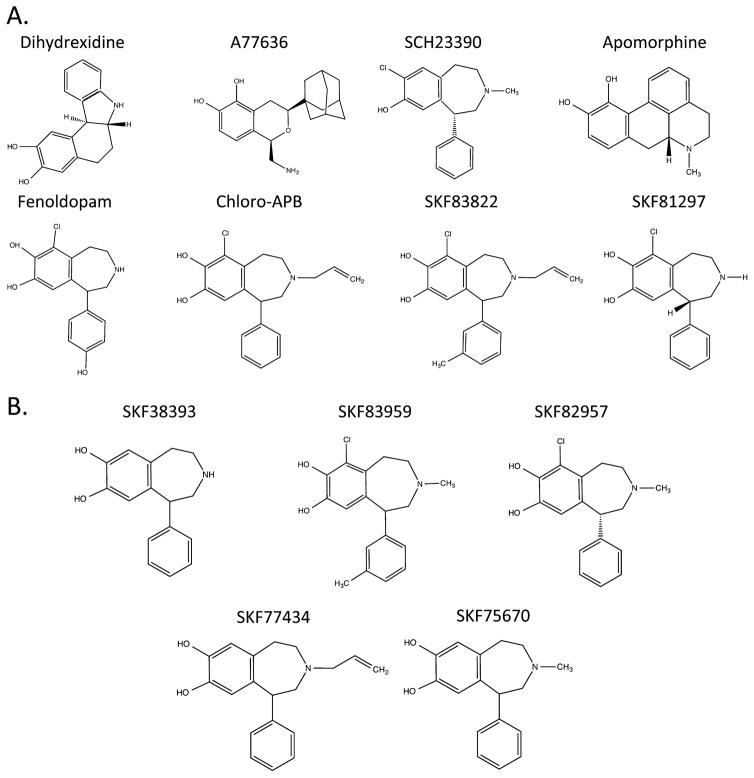
Figure 1
Figure 1
Chemical structures of compounds used in this study. (A) D1R-selective ligands shown include dihydrexidine, A77636, and apomorphine, as well as substituted benzazepines that were not found to be functionally selective for D1R signaling, including the D1R-selective antagonist SCH23390. (B) Substituted benzazepines that were found to exhibit D1R-mediated G protein-biased signaling.
Figure 2
Figure 2
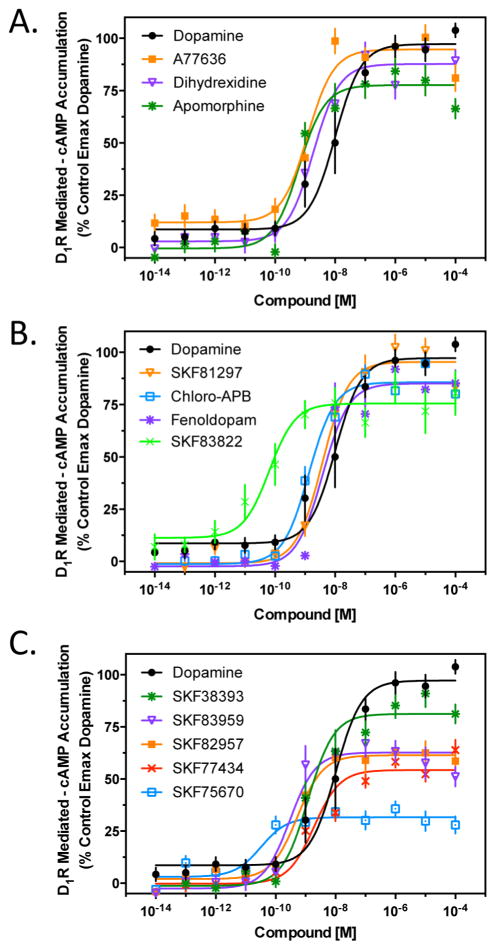
Agonist stimulation of D1R-mediated cAMP accumulation. HEK293 cells stably expressing the D1R were assayed for agonist stimulation of cAMP accumulation as described in Methods. Cells were stimulated with the indicated concentrations of dopamine or test compound. (A) Cells were stimulated with the D1R-selective agonists A77636, dihydrexidine, and apomorphine. (B) Cells were stimulated with the indicated substituted benzazepines, all of which behaved as full, or nearly full, agonists of D1R-mediated cAMP accumulation. (C) Cells were stimulated with substituted benzazepines that behaved as partial agonists of D1R-mediated cAMP accumulation. All data are means of at least three independent experiments conducted on different days in triplicate and expressed as a percentage of the maximal signal given by dopamine (N = 3–4). EC50 and Emax values were obtained for each individual experiment through nonlinear regression, and average data are reported in Table 1.
Figure 3
Figure 3
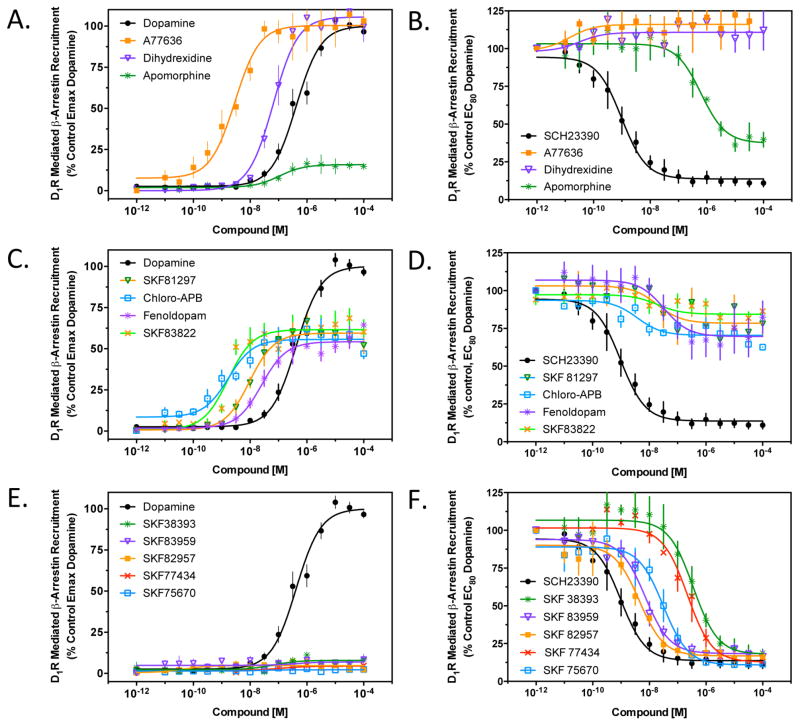
Agonist stimulation of recruitment of β-arrestin to the D1R. DiscoveRx PathHunter cells were assayed for agonist-induced recruitment of β-arrestin-2 to the D1R as described in Methods. (A) Cells were stimulated with the D1R-selective agonists A77636, dihydrexidine, and apomorphine. (B) Cells were incubated with an EC80 concentration of dopamine (1 μM) along with the indicated concentrations of the test compounds shown in panel A. The known D1R antagonist SCH23390 was used as a control. (C) Cells were stimulated with the indicated substituted benzazepines, all of which behaved as partial agonists of D1R-mediated stimulation of β-arrestin recruitment. (D) Cells were incubated with an EC80 concentration of dopamine (1 μM) along with the indicated concentrations of the test compounds shown in panel C. The known D1R antagonist SCH23390 was used as a control. (E) Cells were stimulated with the indicated substituted benzazepines, none of which exhibited agonist activity of D1R-mediated stimulation of β-arrestin recruitment. (F) Cells were incubated with an EC80 concentration of dopamine (1 μM) along with the indicated concentrations of the test compounds shown in panel E. The known D1R antagonist SCH23390 was used as a control. All data are means of at least three independent experiments conducted on different days in triplicate and are expressed as a percentage of either the maximal signal given by dopamine (A, C, and E) or the signal given by an EC80 concentration (1 μM) of dopamine (B, D, and F). Average EC50/IC50 and Emax/Imax values were obtained using nonlinear regression analyses and are listed in Table 2.
Figure 4
Figure 4
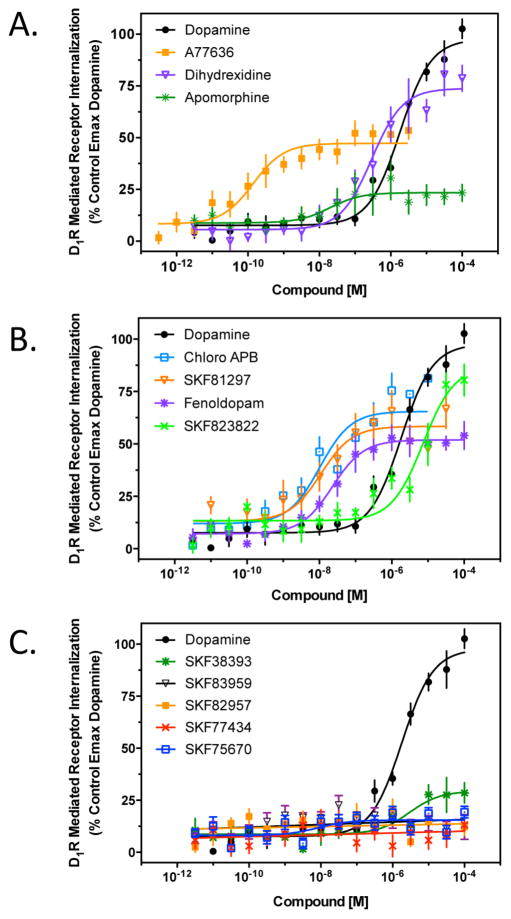
Agonist-induced internalization of the D1R. Receptor internalization assays were conducted using the D1R PathHunter internalization assay system as described in Methods. Percent internalization is expressed as the maximum produced by dopamine. (A) Cells were stimulated with the reference D1R-selective agonists, A77636, dihydrexidine, and apomorphine. (B) Cells were incubated with the substituted benzazepines that showed low or no bias in the cAMP and β-arrestin recruitment assays. (C) Cells were incubated with the substituted benzazepines that were G protein-biased and showed insignificant β-arrestin recruitment. All data are means of at least three independent experiments conducted on different days in triplicate and expressed as a percentage of the maximal signal given by dopamine (N = 3–4). EC50 and Emax values were obtained for each individual experiment through nonlinear regression, and average data are reported in Table 3.
Figure 5
Figure 5
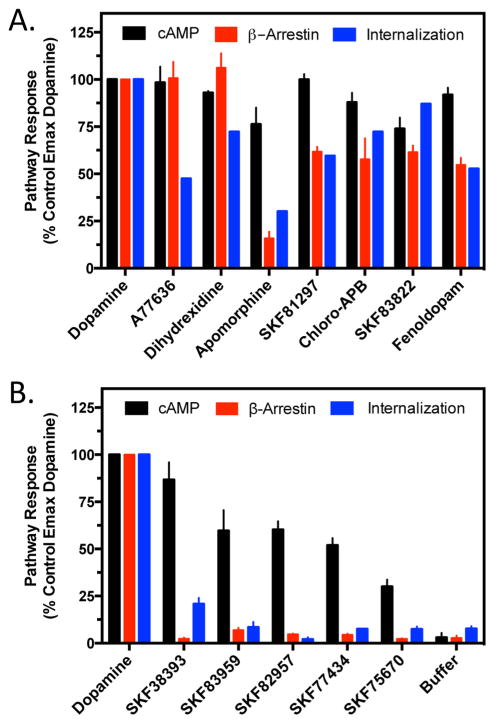
Comparison of agonist-stimulated cAMP accumulation, β-arrestin recruitment, and receptor internalization. The maximal response seen using each agonist at 30 μM is compared to the maximal response produced by dopamine in each assay as determined in the assays shown in Figures 2–4. The data represent the means ± SEM values from three or four individual experiments. (A) D1R-selective agonists that exhibited low or no signaling bias. (B) Activities of highly G protein-biased substituted benzazepines.
Figure 6
Figure 6
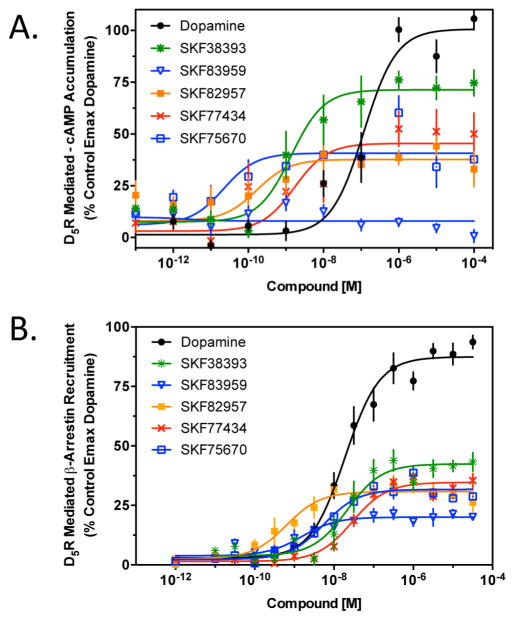
Stimulation of D5R-mediated cAMP accumulation or β-arrestin recruitment by the D1R-biased agonists. (A) D5R-expressing cells were stimulated with the five substituted benzazepines that exhibited high G protein bias at the D1R followed by cAMP measurement as described in Methods. (B) Recruitment of β-arrestin to the D5R following stimulation with the D1R-biased agonists was measured as described in Methods. All data are means of at least three independent experiments conducted on different days in triplicate and expressed as a percentage of the maximal signal given by dopamine (N = 3–4). EC50 and Emax values were obtained for each individual experiment through nonlinear regression, and average data are reported in Table 4.

References

    1. Rankin ML, Hazelwood LA, Free RB, Namkung Y, Rex EB, Roof RA, Sibley DR. Molecular pharmacology of the dopamine receptors. In: Iversen LL, Iversen SD, Dunnett SB, Bjorklund A, editors. Dopamine Handbook. Oxford University Press; New York: 2009. pp. 63–87.
    1. Kapur S, Mamo D. Half a century of antipsychotics and still a central role for dopamine D2 receptors. Prog Neuro-Psychopharmacol Biol Psychiatry. 2003;27:1081–1090. - PubMed
    1. Sibley DR, Monsma FJ., Jr Molecular biology of dopamine receptors. Trends Pharmacol Sci. 1992;13:61–69. - PubMed
    1. Beaulieu JM, Gainetdinov RR. The physiology, signaling, and pharmacology of dopamine receptors. Pharmacol Rev. 2011;63:182–217. - PubMed
    1. Swinney DC. Successful drug discovery. Curr Top Med Chem. 2006;6:403–404. - PubMed

Publication types

MeSH terms