


The discovery and development of sorafenib for the treatment of thyroid cancer
- PMID: 25662396
- PMCID: PMC4638120
- DOI: 10.1517/17460441.2015.1006194
The discovery and development of sorafenib for the treatment of thyroid cancer
Abstract
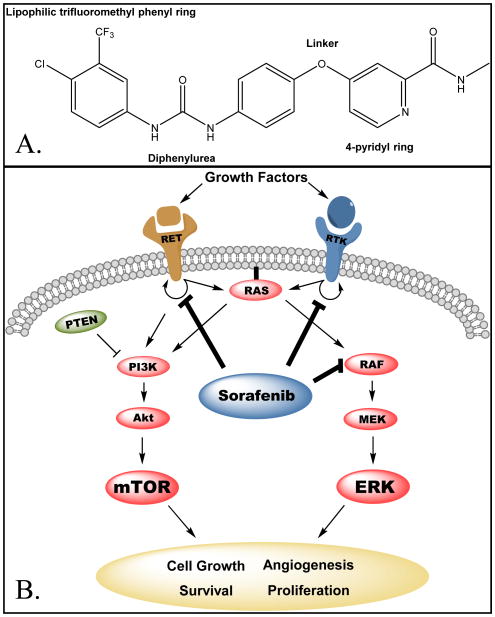
Introduction: Although the prognosis for most differentiated thyroid cancers (DTCs) remains excellent, recurrence and insensitivity to radioactive iodine (RAI) lead to therapeutic challenges and poorer outcomes. In defining the pathogenesis of DTC, multiple genetic alterations have been identified in key pathways focused around receptor tyrosine kinases (RTKs) and the MAPK cascade. Sorafenib was specifically developed to target rapidly accelerated fibrosarcoma (RAF) kinase in the MAPK pathway. It has been shown, however, to have potent inhibition of several key RTKs, RAF kinase and the V600E BRAF mutation, gaining FDA approval in November 2013 for advanced RAI-refractory DTC.
Areas covered: The authors provide a review of the targeted RAF kinase discovery strategy as well as the preclinical and clinical development of sorafenib, leading to FDA approval of DTC. The authors also provide some insight into the clinical use of sorafenib and look at important considerations for treatment.
Expert opinion: Sorafenib significantly improves progression-free survival in metastatic DTC patients who are RAI-refractory. However, the overall survival benefit is still unproven and requires additional follow up. Despite its cost and significant side-effect profile, which results in dose reductions in the majority of DTC patients, sorafenib should be considered for the treatment of RAI-refractory advanced DTC patients following evaluation of their individual risk-benefit stratification.
Keywords: differentiated thyroid cancer; sorafenib; thyroid cancer; thyroid cancer treatment; tyrosine kinase inhibitor.
Figures
References
-
- Howlader N, Noone AM, Krapcho M, Garshell J, Miller D, Altekruse SF, Kosary CL, Yu M, Ruhl J, Tatalovich Z, Mariotto A, Lewis DR, Chen HS, Feuer EJ, Cronin KA, editors. SEER Cancer Statistics Review. National Cancer Institute; Bethesda, MD: 1975-2011. http://seer.cancer.gov/csr/1975_2011/, based on November 2013 SEER data submission, posted to the SEER web site, April 2014.
-
- Hundahl SA, Fleming ID, Fremgen AM, Menck HR. A National Cancer Data Base report on 53,856 cases of thyroid carcinoma treated in the U.S., 1985-1995 [see comments] Cancer. 1998;83:2638–48. - PubMed
-
- Davies L, Welch HG. Increasing incidence of thyroid cancer in the United States, 1973-2002. JAMA. 2006;295:2164–7. - PubMed
-
- Cooper DS, Doherty GM, Haugen BR, et al. Revised American Thyroid Association management guidelines for patients with thyroid nodules and differentiated thyroid cancer. Thyroid. 2009;19:1167–214. - PubMed
-
- Mazzaferri EL, Massoll N. Management of papillary and follicular (differentiated) thyroid cancer: new paradigms using recombinant human thyrotropin. Endocr Relat Cancer. 2002;9:227–47. - PubMed
Publication types
MeSH terms
Substances
Grants and funding
LinkOut - more resources
Full Text Sources
Other Literature Sources
Medical
Research Materials
Miscellaneous
