


Intraventricular hemorrhage expansion in patients with spontaneous intracerebral hemorrhage
- PMID: 25663233
- PMCID: PMC4352099
- DOI: 10.1212/WNL.0000000000001344
Intraventricular hemorrhage expansion in patients with spontaneous intracerebral hemorrhage
Abstract
Objective: To evaluate whether delayed appearance of intraventricular hemorrhage (dIVH) represents an independent entity from intraventricular hemorrhage (IVH) present on admission CT or is primarily related to the time interval between symptom onset and admission CT.
Methods: A total of 282 spontaneous intracerebral hemorrhage (ICH) patients, admitted February 2009-March 2014 to the neurological intensive care unit of a tertiary care university hospital, were prospectively enrolled in the ICH Outcomes Project. Multivariate logistic regression was used to determine associations with acute mortality and functional long-term outcome (modified Rankin Scale).
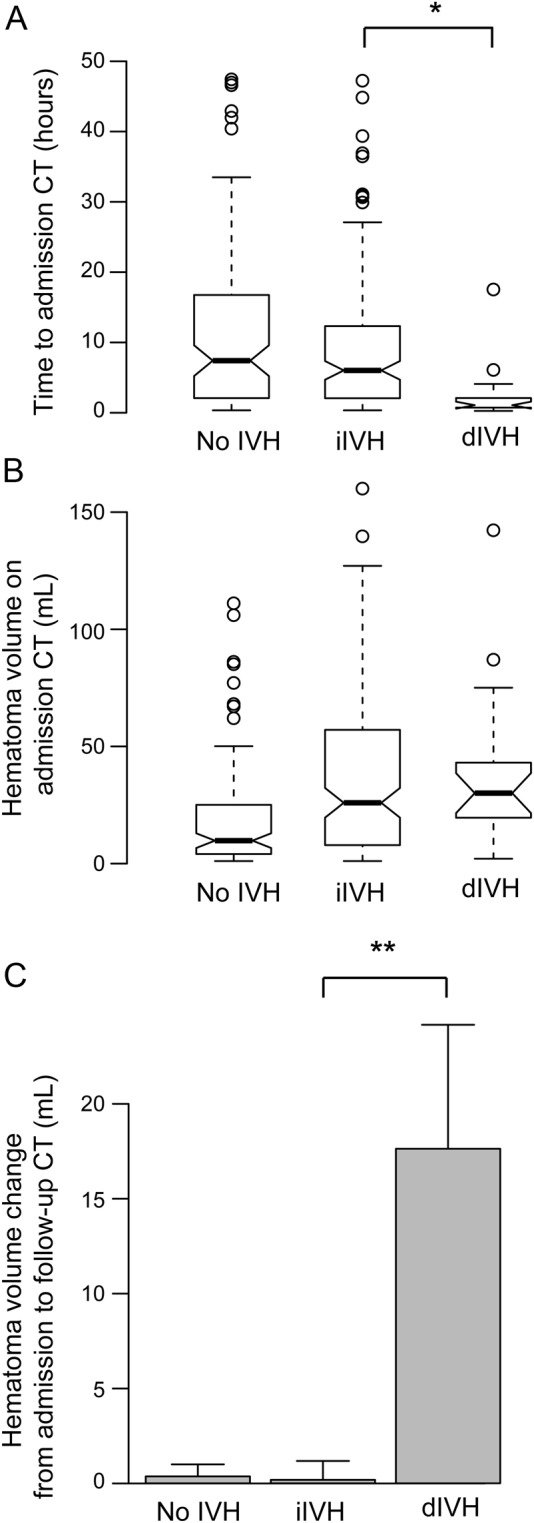
Results: A cohort of 282 ICH patients was retrospectively studied: 151 (53.5%) had intraventricular hemorrhage on initial CT scan (iIVH). Of the remaining 131 patients, 19 (14.5%) developed IVH after the initial CT scan (dIVH). The median times from symptom onset to admission CT were 1.1, 6.0, and 7.4 hours for the dIVH, iIVH, and no IVH groups (Mann-Whitney U test, dIVH vs iIVH, p < 0.001) and median time from onset to dIVH detection was 7.2 hours. The increase in ICH volume following hospital admission was larger in dIVH than in iIVH and no IVH patients (mean 17.6, 0.2, and 0.4 mL). After controlling for components of the ICH score and hematoma expansion, presence of IVH on initial CT was associated with discharge mortality and poor outcome at 3, 6, and 12 months, but dIVH was not associated with any of the outcome measures.
Conclusions: In ICH patients, associated IVH on admission imaging is commonly encountered and is associated with poor long-term outcome. In contrast, dIVH on subsequent scans is far less common and does not appear to portend worse outcome.
© 2015 American Academy of Neurology.
Figures
Comment in
-
Comment: intraventricular hemorrhage--it's the blood that matters, not the timing.Neurology. 2015 Mar 10;84(10):993. doi: 10.1212/WNL.0000000000001348. Epub 2015 Feb 6. Neurology. 2015. PMID: 25663220 No abstract available.
References
-
- Mayer SA, Davis SM, Skolnick BE, et al. Can a subset of intracerebral hemorrhage patients benefit from hemostatic therapy with recombinant activated factor VII? Stroke 2009;40:833–840. - PubMed
Publication types
MeSH terms
LinkOut - more resources
Full Text Sources
