


Provision of a surgeon's performance data for people considering elective surgery
- PMID: 25663572
- PMCID: PMC7390274
- DOI: 10.1002/14651858.CD006327.pub3
Provision of a surgeon's performance data for people considering elective surgery
Abstract
Background: A consumer model of health supports that people undergoing elective surgery should be informed about the past operative performance of their surgeon before making two important decisions: 1. to consent to the proposed surgery, and 2. to have a particular doctor perform the surgery. This information arguably helps empower patients to participate in their care. While surgeons' performance data are available in some settings, there continues to be controversy over the provision of such data to patients, and the question of whether consumers should, or want to, be provided with this information.
Objectives: To assess the effects of providing a surgeon's performance data to people considering elective surgery on patient-based and service utilisation outcomes.
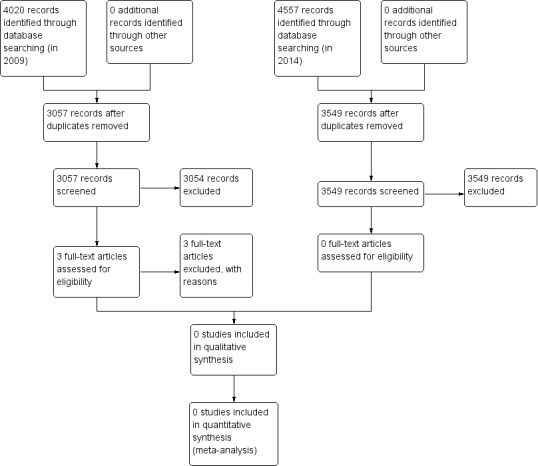
Search methods: For the original review, we searched: the Cochrane Central Register of Controlled Trials (CENTRAL, The Cochrane Library, 2009, Issue 4); MEDLINE (Ovid) (1950 to 28 September 2009); EMBASE (Ovid) (1988 to 28 September 2009); PsycINFO (Ovid) (1806 to 28 September 2009); CINAHL (EBSCO) (1982 to 20 October 2009); Current Contents (Ovid) (1992 to 23 November 2009); and ProQuest Dissertations and Theses (1861 to 20 October 2009).For this update, we searched: CENTRAL (2009 to 3 March 2014); MEDLINE (Ovid) (2009 to 3 March 2014); EMBASE (Ovid) (2009 to 3 March 2014); PsycINFO (Ovid) (2009 to 9 March 2014); CINAHL (EBSCO) (2009 to 9 March 2014), Current Contents (Web of Science) (November 2009 to 21 March 2014), and ProQuest Dissertations and Theses (2009 to 21 March 2014). We applied no language restrictions.
Selection criteria: Randomised controlled trials (RCTs), cluster RCTs, quasi-RCTs and controlled before and after studies (CBAs), in which an individual surgeon's performance data were provided to people considering elective surgery. We considered the CBAs for inclusion from 2009 onwards.
Data collection and analysis: Two review authors (AH, SH) independently assessed all titles, abstracts, or both of retrieved citations. We identified no studies for inclusion. Consequently, we conducted no data collection or analysis.
Main results: We found no studies that met the inclusion criteria; therefore, there are no results to report on the effect of the provision of a surgeon's performance data for people considering elective surgery.
Authors' conclusions: We found no studies reporting the impact of the provision of a surgeon's performance data for people considering elective surgery. This is an important finding in itself. While the public reporting of a surgeon's performance is not a new concept, the efficacy of this data for individual patients has not been empirically tested. A review of qualitative studies or new primary qualitative research may be useful to determine what interventions are currently in use and explore the attitudes of consumers and professionals towards such interventions.
Conflict of interest statement
None known.
Update of
-
Provision of a surgeon's performance data for people considering elective surgery.Cochrane Database Syst Rev. 2010 Nov 10;(11):CD006327. doi: 10.1002/14651858.CD006327.pub2. Cochrane Database Syst Rev. 2010. Update in: Cochrane Database Syst Rev. 2015 Feb 09;(2):CD006327. doi: 10.1002/14651858.CD006327.pub3. PMID: 21069688 Updated.
References
References to studies excluded from this review
Jha 2006 {published data only}
-
- Jha AK, Epstein AM, Jha AK, Epstein AM. The predictive accuracy of the New York State coronary artery bypass surgery report‐card system. Health Affairs 2006; Vol. 25, issue 3:844‐55. - PubMed
Mukamel 2004 {published data only}
-
- Mukamel DB, Weimer DL, Zwanziger J, Gorthy SF, Mushlin AI, Mukamel DB, et al. Quality report cards, selection of cardiac surgeons, and racial disparities: a study of the publication of the New York State Cardiac Surgery Reports. Inquiry 2004; Vol. 41, issue 4:435‐46. - PubMed
Ranganathan 2009 {published data only}
-
- Ranganathan M, Hibbard J, Rodday AMC, Brantes F, Conroy K, Rogers WH, et al. Motivating public use of physician‐level performance data an experiment on the effects of message and mode. Medical Care Research & Review 2009; Vol. 66, issue 1:68‐81. - PubMed
Additional references
Beresford 2001
Bolsin 2012
-
- Bolsin S, Barach P. The role and influence of public reporting of pediatric care outcome data. Progress in Pediatric Cardiology 2012;33:99‐101.
Bozic 2013
Burack 1999
-
- Burack JH, Impellizzeri P, Homel P, Cunningham JN. Public reporting of surgical mortality: a survey of New York State cardiothoracic surgeons. Annals of Thoracic Surgery 1999; Vol. 68, issue 4:1195‐200; discussion 1201‐2. - PubMed
CCCRG 2014
-
- Cochrane Consumers and Communication Review Group. Standard protocol text and additional guidance for review authors, 2014. cccrg.cochrane.org (accessed 8 January 2015).
CHF 2013
-
- Consumers Health Forum of Australia. Informed consent in healthcare: an issues paper, 2013. www.chf.org.au/pdfs/chf/Informed‐Consent‐Issues‐Paper.pdf (accessed 8 January 2015).
Christianson 2010
Clarke 2004
-
- Clarke S, Oakley J. Informed consent and surgeons' performance. Journal of Medicine and Philosophy 2004;29(1):11‐35. - PubMed
Clarke 2007
-
- Clarke S. Surgeons' report cards, heuristics, biases and informed consent. In: Clarke S, Oakley J editor(s). Informed Consent and Clinician Accountability: the Ethics of Report Cards on Surgeon Performance. Cambridge: Cambridge University Press, 2007:167‐79.
Cuschieri 2000
Dahlke 2014
Dox 2004
-
- Dox IG, Melloni BJ, Melloni JL, Melloni ML, Eisner GM. Melloni's Pocket Medical Dictionary: Illustrated. New York: Parthenon Publishing Group, 2004.
Exworthy 2010
-
- Exworthy M, Smith G, Gabe J, Jones IR. Disclosing clinical performance: the case of cardiac surgery. Journal of Health Organization & Management 2010;24(6):571‐83. - PubMed
FACCT 2001
-
- Foundation for Accountability. Consumers and quality: What do they know? What do they want? Results from FACCT consumer research 1996‐2000, 2001. www.policyarchive.org/collections/markle/index?section=5&id=95534 (accessed 8 May 2014).
Freckelton 2007
-
- Freckelton I. Doctor's report cards: a legal perspective. In: Clarke S, Oakley J editor(s). Informed Consent and Clinician Accountability: the Ethics of Report Cards on Surgeon Performance. Cambridge: Cambridge University Press, 2007:279‐93.
Ghalandarpoorattar 2012
-
- Ghalandarpoorattar SM, Kaviani A, Asghari F. Medical error disclosure: the gap between attitude and practice. Postgraduate Medical Journal 2012;88:130‐3. [DOI: ] - PubMed
Gilfillan 2003
Goldfield 2003
Guru 2009
Hannan 2012
-
- Hannan E, Cozzens K, King S, Walford G, Shah N. The New York State Cardiac Registries history, contributions, limitations, and lessons for future efforts to assess and publicaly report healthcare outcomes. Journal of the American College of Cardiology 2012;59(25):2309‐16. [DOI: 10.1016/j/jacc.2011.12.051] - DOI - PubMed
Higgins 2011
-
- Higgins JPT, Green S, editors. Cochrane Handbook for Systematic Reviews of Interventions Version 5.1.0 [updated March 2011]. The Cochrane Collaboration, 2011. Available from www.cochrane‐handbook.org.
Hogg 1999
-
- Hogg C. Patients, Power and Politics: from Patients to Citizens. London: Sage Publications, 1999.
Ireson 2002
-
- Ireson CI, Ford MA, Hower JM, Schwartz RW. Outcome report cards: a necessity in the health care market. Archives of Surgery 2002;137(1):46‐51. - PubMed
Irvine 1999
-
- Irvine R. Losing patients: health care consumers, power and sociocultural change. In: Grbich C editor(s). Health in Australia: Sociological Concepts and Issues. 2nd Edition. Sydney: Longman, 1999:175‐96.
Keogh 2004
Ketelaar 2011
-
- Ketelaar NABM, Faber MJ, Flottorp S, Rygh LH, Deane KHO, Eccles MP. Public release of performance data in changing the behaviour of healthcare consumers, professionals or organisations. Cochrane Database of Systematic Reviews 2011, Issue 11. [DOI: 10.1002/14651858.CD004538.pub2] - DOI - PMC - PubMed
Kinnersley 2013
-
- Kinnersley P, Phillips K, Savage K, Kelly MJ, Farrell E, Morgan B, et al. Interventions to promote informed consent for patients undergoing surgical and other invasive healthcare procedures. Cochrane Database of Systematic Reviews 2013, Issue 7. [DOI: 10.1002/14651858.CD009445.pub2] - DOI - PMC - PubMed
Marasco 2005
-
- Marasco SF, Ibrahim JE, Oakley J. Public disclosure of surgeon‐specific report cards: current status of the debate. ANZ Journal of Surgery 2005;75:1000‐4. - PubMed
Marjoua 2012
Marshall 2000
-
- Marshall MN, Shekelle PG, Leatherman S, Brook RH. The public release of performance data: what do we expect to gain? A review of the evidence. JAMA 2000;283:1866‐74. - PubMed
Marshall 2002
-
- Marshall MN, Brook RH. Public reporting of comparative information about the quality of healthcare. Medical Journal of Australia 2002;176(5):205‐6. - PubMed
Maytham 2011
NHMRC 2004
-
- National Health and Medical Research Council. General guidelines for medical practitioners on providing information to patients. www.nhmrc.gov.au/guidelines/publications/e57 (accessed on 04 June 2014) 2004.
Poloniecki 1998
RevMan 2012 [Computer program]
-
- The Nordic Cochrane Centre, The Cochrane Collaboration. Review Manager (RevMan). Version 5.2. Copenhagen: The Nordic Cochrane Centre, The Cochrane Collaboration, 2012.
Ryan 2013
-
- Ryan R, Hill S, Prictor M, McKenzie J, Cochrane Consumers and Communication Review Group. Study quality guide, 2013. cccrg.cochrane.org/author‐resources (accessed 30 March 2014).
Say 2003
Schneider 1998
-
- Schneider EC, Epstein AM. Use of public performance reports: a survey of patients undergoing cardiac surgery. JAMA 1998;279(20):1638‐42. - PubMed
UKDH 2004
-
- United Kingdom Department of Health. Patient agreement to investigation or treatment, 2004. www.dh.gov.uk/assetRoot/04/01/90/34/04019034.pdf (accessed 11 May 2004).
Walton 2007
-
- Walton M. Public reports: putting patients in the picture requires a new relationship between doctors and patients. In: Clarke S, Oakley J editor(s). Informed Consent and Clinician Accountability: the Ethics of Report Cards on Surgeon Performance. Cambridge: Cambridge University Press, 2007:65‐75.
References to other published versions of this review
Henderson 2007
-
- Henderson A, Henderson S. Provision of a surgeon's performance data for people considering elective surgery. Cochrane Database of Systematic Reviews 2007, Issue 1. [DOI: 10.1002/14651858.CD006327] - DOI
Publication types
MeSH terms
LinkOut - more resources
Full Text Sources
Miscellaneous
