


Appropriate kidney stone size for ureteroscopic lithotripsy: When to switch to a percutaneous approach
- PMID: 25664253
- PMCID: PMC4317621
- DOI: 10.5527/wjn.v4.i1.111
Appropriate kidney stone size for ureteroscopic lithotripsy: When to switch to a percutaneous approach
Abstract
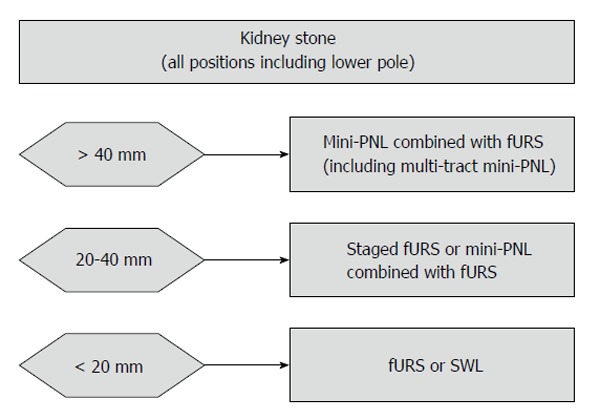
Flexible ureteroscopy (fURS) has become a more effective and safer treatment for whole upper urinary tract stones. Percutaneous nephrolithotomy (PNL) is currently the first-line recommended treatment for large kidney stones ≥ 20 mm and it has an excellent stone-free rate for large kidney stones. However, its invasiveness is not negligible considering its major complication rates. Staged fURS is a practical treatment for such large kidney stones because fURS has a minimal blood transfusion risk, short hospitalization and few restrictions on daily routines. However, as the stone size becomes larger, the stone-free rate decreases, and the number of operations required increases. Therefore, in our opinion, staged fURS is a practical option for kidney stones 20 to 40 mm. Miniaturized PNL combined with fURS should be considered to be a preferred option for stones larger than 40 mm. Moreover, URS is an effective treatment for multiple upper urinary tract stones. Especially for patients with a stone burden < 20 mm, URS is a favorable option that promises a high stone-free rate after a single session either unilaterally or bilaterally. However, for patients with a stone burden ≥ 20 mm, a staged operation should be considered to achieve stone-free status.
Keywords: Kidney calculi; Laser; Lithotripsy; Nephrostomy; Percutaneous; Ureteroscopy.
Figures
References
-
- Glowacki LS, Beecroft ML, Cook RJ, Pahl D, Churchill DN. The natural history of asymptomatic urolithiasis. J Urol. 1992;147:319–321. - PubMed
-
- Burgher A, Beman M, Holtzman JL, Monga M. Progression of nephrolithiasis: long-term outcomes with observation of asymptomatic calculi. J Endourol. 2004;18:534–539. - PubMed
-
- Hübner W, Porpaczy P. Treatment of caliceal calculi. Br J Urol. 1990;66:9–11. - PubMed
-
- Inci K, Sahin A, Islamoglu E, Eren MT, Bakkaloglu M, Ozen H. Prospective long-term followup of patients with asymptomatic lower pole caliceal stones. J Urol. 2007;177:2189–2192. - PubMed
-
- Keeley FX, Tilling K, Elves A, Menezes P, Wills M, Rao N, Feneley R. Preliminary results of a randomized controlled trial of prophylactic shock wave lithotripsy for small asymptomatic renal calyceal stones. BJU Int. 2001;87:1–8. - PubMed
Publication types
LinkOut - more resources
Full Text Sources
Other Literature Sources
