Review
. 2015 Mar;22(2):94-101.
doi: 10.1097/PAP.0000000000000049.

The evolving molecular genetics of low-grade glioma

Affiliations
Review

The evolving molecular genetics of low-grade glioma

Sriram Venneti et al. Adv Anat Pathol. 2015 Mar.

Erratum in

  • Adv Anat Pathol. 2015 May;22(3):226

Abstract

Low-grade gliomas (LGG) constitute grades I and II tumors of astrocytic and grade II tumors of oligodendroglial lineage. Although these tumors are typically slow growing, they may be associated with significant morbidity and mortality because of recurrence and malignant progression, even in the setting of optimal resection. LGG in pediatric and adult age groups are currently classified by morphologic criteria. Recent years have heralded a molecular revolution in understanding brain tumors, including LGG. Next-generation sequencing has definitively demonstrated that pediatric and adult LGG fundamentally differ in their underlying molecular characteristics, despite being histologically similar. Pediatric LGG show alterations in FGFR1 and BRAF in pilocytic astrocytomas and FGFR1 alterations in diffuse astrocytomas, each converging on the mitogen-activated protein kinase signaling pathway. Adult LGG are characterized by IDH1/2 mutations and ATRX mutations in astrocytic tumors and IDH1/2 mutations and 1p/19q codeletions in oligodendroglial tumors. TERT promoter mutations are also noted in LGG and are mainly associated with oligodendrogliomas. These findings have considerably refined approaches to classifying these tumors. Moreover, many of the molecular alterations identified in LGG directly impact on prognosis, tumor biology, and the development of novel therapies.


Conflict of interest statement

The authors have no conflicts of interest.

Figures
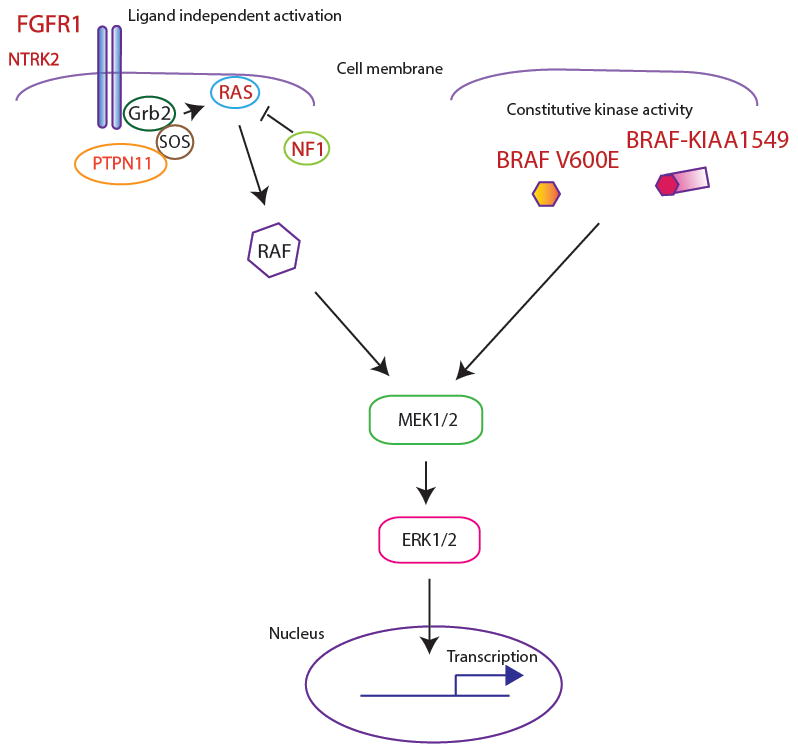
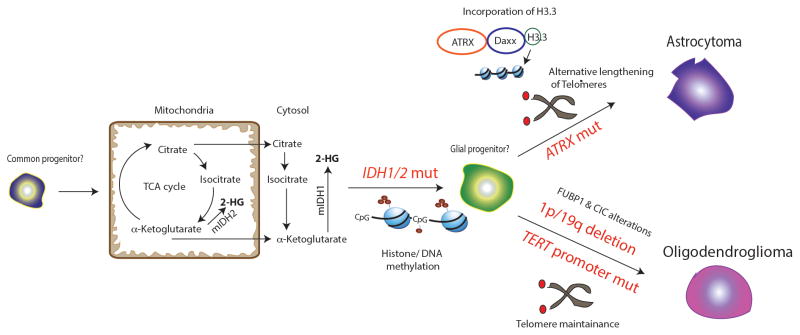
FIG. 1
FIG. 1. IDH 1/2, ATRX, and TERT promoter mutations and 1p/19q codeletion in adult LGG
IDH1/2 mutations are thought to be an early event in adult LGG pathogenesis in a common precursor cell. Mutations in IDH1 (cytoplasmic) and IDH2 (mitochondrial) result in the generation of the oncometabolite 2-hydroxyglutarate (2-HG). 2-HG is thought to inhibit α-ketoglutarate dependent demethylases resulting in histone and DNA-CpG island methylation (G-CIMP phenotype). Mutations in ATRX are seen in astrocytic tumors. ATRX is a helicase belonging to the SWI/SNF family involved in H3.3 deposition (along with its partner DAXX). Its deficiency induces alternative lengthening of telomeres. 1p/19q codeletion is seen in oligodendrogliomas. CIC and FUBP1 alterations are associated with 1p/19q codeletion in a variable percentage of oligodendrogliomas. TERT promoter mutations are also noted in oligodendrogliomas and are thought to be important for telomere maintenance. Text in red indicates mutations.
FIG. 2
FIG. 2. FGFR1 and BRAF alterations in pediatric LGG converge on the MAP kinase pathway
Alterations in FGFR1 result in constitutive activation of the receptor resulting in activation of the MAP kinase pathway. A subset of pediatric LGG also shows mutations in the receptor tyrosine kinase NTRK2. Rare mutations involve other members of this pathway including RAS, NF1 (negative regulator of RAS) and PTPN11, a tyrosine phosphatase adaptor protein. BRAF V600E mutations and the BRAF-KIAA1549 fusion (other rare fusions not illustrated) also result in constitutive kinase activity and aberrant MAP kinase activation. Text in red indicates mutations/alterations.
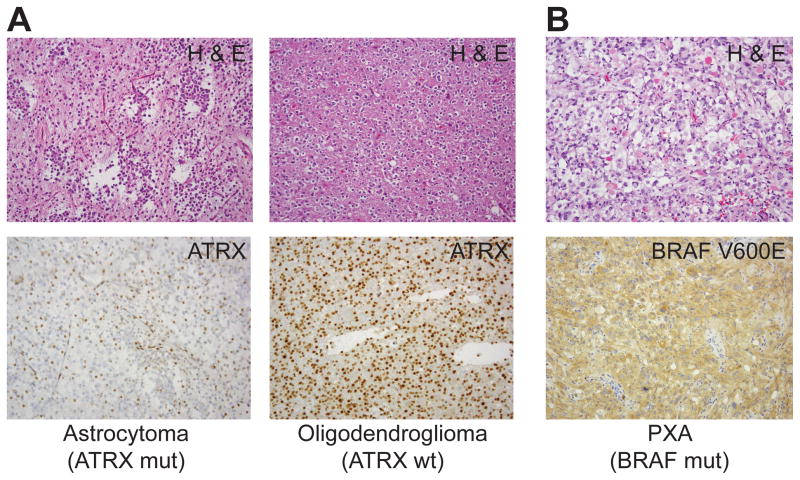
FIG. 3
FIG. 3. Immunohistochemical assessment of mutations in ATRX and BRAF
A, Loss-of-function mutations in ATRX lead to loss of nuclear expression. H & E stained and ATRX-immunostained micrographs of ATRX-mut and ATRX-wt tumors are shown. B, positive BRAF V600E immunostaining in a mutant-harboring PXA. H& E staining also shown.

References

    1. Louis DN, Perry A, Burger P, et al. International Society of Neuropathology-Haarlem Consensus Guidelines, for Nervous System Tumor Classification and Grading. Brain Pathol. 2014 - PMC - PubMed
    1. Wu G, Broniscer A, McEachron TA, et al. Somatic histone H3 alterations in pediatric diffuse intrinsic pontine gliomas and non-brainstem glioblastomas. Nature genetics. 2012;44:251–253. - PMC - PubMed
    1. Schwartzentruber J, Korshunov A, Liu XY, et al. Driver mutations in histone H3. 3 and chromatin remodelling genes in paediatric glioblastoma. Nature. 2012;482:226–231. - PubMed
    1. Bar EE, Lin A, Tihan T, et al. Frequent gains at chromosome 7q34 involving BRAF in pilocytic astrocytoma. Journal of neuropathology and experimental neurology. 2008;67:878–887. - PubMed
    1. Jones DT, Kocialkowski S, Liu L, et al. Tandem duplication producing a novel oncogenic BRAF fusion gene defines the majority of pilocytic astrocytomas. Cancer research. 2008;68:8673–8677. - PMC - PubMed

Publication types