


Mercury Exposure and Antinuclear Antibodies among Females of Reproductive Age in the United States: NHANES
- PMID: 25665152
- PMCID: PMC4529012
- DOI: 10.1289/ehp.1408751
Mercury Exposure and Antinuclear Antibodies among Females of Reproductive Age in the United States: NHANES
Abstract
Background: Immune dysregulation associated with mercury has been suggested, although data in the general population are lacking. Chronic exposure to low levels of methylmercury (organic) and inorganic mercury is common, such as through fish consumption and dental amalgams.
Objective: We examined associations between mercury biomarkers and antinuclear antibody (ANA) positivity and titer strength.
Methods: Among females 16-49 years of age (n = 1,352) from the National Health and Nutrition Examination Survey (NHANES) 1999-2004, we examined cross-sectional associations between mercury and ANAs (indirect immunofluorescence; cutoff ≥ 1:80). Three biomarkers of mercury exposure were used: hair (available 1999-2000) and total blood (1999-2004) predominantly represented methylmercury, and urine (1999-2002) represented inorganic mercury. Survey statistics were used. Multivariable modeling adjusted for several covariates, including age and omega-3 fatty acids.
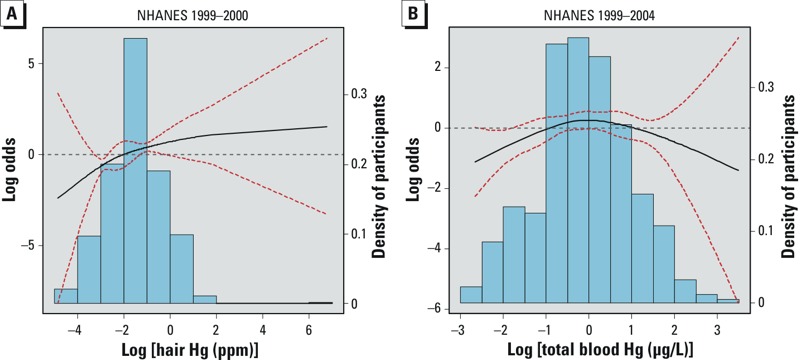
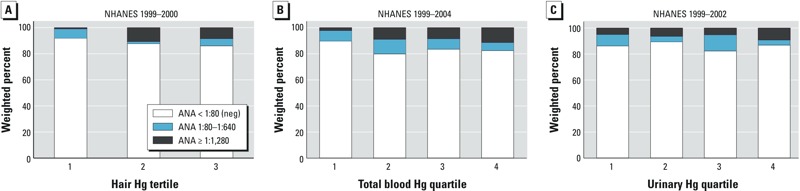
Results: Sixteen percent of females were ANA positive; 96% of ANA positives had a nuclear speckled staining pattern. Geometric mean (geometric SD) mercury concentrations were 0.22 (0.03) ppm in hair, 0.92 (0.05) μg/L blood, and 0.62 (0.04) μg/L urine. Hair and blood, but not urinary, mercury were associated with ANA positivity (sample sizes 452, 1,352, and 804, respectively), after adjusting for confounders: for hair, odds ratio (OR) = 4.10 (95% CI: 1.66, 10.13); for blood, OR = 2.32 (95% CI: 1.07, 5.03) comparing highest versus lowest quantiles. Magnitudes of association were strongest for high-titer (≥ 1:1,280) ANA: hair, OR = 11.41 (95% CI: 1.60, 81.23); blood, OR = 5.93 (95% CI: 1.57, 22.47).
Conclusions: Methylmercury, at low levels generally considered safe, was associated with subclinical autoimmunity among reproductive-age females. Autoantibodies may predate clinical disease by years; thus, methylmercury exposure may be relevant to future autoimmune disease risk.
Conflict of interest statement
E.C.S. had full access to all the data in the study and takes responsibility for the integrity of the data and the accuracy of the data analysis.
The authors declare they have no actual or potential competing financial interests.
Figures
References
-
- Agency for Toxic Substances and Disease Registry. 2013 ATSDR Substance Priority List. 2013. Available: http://www.atsdr.cdc.gov/SPL/index.html [accessed 15 January 2015]
-
- Arnett FC, Reveille JD, Goldstein R, Pollard KM, Leaird K, Smith EA, et al. Autoantibodies to fibrillarin in systemic sclerosis (scleroderma). An immunogenetic, serologic, and clinical analysis. Arthritis Rheum. 1996;39:1151–1160. - PubMed
-
- Bradwell AR, Hughes RG, Harden EL. Birmingham, UK: Binding Site; 2003. Atlas of HEp-2 Patterns. 2nd ed.
Publication types
MeSH terms
Substances
Grants and funding
LinkOut - more resources
Full Text Sources
Other Literature Sources