Review
. 2015 Jun:83:101-11.
doi: 10.1016/j.yjmcc.2015.02.004. Epub 2015 Feb 7.

Age-associated pro-inflammatory remodeling and functional phenotype in the heart and large arteries

Affiliations
Review

Age-associated pro-inflammatory remodeling and functional phenotype in the heart and large arteries

Mingyi Wang et al. J Mol Cell Cardiol. 2015 Jun.

Abstract

The aging population is increasing dramatically. Aging-associated stress simultaneously drives proinflammatory remodeling, involving angiotensin II and other factors, in both the heart and large arteries. The structural remodeling and functional changes that occur with aging include cardiac and vascular wall stiffening, systolic hypertension and suboptimal ventricular-arterial coupling, features that are often clinically silent and thus termed a silent syndrome. These age-related effects are the result of responses initiated by cardiovascular proinflammatory cells. Local proinflammatory signals are coupled between the heart and arteries due to common mechanical and humoral messengers within a closed circulating system. Thus, targeting proinflammatory signaling molecules would be a promising approach to improve age-associated suboptimal ventricular-arterial coupling, a major predisposing factor for the pathogenesis of clinical cardiovascular events such as heart failure.

Keywords: Aging; Cardiovascular remodeling; Proinflammation; Ventricular–arterial coupling.


Conflict of interest statement

Conflicts of interest statement

None declared.

Figures
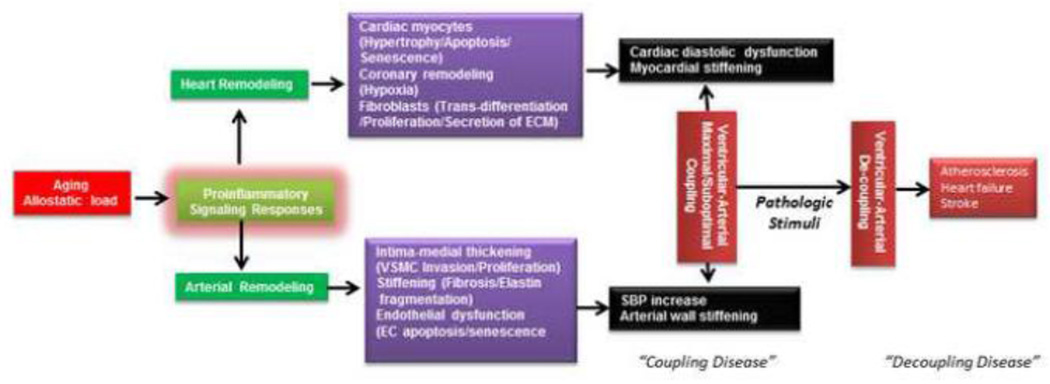
Figure 1
Figure 1. Impact of proinflammatory signaling on heart and arterial phenotype and ventricular-arterial coupling with advancing age
Aging increases allostatic load, including Ang II signaling, leading to proinflammation. With aging, adverse remodeling develops in both the heart and large arteries, which is the underlying mechanism of abnormal arterial-ventricular coupling. A mismatched or suboptimal arterial-ventricular mechanical coupling, sometimes known as “coupling disease”, is manifest by increases in SBP and left ventricular diastolic dysfunction. Suboptimal arterial-ventricular coupling increases the susceptibility to complications such as heart failure, atherosclerosis and stroke (sometimes termed “de-coupling diseases”), in response to pathologic stimuli such as ischemia.
Figure 2
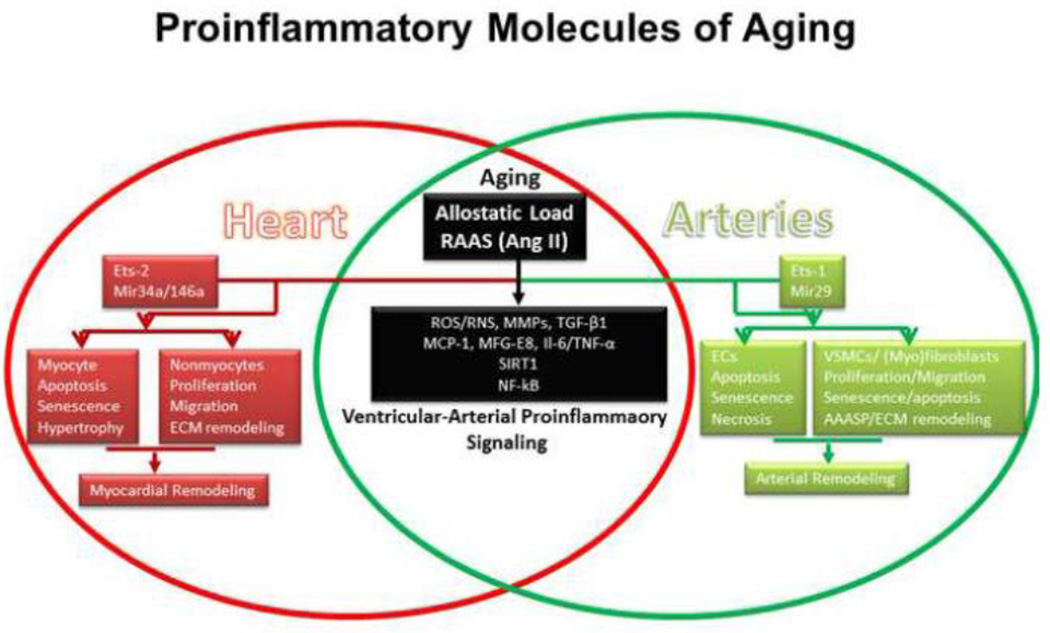
Figure 2. Proinflammatory signaling mechanisms and effect of cellular phenotype during aging
Abbreviations and acronyms: Ang II: angiotensin II; Ets-1/2: the v-ets erythroblastosis virus E26 oncogene homolog 1; MMPs: matrix metalloproteases; MFG-E8: milk fat globule epidermal growth factor-8; MCP-1: monocyte chemo-attractant protein-1; NO: nitric oxide; RAAS: renin angiotensin aldosterone system; SIRT1: silent information regulation 2 homolog 1; TGF-β1: transforming growth factor β1; TNF-α: tumor necrosis factor alpha; IL; interleukin; NF-κB: nuclear factor kappa-light-chain-enhancer of activated B cells. ECs: endothelial cells; VSMCs: vascular smooth muscle cells; ECM: extracellular matrix

References

    1. Merkin SS, Karlamangla A, Roux AV, Shrager S, Seeman TE. Life course socioeconomic status and longitudinal accumulation of allostatic load in adulthood: multi-ethnic study of atherosclerosis. American journal of public health. 2014;104:e48–e55. - PMC - PubMed
    1. Seeman TE, Singer BH, Rowe JW, Horwitz RI, McEwen BS. Price of adaptation--allostatic load and its health consequences. MacArthur studies of successful aging. Archives of internal medicine. 1997;157:2259–2268. - PubMed
    1. Saavedra JM. Angiotensin II AT(1) receptor blockers ameliorate inflammatory stress: a beneficial effect for the treatment of brain disorders. Cellular and molecular neurobiology. 2012;32:667–681. - PMC - PubMed
    1. Wang M, Jiang L, Monticone RE, Lakatta EG. Proinflammation: the key to arterial aging. Trends in endocrinology and metabolism: TEM. 2014;25:72–79. - PMC - PubMed
    1. Chantler PD, Lakatta EG. Arterial-ventricular coupling with aging and disease. Frontiers in physiology. 2012;3:90. - PMC - PubMed

Publication types

MeSH terms