. 2015 Jul;40(8):1957-68.
doi: 10.1038/npp.2015.46. Epub 2015 Feb 10.

Individual Differences in Impulsive Action Reflect Variation in the Cortical Serotonin 5-HT2A Receptor System

Affiliations

Individual Differences in Impulsive Action Reflect Variation in the Cortical Serotonin 5-HT2A Receptor System

Latham H L Fink et al. Neuropsychopharmacology. 2015 Jul.

Abstract

Impulsivity is an important feature of multiple neuropsychiatric disorders, and individual variation in the degree of inherent impulsivity could play a role in the generation or exacerbation of problematic behaviors. Serotonin (5-HT) actions at the 5-HT2AR receptor (5-HT2AR) promote and 5-HT2AR antagonists suppress impulsive action (the inability to withhold premature responses; motor impulsivity) upon systemic administration or microinfusion directly into the medial prefrontal cortex (mPFC), a node in the corticostriatal circuit that is thought to play a role in the regulation of impulsive action. We hypothesized that the functional capacity of the 5-HT2AR, which is governed by its expression, localization, and protein/protein interactions (eg, postsynaptic density 95 (PSD95)), may drive the predisposition to inherent impulsive action. Stable high-impulsive (HI) and low-impulsive (LI) phenotypes were identified from an outbred rodent population with the 1-choice serial reaction time (1-CSRT) task. HI rats exhibited a greater head-twitch response following administration of the preferential 5-HT2AR agonist 2,5-dimethoxy-4-iodoamphetamine (DOI) and were more sensitive to the effects of the selective 5-HT2AR antagonist M100907 to suppress impulsive action relative to LI rats. A positive correlation was observed between levels of premature responses and 5-HT2AR binding density in frontal cortex ([(3)H]-ketanserin radioligand binding). Elevated mPFC 5-HT2AR protein expression concomitant with augmented association of the 5-HT2AR with PSD95 differentiated HI from LI rats. The observed differential sensitivity of HI and LI rats to 5-HT2AR ligands and associated distinct 5-HT2AR protein profiles provide evidence that spontaneously occurring individual differences in impulsive action reflect variation in the cortical 5-HT2AR system.


Figures
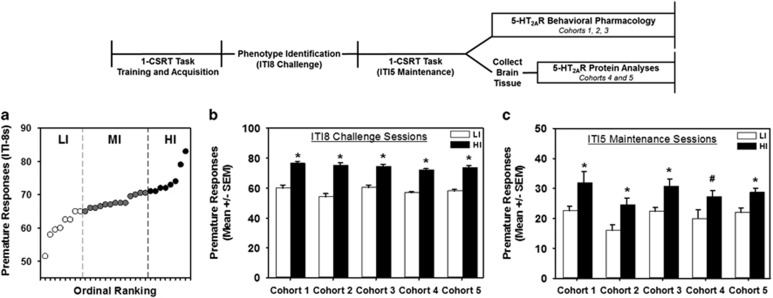
Figure 1
Figure 1
1-CSRT task separates impulsive action phenotypes. (a) Ordinal ranking of a representative cohort (cohort 3) based on premature responses averaged over two ITI8 challenge sessions. Low-impulsive (LI, n=8, open circles) and high-impulsive rats (HI, n=8, closed circles) were defined by lower and upper quartiles, respectively, from mid-impulsive rats (MI, n=13, gray circles). (b) HI rats (black bars) exhibit elevated premature responses vs LI rats (white bars) in all cohorts during performance in ITI8 challenge sessions and (c) during stable performance in ITI5 maintenance sessions, as averaged over 2 to 3 days before subsequent experimentation (*p<0.05 vs LI, #p=0.06).
Figure 2
Figure 2
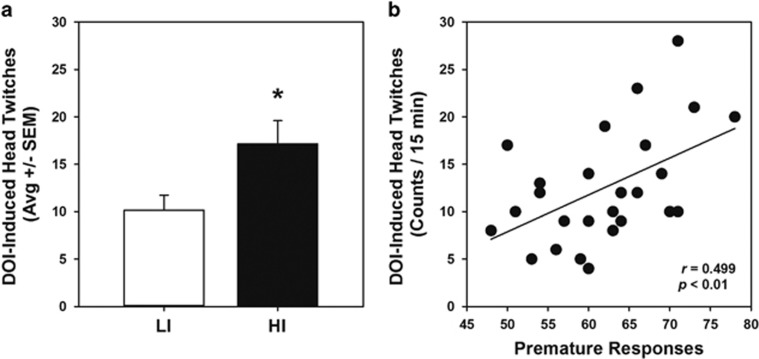
Inherent impulsive action predicts the DOI-elicited head-twitch response. Upon completion of 1-CSRT task training and phenotypic identification (cohort 1), injection of DOI (1 mg/kg, s.c.) resulted in head-twitches that were quantified over a 15-min period. (a) HI rats (n=7, black bar) exhibited a greater number of head twitches than LI rats (n=7, white bar; *p<0.05 vs LI-VEH). (b) There was a positive correlation between the number of head-twitches and premature responses during phenotype identification on the ITI8 challenge in the 1-CSRT task (r=0.499; p<0.01).
Figure 3
Figure 3
HI rats are more sensitive to the behavioral effects of M100907, but not DOI, in the 1-CSRT task. Following 1-CSRT task training and phenotypic identification, the effects of DOI (0.01, 0.03, and 0.1 mg/kg; cohort 2) and M100907 (0.001, 0.01, and 0.1 mg/kg; cohort 3) were each evaluated in separate cohorts of rats under ITI5 conditions. In both cohorts, baseline levels of premature responses in HI rats administered vehicle (VEH; closed circles, upper dotted line) were significantly higher than the vehicle baseline in LI rats (open circles, lower dashed line; *p<0.05 vs LI-VEH). (a) In both HI (n=9) and LI rats (n=7), DOI significantly increased premature responses at 0.03 mg/kg (#p<0.05 vs HI-VEH, *p<0.05 vs LI-VEH). (b) In HI rats (n=8), M100907 significantly suppressed premature responses at 0.01 and 0.1 mg/kg (#p<0.05 vs HI-VEH), below the vehicle baseline of LI rats (n=8). Only the highest dose of M100907 (0.1 mg/kg) significantly suppressed premature responses in LI rats (*p<0.05 vs LI-VEH).
Figure 4
Figure 4
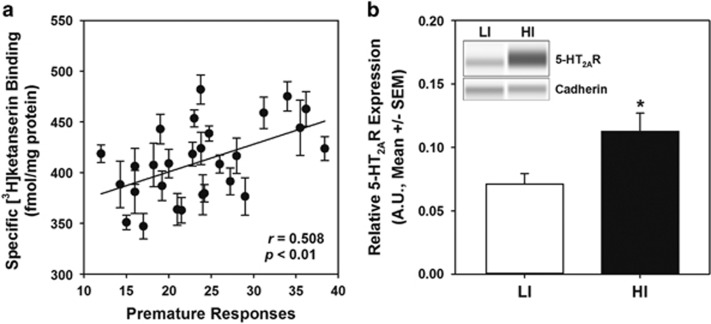
Inherent impulsive action predicts 5-HT2AR binding density and protein expression in whole frontal cortex. (a) Following 1-CSRT task training and phenotypic identification (cohort 4), whole frontal cortex was collected and a crude synaptosomal preparation analyzed for single-point radioligand binding ([3H]-ketanserin, 10 nM) to approximate saturation binding. Specific [3H]-ketanserin binding positively correlated with premature responses during stable ITI5 performance in the 1-CSRT task (n=28; r=0.508, p<0.01). Error bars (±SEM) represent results from three independent experiments run in triplicate. (b) The subset of HI and LI samples from the same frontal cortex crude synaptosomal preparations were then analyzed by capillary gel-based immunodetection. Quantitation of 5-HT2AR immunoreactivity (normalized to cadherin loading control) revealed elevated 5-HT2AR protein expression in HI (n=6, black bar) relative to LI rats (n=6, white bar; *p<0.05 vs. LI). The inset presents representative electrophoretic bands. Arbitrary units (AU) of normalized densitometry are presented (see Materials and Methods).
Figure 5
Figure 5
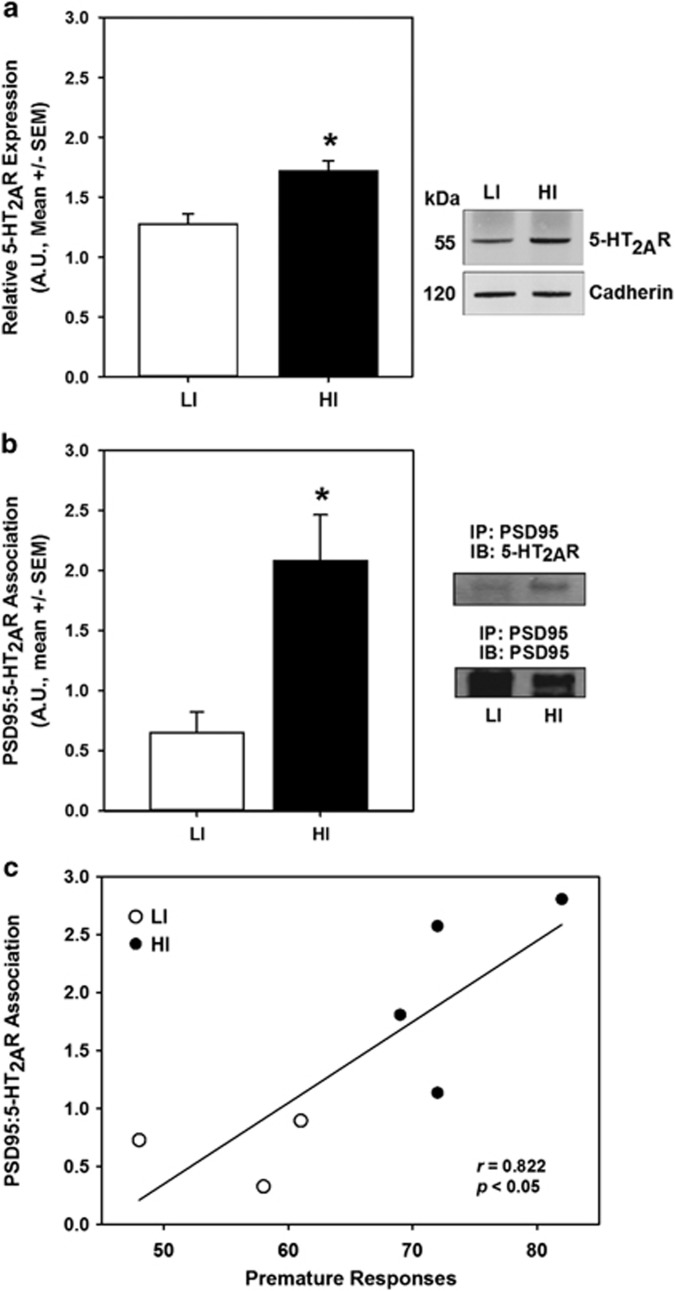
Inherent impulsive action predicts synaptic protein expression in mPFC. (a) Following 1-CSRT task training and phenotypic identification (cohort 5), the mPFC was collected for biochemical analysis. Immunoblot for the 5-HT2AR and cadherin loading control was performed using crude synaptosomal protein from the mPFC (inset, representative blot). Densitometric quantitation revealed elevated 5-HT2AR protein expression in HI (n=7, black bar) relative to LI rats (n=7, white bar; p<0.05). (b) Immunoprecipitation (IP) of mPFC crude synaptosomes with α-PSD95 antibody followed by immunoblots (IB) for 5-HT2AR and PSD95 (right, representative blots) revealed an increased 5-HT2AR/PSD95 association in HI (n=4, black bar) relative to LI rats (n=3, white bar; p<0.05). (c) There was a correlation between premature responses in the 1-CSRT task and densitometric quantitation of 5-HT2AR/PSD95 association (r=0.822; p<0.05). Arbitrary units (AU) of normalized densitometry are presented (see Materials and Methods).

References

    1. Abbas AI, Yadav PN, Yao WD, Arbuckle MI, Grant SG, Caron MG et al (2009). PSD-95 is essential for hallucinogen and atypical antipsychotic drug actions at serotonin receptors. JNeurosci 29: 7124–7136. - PMC - PubMed
    1. American Psychiatric Association (2013). Diagnostic and Statistical Manual of Mental Disorders: DSM-5.
    1. Anastasio NC, Gilbertson SR, Bubar MJ, Agarkov A, Stutz SJ, Jeng YJ et al (2013). Peptide inhibitors disrupt the serotonin 5-HT2C receptor interaction with phosphatase and tensin homolog to allosterically modulate cellular signaling and behavior. J Neurosci 33: 1615–1630. - PMC - PubMed
    1. Anastasio NC, Lanfranco MF, Bubar MJ, Seitz PK, Stutz SJ, McGinnis AG et al (2010). Serotonin 5-HT(2C) receptor protein expression is enriched in synaptosomal and post-synaptic compartments of rat cortex. J Neurochem 113: 1504–1515. - PMC - PubMed
    1. Anastasio NC, Stoffel EC, Fox RG, Bubar MJ, Rice KC, Moeller FG et al (2011). Serotonin (5-hydroxytryptamine) 5-HT2A receptor: association with inherent and cocaine-evoked behavioral disinhibition in rats. Behav Pharmacol 22: 248–261. - PMC - PubMed

Publication types

MeSH terms

LinkOut - more resources