


Photorhabdus insect-related (Pir) toxin-like genes in a plasmid of Vibrio parahaemolyticus, the causative agent of acute hepatopancreatic necrosis disease (AHPND) of shrimp
- PMID: 25667334
- PMCID: PMC4785170
- DOI: 10.3354/dao02830
Photorhabdus insect-related (Pir) toxin-like genes in a plasmid of Vibrio parahaemolyticus, the causative agent of acute hepatopancreatic necrosis disease (AHPND) of shrimp
Abstract
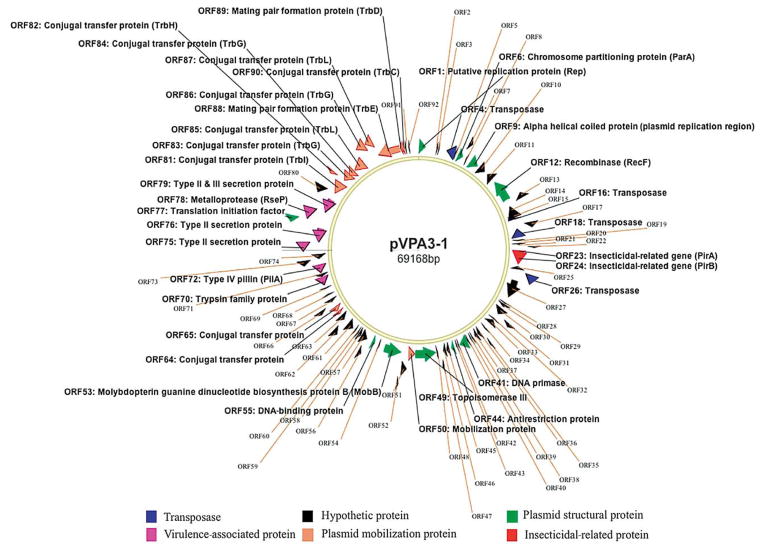
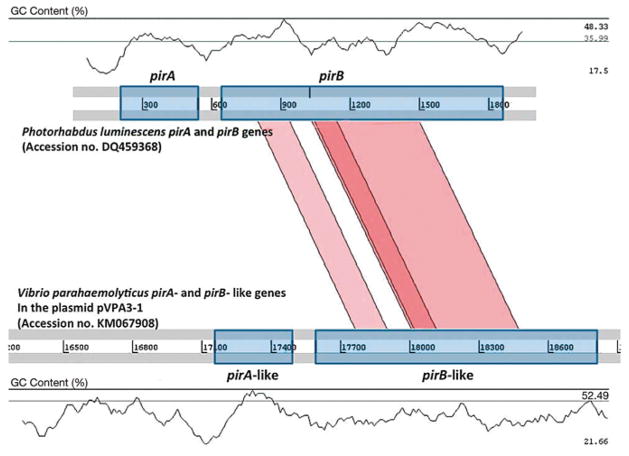
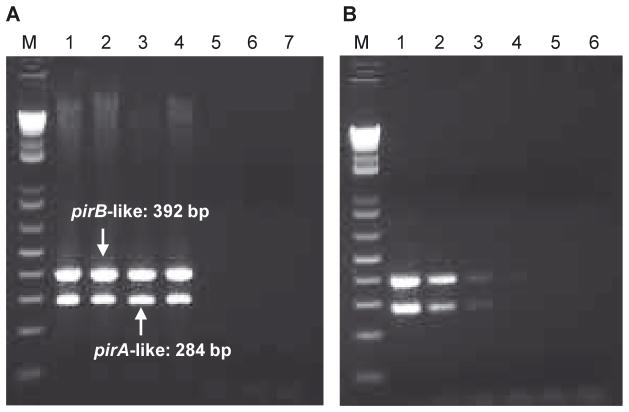
The 69 kb plasmid pVPA3-1 was identified in Vibrio parahaemolyticus strain 13‑028/A3 that can cause acute hepatopancreatic necrosis disease (AHPND). This disease is responsible for mass mortalities in farmed penaeid shrimp and is referred to as early mortality syndrome (EMS). The plasmid has a GC content of 45.9% with a copy number of 37 per bacterial cell as determined by comparative quantitative PCR analyses. It consists of 92 open reading frames that encode mobilization proteins, replication enzymes, transposases, virulence-associated proteins, and proteins similar to Photorhabdus insect-related (Pir) toxins. In V. parahaemolyticus, these Pir toxin-like proteins are encoded by 2 genes (pirA- and pirB-like) located within a 3.5 kb fragment flanked with inverted repeats of a transposase-coding sequence (1 kb). The GC content of these 2 genes is only 38.2%, substantially lower than that of the rest of the plasmid, which suggests that these genes were recently acquired. Based on a proteomic analysis, the pirA-like (336 bp) and pirB-like (1317 bp) genes encode for 13 and 50 kDa proteins, respectively. In laboratory cultures of V. parahaemolyticus 13-028/A3, both proteins were secreted into the culture medium. We developed a duplex PCR diagnostic method, with a detection limit of 10(5) CFU ml(-1) and targeting pirA- and pirB-like genes in this strain of V. parahaemolyticus. This PCR protocol can reliably detect AHPND-causing strains of V. parahaemolyticus and does not cross react with non-pathogenic strains or with other species of Vibrio isolated from shrimp ponds.
Figures
References
-
- Blackburn MB, Farrar RR, Novak NG, Lawrence SD. Remarkable susceptibility of the diamondback moth (Plutella xylostella) to ingestion of Pir toxins from Photorhabdus luminescens. Entomol Exp Appl. 2006;121:31–37.
-
- Duchaud E, Rusniok C, Frangeul L, Buchrieser C, et al. The genome sequence of the entomopathogenic bacterium Photorhabdus luminescens. Nat Biotechnol. 2003;21:1307–1313. - PubMed
Publication types
MeSH terms
Substances
Grants and funding
LinkOut - more resources
Full Text Sources
Other Literature Sources
Molecular Biology Databases
Miscellaneous
