


Development and economic trends in cancer therapeutic drugs: a 5-year update 2010-2014
- PMID: 25668005
- PMCID: PMC4366897
- DOI: 10.1038/bjc.2015.56
Development and economic trends in cancer therapeutic drugs: a 5-year update 2010-2014
Abstract
Background: Over the past 20 years, the mechanisms of action, duration of benefits and economic costs of newly licenced cancer drugs have changed significantly; however, summary data on these characteristics are limited.
Methods: In this study, using historical copies of the British National Formulary and relevant contemporary publications, we have documented for each new cancer drug the year of introduction, therapeutic classification, initial indication, median duration of treatment and the cost of treatment at introduction relative to the then current UK GDP per capita.
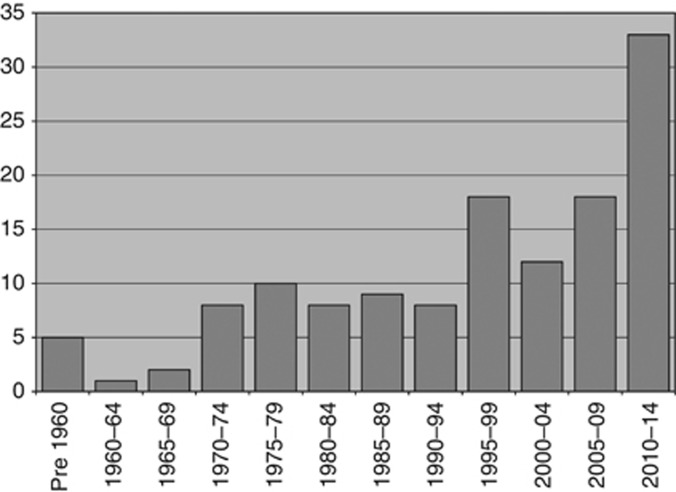
Results: Before 2000, there were 69 cancer treatment drugs available, of which 50 (72.5%) were classical cytotoxic drugs. In the subsequent 15 years, there have been 63 more new cancer treatment drugs added, including 20 kinase inhibitors and 11 monoclonal antibodies. The average median duration of treatment with a new drug has risen from 181 days in 1995-1999 to 263 days in 2010-2014. The average cost of treatment has also risen from £3036.91 (20.6% of UK per capita GDP) in 1995-1999 to £20 233 (89.0%) in 2005-2009 and now to £35 383 (141.7%) in 2010-2014.
Conclusions: The last 5 years has seen 33 new cancer drugs. These drugs deliver significant benefits in patient outcomes and are taken for increasing lengths of time. Alongside these clinical benefits, the direct costs of new treatments have increased significantly over the past decade.
Figures
References
-
- Coiffier B, Lepage E, Briere J, Herbrecht R, Tilly H, Bouabdallah R, Morel P, Van Den Neste E, Salles G, Gaulard P, Reyes F, Lederlin P, Gisselbrecht C. CHOP chemotherapy plus rituximab compared with CHOP alone in elderly patients with diffuse large-B-cell lymphoma. N Engl J Med. 2002;346:235–242. - PubMed
-
- Fojo T, Mailankody S, Lo A. Unintended consequences of expensive cancer therapeutics-the pursuit of marginal indications and a me-too mentality that stifles innovation and creativity: the John Conley lecture. JAMA Otolaryngol Head Neck Surg. 2014;140:1225–1236. - PubMed
-
- Khera N. Reporting and Grading Financial Toxicity. J Clin Oncol. 2014;29:3337–3338. - PubMed
MeSH terms
Substances
LinkOut - more resources
Full Text Sources
Other Literature Sources
Miscellaneous
