


γ-Herpesvirus load as surrogate marker of early death in HIV-1 lymphoma patients submitted to high dose chemotherapy and autologous peripheral blood stem cell transplantation
- PMID: 25668032
- PMCID: PMC4323102
- DOI: 10.1371/journal.pone.0116887
γ-Herpesvirus load as surrogate marker of early death in HIV-1 lymphoma patients submitted to high dose chemotherapy and autologous peripheral blood stem cell transplantation
Abstract
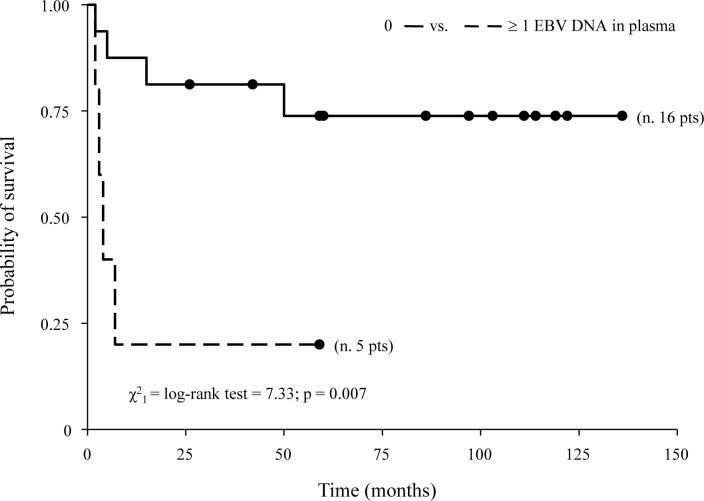
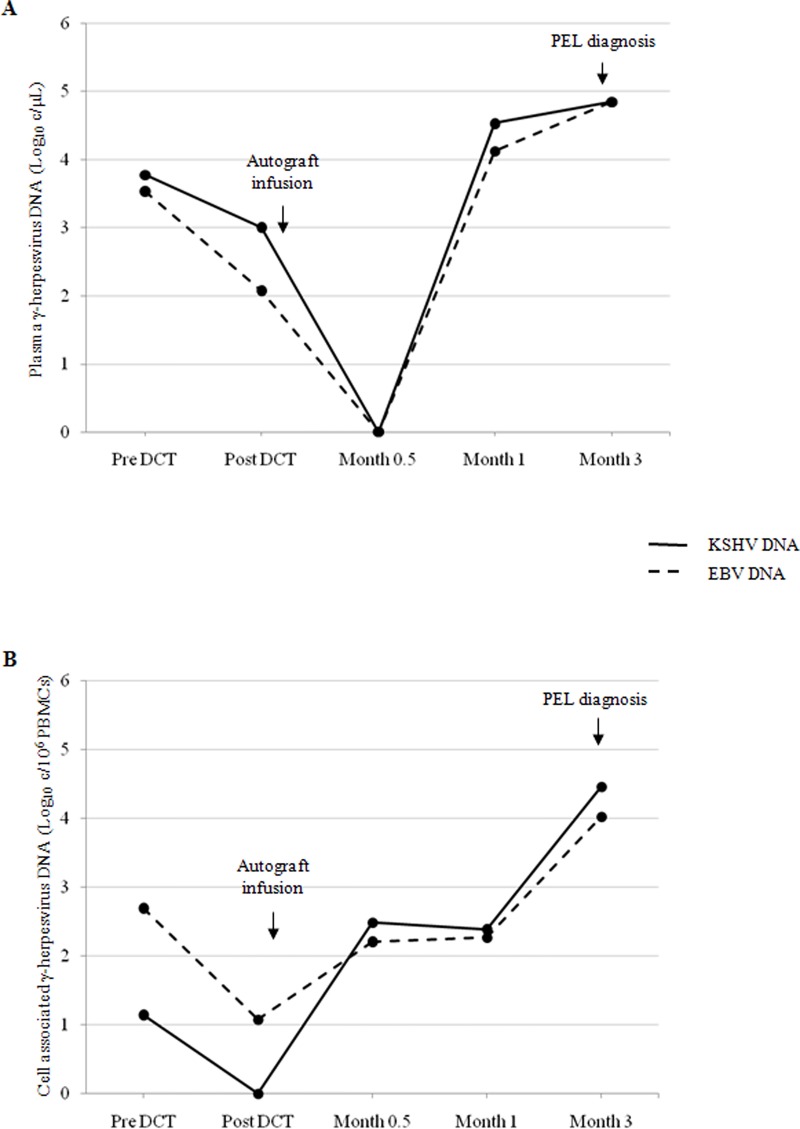
Autologous stem cell transplantation (ASCT) is a feasible procedure for human immunodeficiency virus-1 (HIV-1) lymphoma patients, whose underlying disease and intrinsic HIV-1- and ASCT-associated immunodeficiency might increase the risk for γ-herpesvirus load persistence and/or reactivation. We evaluated this hypothesis by investigating the levels of Epstein-Barr virus (EBV)- and Kaposi sarcoma-associated herpesvirus (KSHV)-DNA levels in the peripheral blood of 22 HIV-1-associated lymphoma patients during ASCT, highlighting their relationship with γ-herpesvirus lymphoma status, immunological parameters, and clinical events. EBV-DNA was detected in the pre-treatment plasma and peripheral blood mononuclear cells (PBMCs) of 12 (median 12,135 copies/mL) and 18 patients (median 417 copies/10(6) PBMCs), respectively; the values in the two compartments were correlated (r = 0.77, p = 0.0001). Only EBV-positive lymphomas showed detectable levels of plasma EBV-DNA. After debulking chemotherapy, plasma EBV-DNA was associated with lymphoma chemosensitivity (p = 0.03) and a significant higher mortality risk by multivariate Cox analysis adjusted for EBV-lymphoma status (HR, 10.46, 95% CI, 1.11-98.32, p = 0.04). After infusion, EBV-DNA was detectable in five EBV-positive lymphoma patients who died within six months. KSHV-DNA load was positive in only one patient, who died from primary effusion lymphoma. Fluctuations in levels of KSHV-DNA reflected the patient's therapy and evolution of his underlying lymphoma. Other γ-herpesvirus-associated malignancies, such as multicentric Castleman disease and Kaposi sarcoma, or end-organ complications after salvage treatment were not found. Overall, these findings suggest a prognostic and predictive value of EBV-DNA and KSHV-DNA, the monitoring of which could be a simple, complementary tool for the management of γ-herpesvirus-positive lymphomas in HIV-1 patients submitted to ASCT.
Conflict of interest statement
Figures
References
-
- Stevens SJ, Smits PH, Verkuijlen SA, Rockx DA, van Gorp EC, et al. (2007) Aberrant Epstein-Barr virus persistence in HIV carriers is characterized by anti-Epstein-Barr virus IgA and high cellular viral loads with restricted transcription. AIDS 21:2141–9. - PubMed
-
- Van Esser JW, van der Holt B, Meijer E, Niesters HG, Trenschel R, et al. (2001) Epstein-Barr virus (EBV) reactivation is a frequent event after allogeneic stem cell transplantation (SCT) and quantitatively predicts EBV-lymphoproliferative disease following T-cell—depleted SCT. Blood 98:972–8. - PubMed
-
- Juvonen E, Aalto S, Tarkkanen J, Volin L, Hedman K, et al. (2007) Retrospective evaluation of serum Epstein Barr virus DNA levels in 406 allogeneic stem cell transplant patients. Haematologica 92:819–25. - PubMed
Publication types
MeSH terms
Substances
LinkOut - more resources
Full Text Sources
Other Literature Sources
