. 2015 Mar;97(3):234-46.
doi: 10.1002/cpt.59. Epub 2015 Feb 4.

From adaptive licensing to adaptive pathways: delivering a flexible life-span approach to bring new drugs to patients

Affiliations

From adaptive licensing to adaptive pathways: delivering a flexible life-span approach to bring new drugs to patients

H-G Eichler et al. Clin Pharmacol Ther. 2015 Mar.

Abstract

The concept of adaptive licensing (AL) has met with considerable interest. Yet some remain skeptical about its feasibility. Others argue that the focus and name of AL should be broadened. Against this background of ongoing debate, we examine the environmental changes that will likely make adaptive pathways the preferred approach in the future. The key drivers include: growing patient demand for timely access to promising therapies, emerging science leading to fragmentation of treatment populations, rising payer influence on product accessibility, and pressure on pharma/investors to ensure sustainability of drug development. We also discuss a number of environmental changes that will enable an adaptive paradigm. A life-span approach to bringing innovation to patients is expected to help address the perceived access vs. evidence trade-off, help de-risk drug development, and lead to better outcomes for patients.


Conflict of interest statement

Richard Barker is a non‐executive director of Celgene and iCo Therapeutics; John Ferguson is a Novartis employee and stockholder; Sarah Garner is an employee of NICE. She receives an IMI grant via employment; Gigi Hirsch is the Executive Director of the MIT Center for Biomedical Innovation (CBI). CBI receives consortium membership fees, research grants, and unrestricted grants from a range of non‐profit organizations as well as corporate sponsors, listed at http://cbi.mit.edu/community/; Anton Hoos is Principal of M4P Consulting and has been a paid consultant to pharmaceutical industry. At time of publication, he will be an employee of Amgen; Paul Huckle is an employee and shareholder of GSK; John Maraganore is an employee, CEO, and director of Alnylam Pharmaceuticals; a director of Agios Pharmaceuticals and Bluebird Bio; a Venture Partner with Third Rock Ventures; and a member of BIO, where he serves on the Executive Committee, Chair of the Emerging Company Section, and Co‐Chair of the Regulatory Environment Committee (REC); Sebastian Schneeweiss is consultant to WHISCON, LLC and to Aetion, Inc., a software manufacturer of which he also owns shares. He is principal investigator of investigator‐initiated grants to the Brigham and Women's Hospital from Novartis, and Boehringer Ingelheim unrelated to the topic of this study; Mark Trusheim is President of Co‐Bio Consulting, LLC which serves clients in the life sciences industries.

Figures

Figure 1
Figure 1
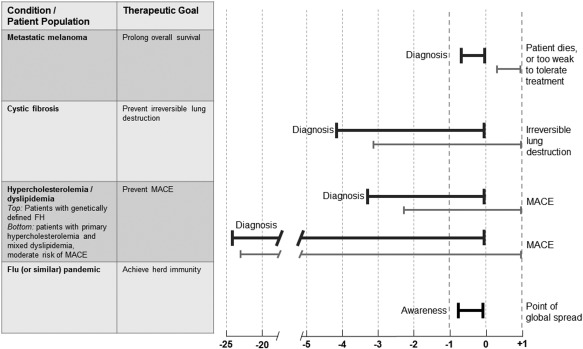
Treatment window of opportunity. The schematic illustrates why the time of access to a promising treatment is relevant to patients with any serious condition, independent of the time course of the disease. Treatment windows of opportunity are shown for a few exemplary serious conditions ranging from very short (metastatic melanoma) to extremely long disease courses (primary hypercholesterolemia and mixed dyslipidemia). Estimates of windows are symbolized by bold horizontal lines, the start‐ and endpoints are described for each condition; the lengths of the lines are for illustration purposes only, and are not based on epidemiological data. Note that the time of the endpoint of the treatment window of opportunity may not be known for many health states (e.g., hypercholesterolemia) and the window period may in reality end long before the time of the events shown in the figure (e.g., because irreversible vascular damage has occurred before the MACE occurs). Nonetheless, all patients will eventually reach the endpoint of their treatment windows of opportunity; this is illustrated by the right‐alignment of the horizontal lines. The thin lines underneath each bold line are intended to show that each year a new cohort of patients with the same condition emerges and will reach the endpoint of their window 1 year after the previous cohort. This is true for all conditions where the year‐on‐year incidences remain relatively stable and in the absence of other emerging treatment options. The dashed vertical lines illustrate that a difference in time to market access of, for example, 2 years (year –1 vs. year +1) will have the same effect on patients with metastatic melanoma as for patients with hypercholesterolemia, insofar as the two annual cohorts of patients who are at the end of their treatment window of opportunity will gain or lose an opportunity to benefit from promising treatment. It follows that the time course of a disease per se should not be a driver of the evidence vs. access debate. The obvious but rare exceptions to this rule will be conditions with highly variable incidence rates. This is illustrated by the last example, flu (or similar) pandemic, where urgency of access is primarily determined by the anticipated time to peak global spread. The two different treatment window of opportunity lines under the “hypercholesterolemia/dyslipidemia” heading are intended to show that subgroups of patients within the same broad condition may have very different windows. FH: familial hypercholesterolemia; MACE: major adverse cardiac events.
Figure 2
Figure 2
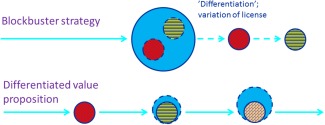
The transition from “big‐to‐small” towards “small‐to‐big” as proposed under an adaptive pathway. Under the blockbuster strategy, sponsors would initially aim to obtain a license and coverage population that is as broad as possible (symbolized by the large blue circle). Effects in identifiable patient subgroups that are nested within the broad population (symbolized by small colored circles) would be addressed subsequently, often for purposes of differentiation against incoming competitor products. By contrast, an adaptive approach would initially aim to show positive benefit–risk and added value in a defined subpopulation, followed by additional clinical trials and studies in other subpopulations. A potential beneficial effect of this staggered approach is use of more targeted extrapolation (where justified) and nontraditional (e.g., observational) studies which in turn may reduce the total number of patients required to enroll in interventional clinical trials. The total treatment‐eligible population will grow in sequential steps over time (symbolized by the light blue circles).

References

    1. Woodcock, J. Evidence vs. access: can twenty‐first‐century drug regulation refine the tradeoffs? Clin. Pharmacol. Ther. 91:378–380 (2012). - PubMed
    1. Baird, L. et al Accelerated access to innovative medicines for patients in need. Clin. Pharmacol. Ther. 96:559–571 (2014). - PubMed
    1. Commission Regulation (EC) No 507/2006. <http://ec.europa.eu/health/files/eudralex/vol‐1/reg_2006_507/reg_2006_50...>. Accessed 4 July 2014.
    1. Henshall, C. & Schuller, T. HTAi Policy Forum. Health technology assessment, value‐based decision making, and innovation. Int. J. Technol. Assess. Health Care. 29:353–359 (2013). - PubMed
    1. Tominaga, T. , Ando, Y. , Nagai, N. , Sato, J. & Kondo, T. Balancing societal needs and regulatory certainty: the case study of peramivir in Japan. Clin. Pharmacol. Ther. 93:342–344 (2013). - PubMed

MeSH terms