. 2015 Jul;40(8):1979-89.
doi: 10.1038/npp.2015.48. Epub 2015 Feb 11.

The Vasopressin 1b Receptor Antagonist A-988315 Blocks Stress Effects on the Retrieval of Object-Recognition Memory

Affiliations

The Vasopressin 1b Receptor Antagonist A-988315 Blocks Stress Effects on the Retrieval of Object-Recognition Memory

Areg Barsegyan et al. Neuropsychopharmacology. 2015 Jul.

Abstract

Stress-induced activation of the hypothalamo-pituitary-adrenocortical (HPA) axis and high circulating glucocorticoid levels are well known to impair the retrieval of memory. Vasopressin can activate the HPA axis by stimulating vasopressin 1b (V1b) receptors located on the pituitary. In the present study, we investigated the effect of A-988315, a selective and highly potent non-peptidergic V1b-receptor antagonist with good pharmacokinetic properties, in blocking stress effects on HPA-axis activity and memory retrieval. To study cognitive performance, male Sprague-Dawley rats were trained on an object-discrimination task during which they could freely explore two identical objects. Memory for the objects and their location was tested 24 h later. A-988315 (20 or 60 mg/kg) or water was administered orally 90 min before retention testing, followed 60 min later by stress of footshock exposure. A-988315 dose-dependently dampened stress-induced increases in corticosterone plasma levels, but did not significantly alter HPA-axis activity of non-stressed control rats. Most importantly, A-988315 administration prevented stress-induced impairment of memory retrieval on both the object-recognition and the object-location tasks. A-988315 did not alter the retention of non-stressed rats and did not influence the total time spent exploring the objects or experimental context in either stressed or non-stressed rats. Thus, these findings indicate that direct antagonism of V1b receptors is an effective treatment to block stress-induced activation of the HPA axis and the consequent impairment of retrieval of different aspects of recognition memory.


Figures
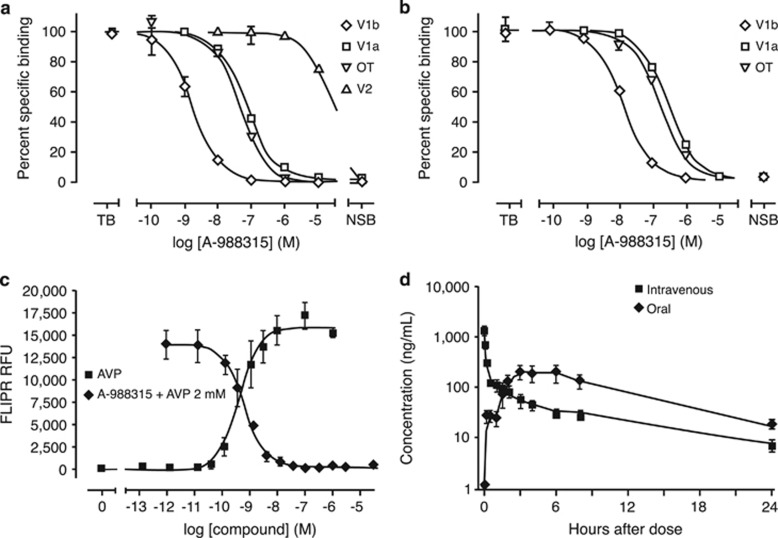
Figure 1
Figure 1
In vitro binding and functional studies, and pharmacokinetics of A-988315. Radioligand-binding displacement by A-988315 in competition-binding experiments using cell membranes expressing either recombinant human (a) V1b, V1a, V2, or oxytocin receptors or rat (b) V1b, V1a, or oxytocin receptors. a and b display displacement binding data from representative binding experiments (summarized data in Table 1). (c) Agonist-induced intracellular Ca2+ release as measured by FLIPR experiments in recombinant human V1b expressing CHO cells. Concentration-dependent V1b antagonism by A-988315 was determined in the presence of 2 nM AVP (~EC80). The concentration–response curves displayed are representative curves from three independent experiments. (d) Time-dependent plasma concentrations of A-988315 after intravenous (2 mg/kg) or oral (10 mg/kg) administration in rats.
Figure 2
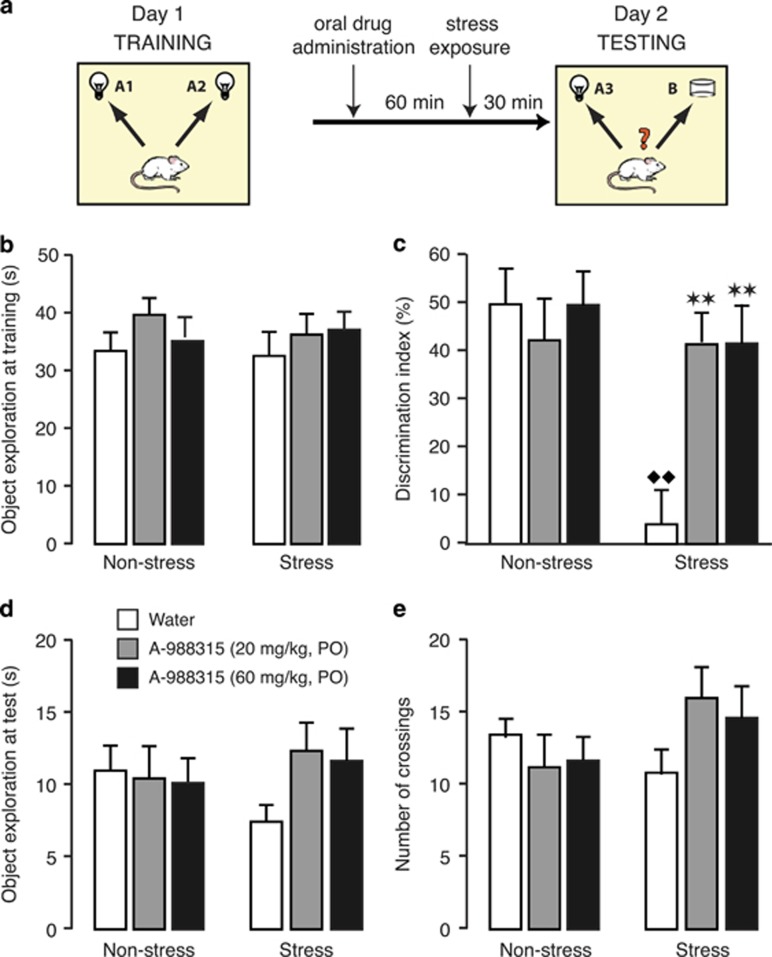
Figure 2
Effect of pretest administration of A-988315 on stress-induced impairment of retrieval of object-recognition memory. (a) Schematic illustration of training procedure, and drug and stress exposure. (b) Total time (in s) spent exploring both identical objects during the 10-min training session, before drug administration or stress exposure. (c) Discrimination index (in %) during the 3-min retention test trial. (d) Total time (in s) spent exploring both objects during the retention test trial. (e) Total number of quadrant crossings during the retention test trial as a measure of exploration of the experimental context. All data are expressed as mean+SEM. **P<0.01 compared with the corresponding water group. ♦♦P<0.01 compared with the corresponding non-stress group. Number of rats per group—non-stress groups: water, n=11; 20 mg/kg, n=11; and 60 mg/kg, n=10; and stress groups: water, n=10; 20 mg/kg, n=9; and 60 mg/kg, n=10.
Figure 3
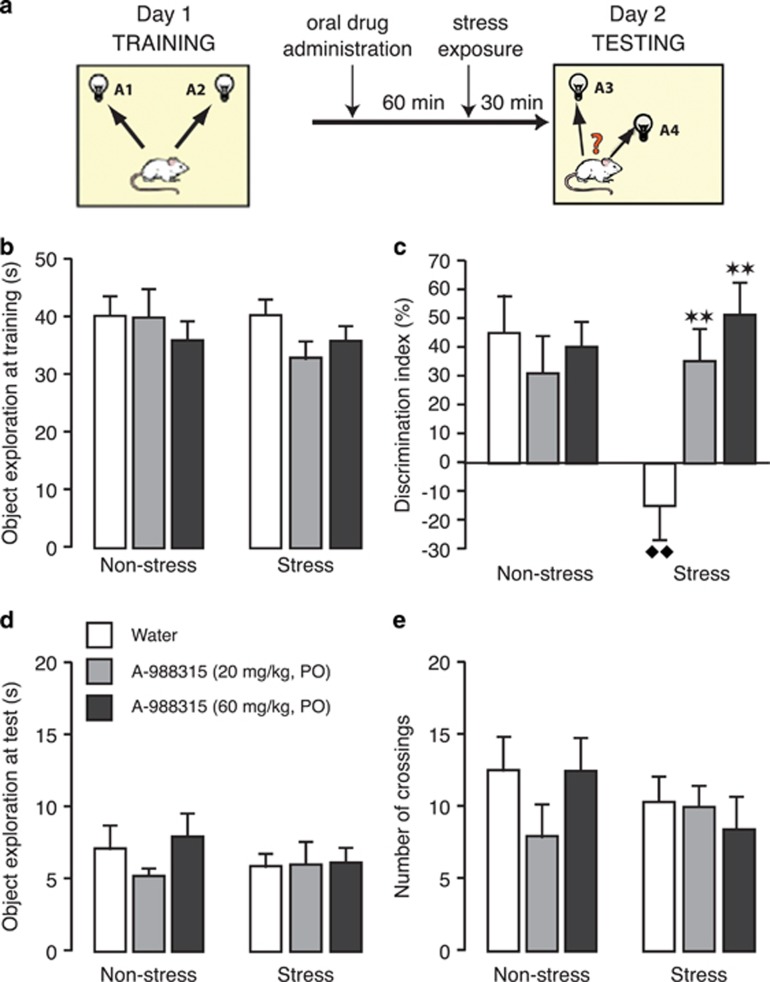
Figure 3
Effect of pretest administration of A-988315 on stress-induced impairment of retrieval of object-location memory. (a) Schematic illustration of training procedure, and drug and stress exposure. (b) Total time (in s) spent exploring both identical objects during the 10-min training session, before drug administration or stress exposure. (c) Discrimination index (in %) during the 3-min retention test trial. (d) Total time (in s) spent exploring both objects during the retention test trial. (e) Total number of quadrant crossings during the retention test trial as a measure of exploration of the experimental context. All data are expressed as mean+SEM. **P<0.01 compared with the corresponding water group. ♦♦P<0.01 compared with the corresponding non-stress group. Number of rats per group—non-stress groups: water, n=10; 20 mg/kg, n=10; and 60 mg/kg, n=11; and stress groups: water, n=11; 20 mg/kg, n=10; and 60 mg/kg, n=11.
Figure 4
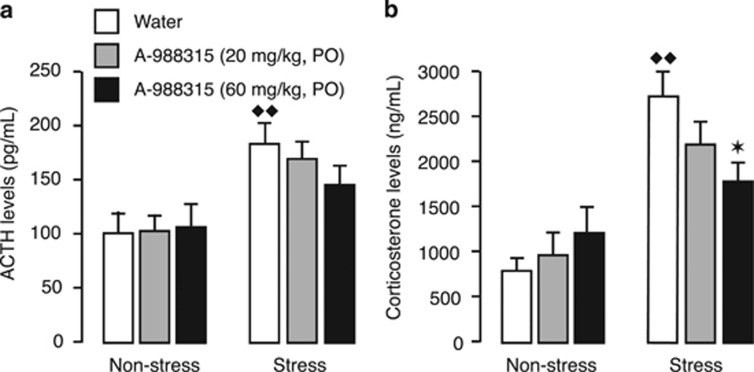
Figure 4
Effect of pretest administration of A-988315 on stress-induced increases in plasma ACTH and corticosterone levels. (a) Plasma ACTH levels (in pg/ml) as assessed immediately after the memory retrieval test. (b) Plasma corticosterone levels (in ng/ml) of rats as assessed immediately after the memory retrieval test. All data are expressed as mean+SEM. *P<0.05 compared with the corresponding water group. ♦♦P<0.01 compared with the corresponding non-stress group. Number of rats per group—non-stress groups: water, n=21; 20 mg/kg, n=21 for ACTH, n=20 for corticosterone; 60 mg/kg, n=21; and stress groups: water, n=21; 20 mg/kg, n=19; 60 mg/kg, n=21.

References

    1. Aguilera G, Rabadan-Diehl C (2000). Vasopressinergic regulation of the hypothalamic–pituitary–adrenal axis: implications for stress adaptation. Regul Pept 96: 23–29. - PubMed
    1. Atsak P, Hauer D, Campolongo P, Schelling G, McGaugh JL, Roozendaal B (2012). Glucocorticoids interact with the hippocampal endocannabinoid system in impairing retrieval of contextual fear memory. Proc Natl Acad Sci USA 109: 3504–3509. - PMC - PubMed
    1. Balderas I, Rodriguez-Ortiz CJ, Salgado-Tonda P, Chavez-Hurtado J, McGaugh JL, Bermudez-Rattoni F (2008). The consolidation of object and context recognition memory involve different regions of the temporal lobe. Learn Mem 15: 618–624. - PMC - PubMed
    1. Baran SE, Armstrong CE, Niren DC, Hanna JJ, Conrad CD (2009). Chronic stress and sex differences on the recall of fear conditioning and extinction. Neurobiol Learn Mem 91: 323–332. - PMC - PubMed
    1. Barberis C, Tribollet E (1996). Vasopressin and oxytocin receptors in the central nervous system. Crit Rev Neurobiol 10: 119–154. - PubMed

Publication types

MeSH terms