Review
. 2015 May:479-480:393-402.
doi: 10.1016/j.virol.2015.01.018. Epub 2015 Feb 7.

Polydnaviruses: From discovery to current insights

Affiliations
Review

Polydnaviruses: From discovery to current insights

Michael R Strand et al. Virology. 2015 May.

Abstract

The International Committee on Taxonomy of Viruses (ICTV) recognized the Polydnaviridae in 1991 as a virus family associated with insects called parasitoid wasps. Polydnaviruses (PDVs) have historically received limited attention but advances in recent years have elevated interest because their unusual biology sheds interesting light on the question of what viruses are and how they function. Here, we present a succinct history of the PDV literature. We begin with the findings that first led ICTV to recognize the Polydnaviridae. We then discuss what subsequent studies revealed and how these findings have shaped views of PDV evolution.

Keywords: Evolution; Genome; Insect; Mutualist; Parasitoid.


Figures

Fig. 1
Fig. 1
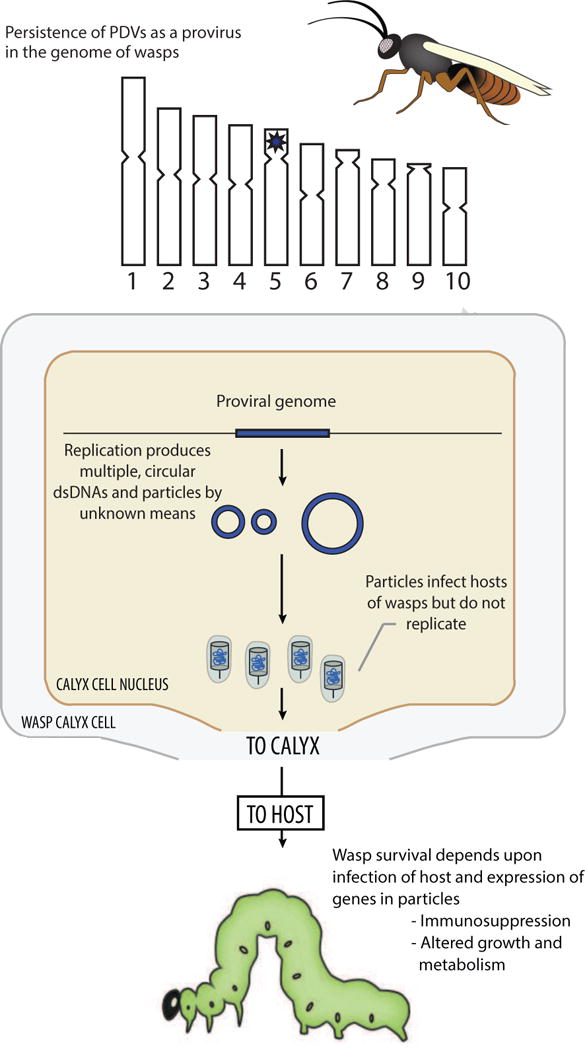
Key characteristics of PDVs in 1991 when the family Polydnaviridae was formally recognized by ICTV. The upper part of the figure shows an adult female wasp whose hypothetical genome consists of ten chromosomes. Data at this time indicated that each PDV associated with a given wasp species was genetically distinct and persisted as an integrated provirus. Based on other known dsDNA viruses with a proviral phase, PDV proviral genomes were implicitly assumed to persist as a large, linear dsDNA that was integrated in the wasp genome (*). The middle part of the figure shows the nucleus of a calyx cell. Data showed that particles packaging multiple circular dsDNAs were produced in calyx cells by unknown means followed by storage of particles in a domain referred to as the calyx. The lower part of the figure shows a larval stage lepidopteran host. Data generated prior to 1991 showed that wasps inject PDV particles into hosts, which infect different types of cells and express genes that cause physiological alterations wasp offspring depend upon for survival. Data generated prior to 1991 also showed that no replication of PDVs occurs in the hosts of wasps.
Fig. 2
Fig. 2
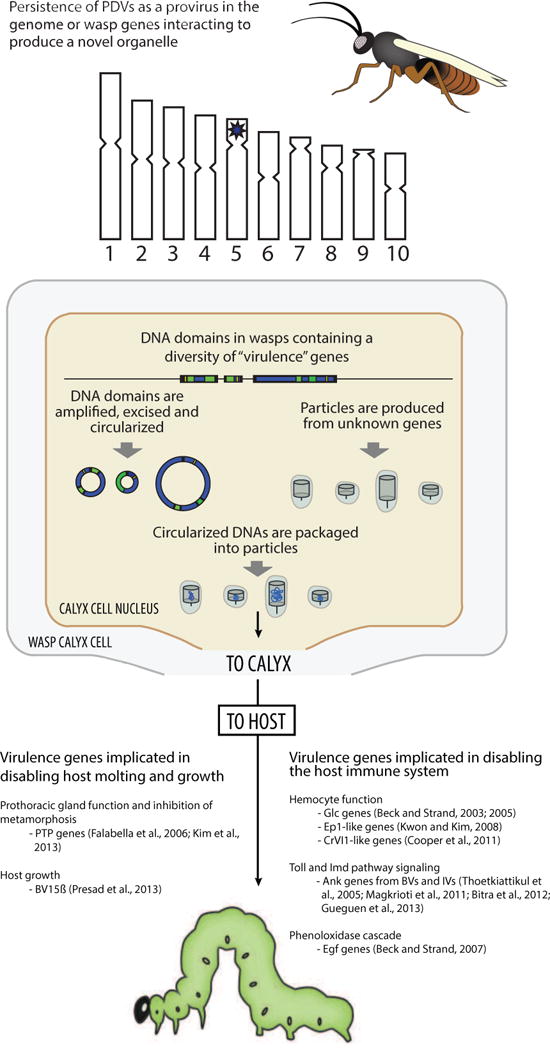
Key characteristics of PDVs as understood in the mid-2000s. Data generated during the 1990s and 2000s showed that the DNAs in BV and IV particles contained numerous virulence genes but almost no genes of recognizable viral origin. Little information was generated during this period regarding PDV proviral genomes but data did suggest the DNAs in BV particles were excised from the wasp genome and amplified in calyx cells before packaging into particles. The genes regulating these events or that were involved in particle formation remained unknown. In contrast, several studies provided insights about the identity and function of the virulence genes that are expressed in the hosts of wasps.
Fig. 3
Fig. 3
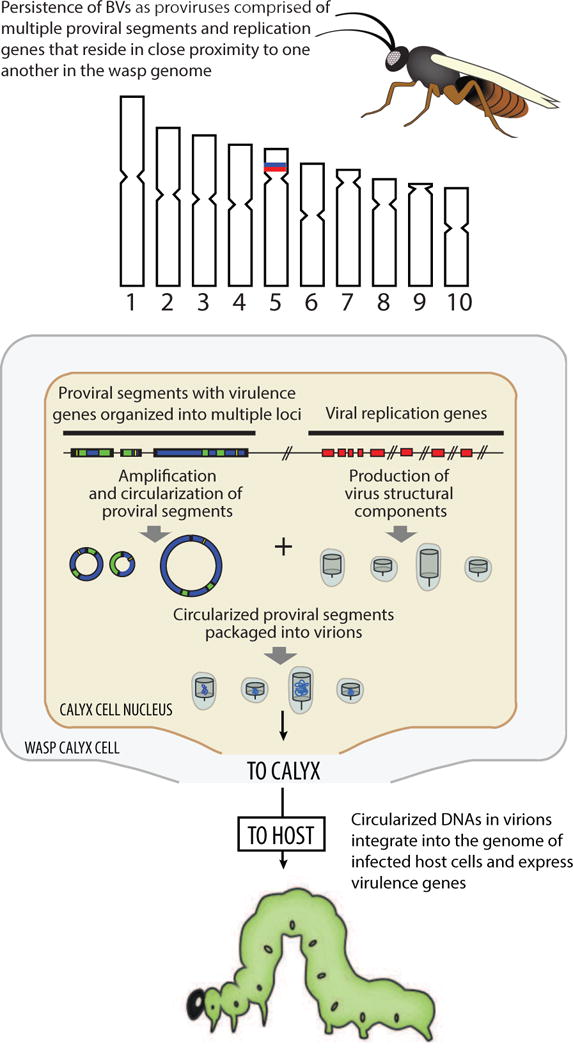
Key characteristics of BVs as understood in 2013. Sequence data established that BV proviral segment loci are organized into multiple loci, which are amplified without excision in calyx cells. Multiple nudivirus-like core genes had also been identified and shown to be required for virion formation. Proviral segment loci and nudivirus-like genes were hypothesized to reside in close physical proximity to one another in the genomes of wasps although precise locations remained unknown (hash marks). Experiments also established that circularized DNAs in BV virions integrate into the genome of infected host cells.
Fig. 4
Fig. 4
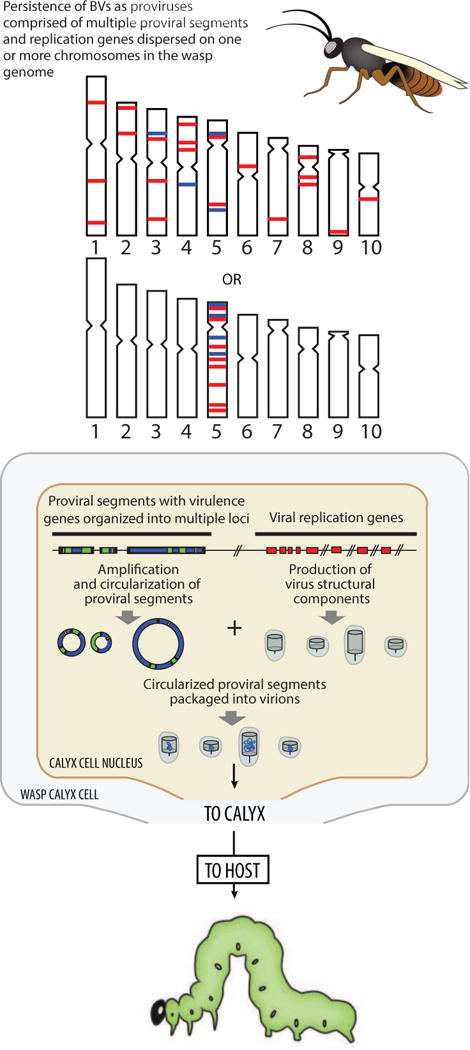
Key characteristics of BVs as understood in 2014. Whole genome sequencing of Microplitis demolitor established that proviral segment loci and nudivirus like genes are overall widely dispersed in the wasp genome on either one or multiple chromosomes.

References

    1. Albrecht U, Wyler T, Pfister-Wilhelm R, Gruber A, Stettler P, Heiniger P, Schumperli D, Lanzrein B. PDV of the parasitic wasp Chelonus inanitus (Braconidae): characterization, genome organization and time point of replication. J Gen Virol. 1994;75:3353–3363. - PubMed
    1. Annaheim M, Lanzrein B. Genome organization of the Chelonus inanitus polydnavirus: excision sites, spacers, and abundance of proviral and excised segments. J Gen Virol 2007. 2007;8:450–57. - PubMed
    1. Andersson JO. Evolutionary genomics: is Buchnera a bacterium or an organelle? Curr Biol. 2000;10:R866–R868. - PubMed
    1. Asgari S, Hellers M, Schmidt O. Host haemocyte inactivation by an insect parasitoid: transient expression of a polydnavirus gene. J Gen Virol. 1996;77:2653–2662. - PubMed
    1. Beck M, Strand MR. RNA interference silences Microplitis demolitor bracovirus genes and implicates glc1.8 in disruption of adhesion in infected host cells. Virology. 2003;314:521–535. - PubMed

Publication types

LinkOut - more resources