


Muscle inflammation susceptibility: a prognostic index of recovery potential after hip arthroplasty?
- PMID: 25670829
- PMCID: PMC4398830
- DOI: 10.1152/ajpendo.00576.2014
Muscle inflammation susceptibility: a prognostic index of recovery potential after hip arthroplasty?
Abstract
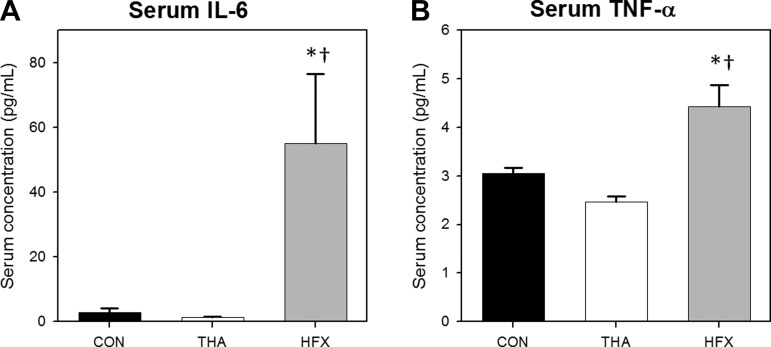
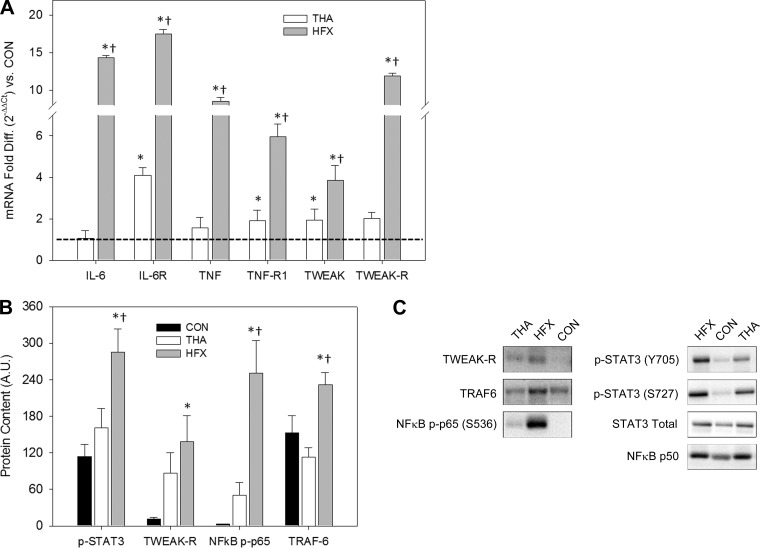
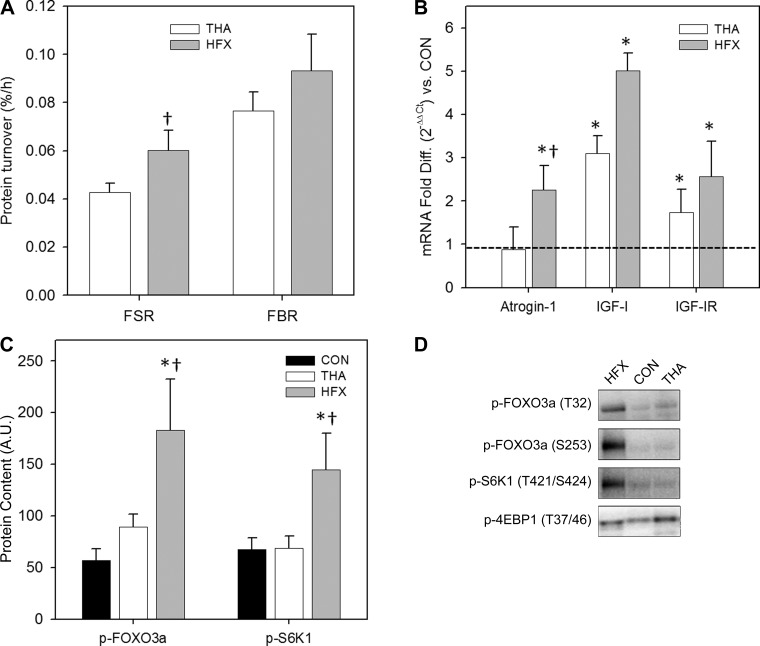
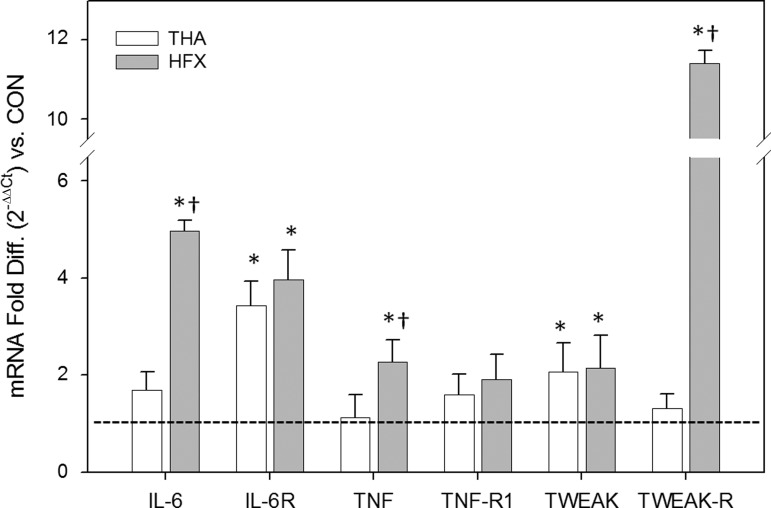
While elective total hip arthroplasty (THA) for end-stage osteoarthritis (OA) improves pain, mobility function, and quality of life in most cases, a large proportion of patients suffer persistent muscle atrophy, pain, and mobility impairment. Extensive skeletal muscle damage is unavoidable in these surgical procedures, and it stands to reason that poor recovery and long-term mobility impairment among some individuals after THA is linked to failed muscle regeneration and regrowth following surgery and that local muscle inflammation susceptibility (MuIS) is a major contributing factor. Here we present results of two integrated studies. In study 1, we compared muscle inflammation and protein metabolism signaling in elective THA (n=15) vs. hip fracture/trauma (HFX; n=11) vs. nonsurgical controls (CON; n=19). In study 2, we compared two subgroups of THA patients dichotomized into MuIS⁺ (n=7) or MuIS⁻ (n=7) based on muscle expression of TNF-like weak inducer of apoptosis (TWEAK) receptor (Fn14). As expected, HFX demonstrated overt systemic and local muscle inflammation and hypermetabolism. By contrast, no systemic inflammation was detected in elective THA patients; however, local muscle inflammation in the perioperative limb was profound in MuIS⁺ and was accompanied by suppressed muscle protein synthesis compared with MuIS⁻. Muscle from the contralateral limb of MuIS⁺ was unaffected, providing evidence of a true inflammation susceptibility localized to the muscle surrounding the hip with end-stage OA. We suggest MuIS status assessed at the time of surgery may be a useful prognostic index for muscle recovery potential and could therefore provide the basis for a personalized approach to postsurgery rehabilitation.
Keywords: inflammation; muscle atrophy; muscle protein metabolism; muscle regeneration; total hip arthroplasty.
Figures
References
-
- Bakkar N, Guttridge DC. NF-kappaB signaling: a tale of two pathways in skeletal myogenesis. Physiol Rev 90: 495–511, 2010. - PubMed
-
- Bamman MM, Ragan RC, Kim JS, Cross JM, Hill VJ, Tuggle SC, Allman RM. Myogenic protein expression before and after resistance loading in 26- and 64-yr-old men and women. J Appl Physiol 97: 1329–1337, 2004. - PubMed
-
- Cai D, Frantz JD, Tawa NE Jr, Melendez PA, Oh BC, Lidov HG, Hasselgren PO, Frontera WR, Lee J, Glass DJ, Shoelson SE. IKKbeta/NF-kappaB activation causes severe muscle wasting in mice. Cell 119: 285–298, 2004. - PubMed
-
- Chazaud B, Brigitte M, Yacoub-Youssef H, Arnold L, Gherardi R, Sonnet C, Lafuste P, Chretien F. Dual and beneficial roles of macrophages during skeletal muscle regeneration. Exerc Sport Sci Rev 37: 18–22, 2009. - PubMed
Publication types
MeSH terms
Substances
Grants and funding
LinkOut - more resources
Full Text Sources
Other Literature Sources
Medical
Research Materials
