. 2015 Feb 11;11(2):e1004972.
doi: 10.1371/journal.pgen.1004972. eCollection 2015 Feb.

Mitochondrial and cytoplasmic ROS have opposing effects on lifespan

Affiliations

Mitochondrial and cytoplasmic ROS have opposing effects on lifespan

Claire E Schaar et al. PLoS Genet. .

Abstract

Reactive oxygen species (ROS) are highly reactive, oxygen-containing molecules that can cause molecular damage within the cell. While the accumulation of ROS-mediated damage is widely believed to be one of the main causes of aging, ROS also act in signaling pathways. Recent work has demonstrated that increasing levels of superoxide, one form of ROS, through treatment with paraquat, results in increased lifespan. Interestingly, treatment with paraquat robustly increases the already long lifespan of the clk-1 mitochondrial mutant, but not other long-lived mitochondrial mutants such as isp-1 or nuo-6. To genetically dissect the subcellular compartment in which elevated ROS act to increase lifespan, we deleted individual superoxide dismutase (sod) genes in clk-1 mutants, which are sensitized to ROS. We find that only deletion of the primary mitochondrial sod gene, sod-2 results in increased lifespan in clk-1 worms. In contrast, deletion of either of the two cytoplasmic sod genes, sod-1 or sod-5, significantly decreases the lifespan of clk-1 worms. Further, we show that increasing mitochondrial superoxide levels through deletion of sod-2 or treatment with paraquat can still increase lifespan in clk-1;sod-1 double mutants, which live shorter than clk-1 worms. The fact that mitochondrial superoxide can increase lifespan in worms with a detrimental level of cytoplasmic superoxide demonstrates that ROS have a compartment specific effect on lifespan - elevated ROS in the mitochondria acts to increase lifespan, while elevated ROS in the cytoplasm decreases lifespan. This work also suggests that both ROS-dependent and ROS-independent mechanisms contribute to the longevity of clk-1 worms.


Conflict of interest statement

The authors have declared that no competing interests exist.

Figures
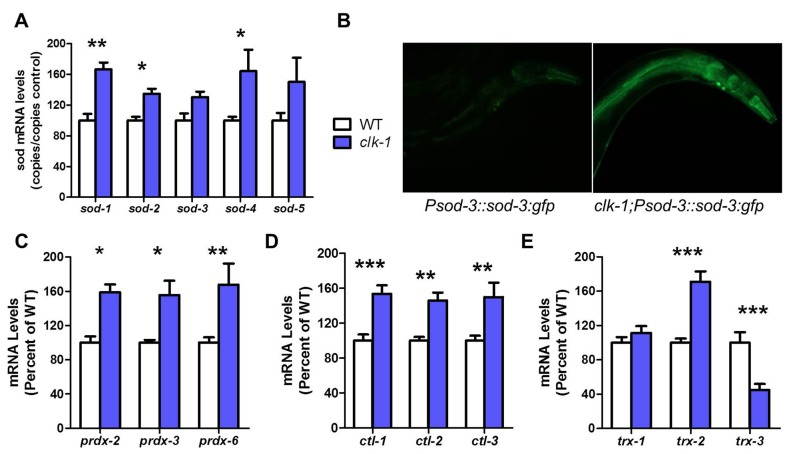
Figure 1
Figure 1. clk-1 worms have increased antioxidant defenses.
The expression of antioxidant genes was examined in day 1 adult worms by quantitative real-time RT-PCR. Compared to WT worms (white), clk-1 worms (blue) showed increased expression of four different types of antioxidant genes including: (A) superoxide dismutases (sod), (C) peroxiredoxins (prdx), (D) catalases (ctl) and (E) thioredoxins (trx). The expression of SOD-3 protein is also significantly increased in clk-1 worms as indicated by an increase in GFP intensity in clk-1 worms expressing a SOD-3:GFP transgene under the sod-3 gene promoter (B). Error bars indicate SEM. * p<0.05, ** p<0.01, *** p<0.001.
Figure 2
Figure 2. clk-1 worms are sensitive to acute exposure to oxidative stress but resistant to chronic exposure.
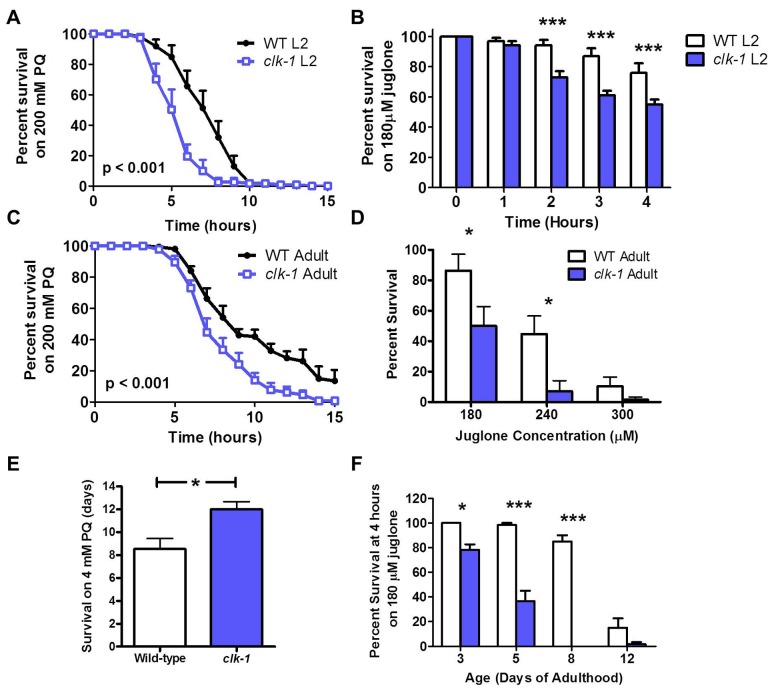
Sensitivity to oxidative stress was assessed during development and adulthood using two superoxide-generating compounds: paraquat (PQ) and juglone. Chronic assays of oxidative stress could only be performed with paraquat because the toxicity of juglone is decreased within 8 hours. During development, clk-1 L2 larvae have decreased survival compared to wild-type worms under conditions of oxidative stress: A. 200 mM paraquat or B. 180 μM juglone. Similarly, in acute assays of oxidative stress assay on day 1 of adulthood, clk-1 worms show decreased survival compared to wild-type worms after exposure to either C. 200 mM paraquat or D. different concentrations of juglone (180–300 μM), indicating increased sensitivity to oxidative stress. E. In a chronic oxidative stress assay where worms are exposed to 4 mM paraquat beginning on day 1 of adulthood after development on NGM plates, clk-1 worms survive significantly longer than wild-type worms. F. However, clk-1 worms remain sensitive to acute oxidative stress throughout adulthood when exposed to 180 μM juglone. Overall, this shows that clk-1 worms are sensitive to acute oxidative stress throughout development and adulthood but are resistant to chronic oxidative stress during adulthood. Error bars indicate SEM. * p<0.05, *** p<0.001.
Figure 3
Figure 3. Stress responsive pathways in clk-1 worms are upregulated during larval development and decline with age.
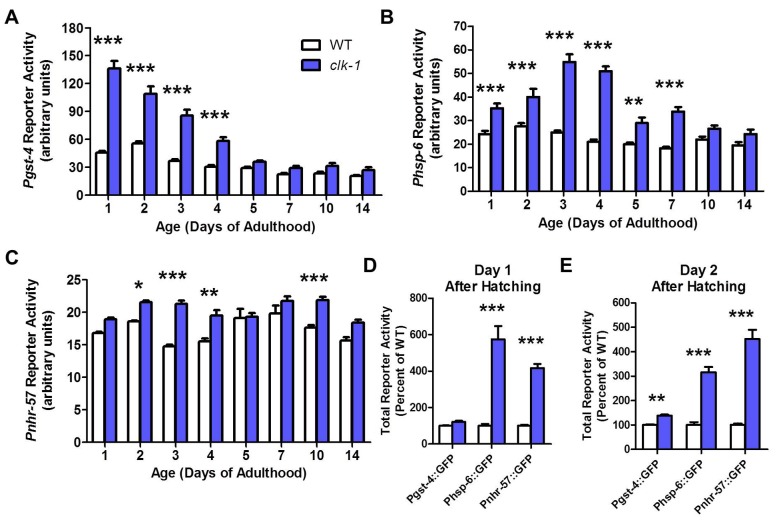
Pgst-4, Phsp-6 and Pnhr-57 reporter constructs were used to monitor the upregulation of oxidative stress response, mitochondrial unfolded protein response (mitoUPR) and hypoxia response during development and aging in clk-1 worms. All three pathways were increased on day 1 of adulthood. A. The upregulation of the oxidative stress response decreases with age. B. The increase in mitoUPR in clk-1 worms continues to increase until day 3 of adulthood and then decreases with age. C. In contrast, the mild upregulation of the hypoxia response is relatively constant with increasing age. D. On day 1 after hatching the mitoUPR and hypoxia response are already activated in clk-1 worm. E. On day 2 after hatching, all three stress response pathways are upregulated in clk-1 worms. Error bars indicate SEM. * p<0.05, ** p<0.01, *** p<0.001.
Figure 4
Figure 4. Antioxidant genes become upregulated in adult clk-1 worms.
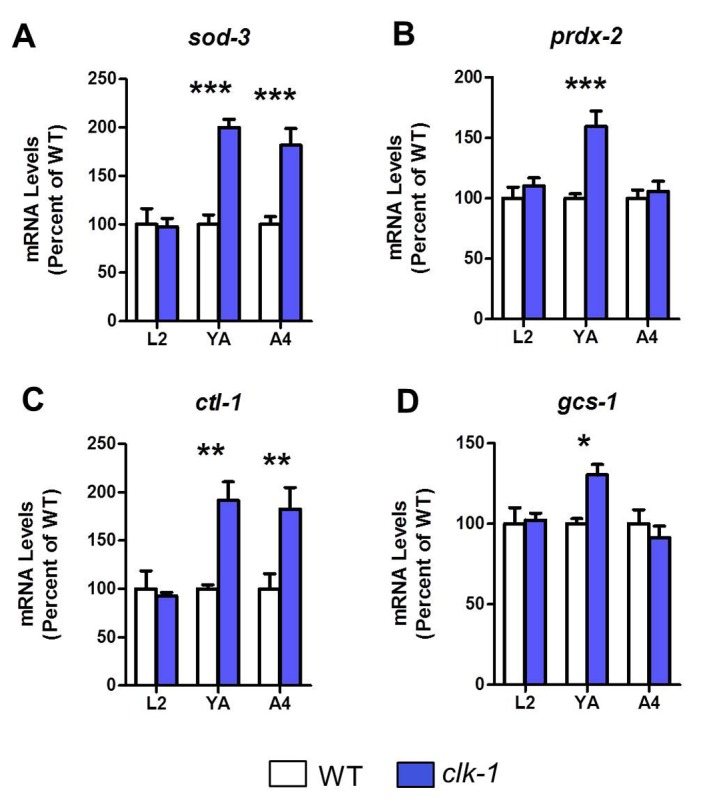
To determine whether the upregulation of antioxidant genes could explain the resistance of clk-1 worms to chronic oxidative stress during adulthood, we examined the time course of gene expression changes in clk-1 worms. We examined worms at three time point: L2 worms (L2), day 1 adult worms (YA) and day 4 adult worms (A4) by quantitative real-time RT-PCR. The antioxidant genes sod-3 (A), prdx-2 (B), ctl-1 (C) and gcs-1 (D) were not upregulated at the L2 phase, but were increased in young adult worms. Thus, there is an increase in antioxidant gene expression at the start of adulthood that corresponds to the increased resistance to chronic oxidative stress in clk-1 worms. Error bars indicate SEM. * p<0.05, ** p<0.01, *** p<0.001.
Figure 5
Figure 5. Increased superoxide has a compartment specific effect on clk-1 lifespan.
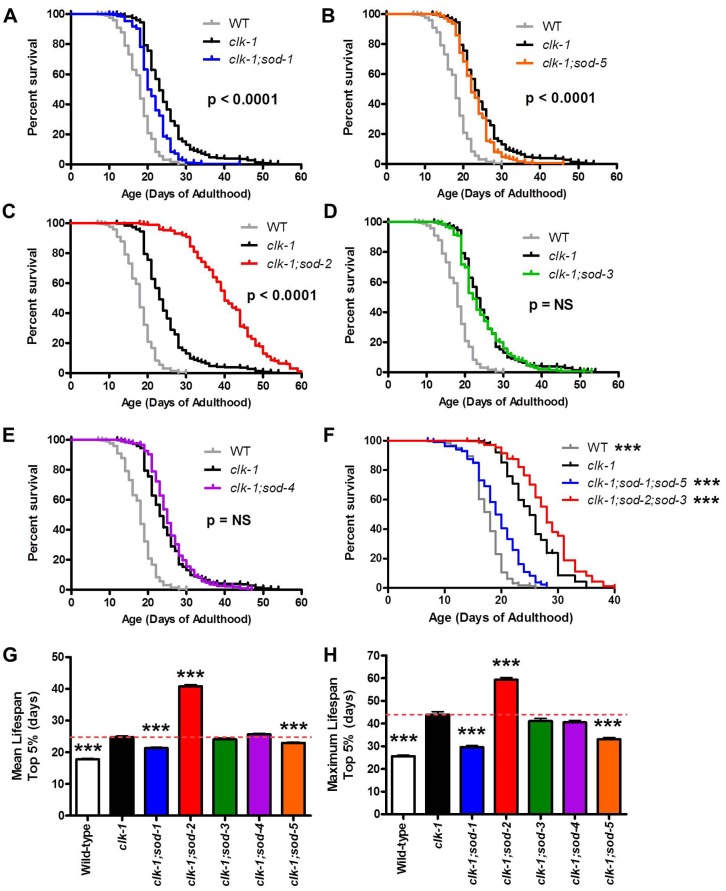
Genetic deletion of individual sod genes allows for a compartment specific increase in the levels of superoxide. A,B. Deletion of either of the cytoplasmic sod genes (sod-1, sod-5) decreases clk-1 lifespan. C. In contrast, deletion of the primary mitochondrial sod gene (sod-2) results in a marked increase in longevity. D,E. Loss of the inducible mitochondrial sod gene (sod-3) or the extracellular sod gene (sod-4) has no effect on clk-1 lifespan. F. While the loss of both cytoplasmic sod genes decreases clk-1 lifespan, clk-1;sod-2;sod-3 mutants, which have no mitochondrial matrix SOD, still live longer than clk-1 worms. G,H. Mean and maximum lifespan for clk-1 double mutants lacking individual sod genes. The p-values shown indicate differences from clk-1 worms. All clk-1 double mutants had lifespans and maximum lifespans that were significantly different from wild-type. The fact that deletion of sod-1 or sod-5 decreases clk-1 lifespan, while deletion of sod-2 increases clk-1 lifespan demonstrates that increasing mitochondrial and cytoplasmic superoxide has opposing effects on lifespan. Error bars indicate SEM. *** p < 0.001. NS = not significant.
Figure 6
Figure 6. Deletion of individual sod genes results in a compartment specific effect on sensitivity to oxidative stress in clk-1 worms.
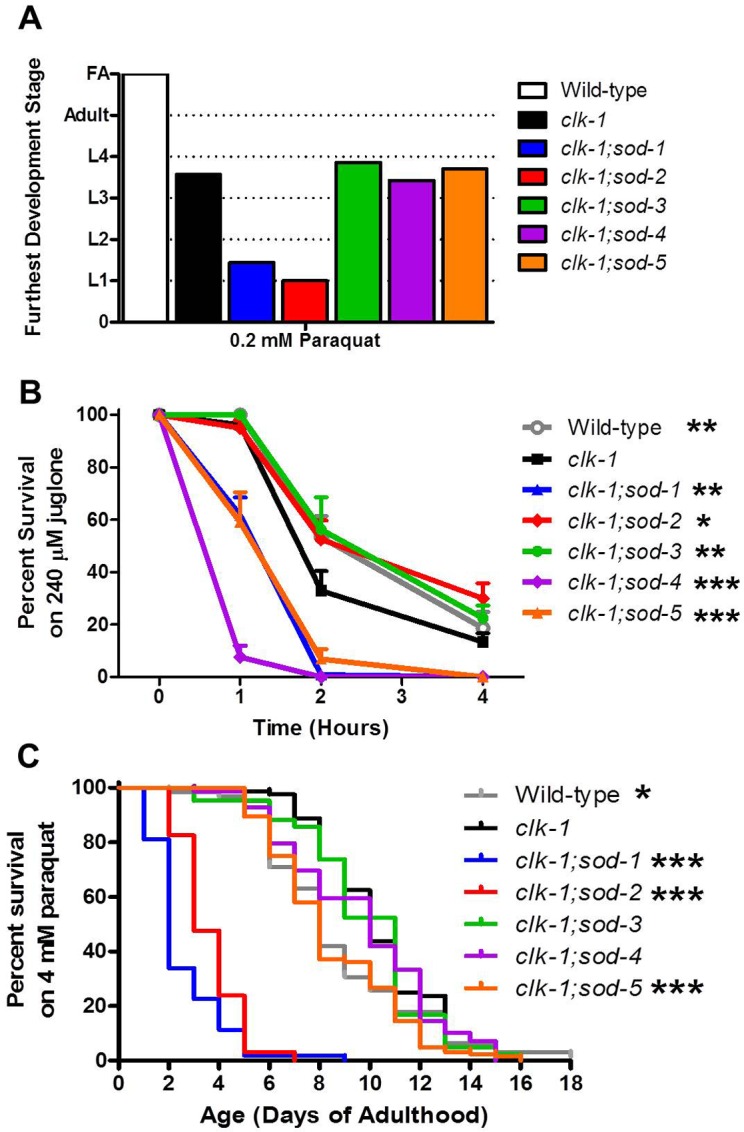
A. Deletion of sod-1 or sod-2 increases clk-1 sensitivity to oxidative stress during development. B. Deletion of sod-1, sod-4 or sod-5 increases clk-1 sensitivity to oxidative stress after acute exposure to juglone on day 1 of adulthood. In contrast, deletion of either mitochondrial sod gene, sod-2 or sod-3, reverts stress sensitivity to wild-type. C. Deletion of sod-1, sod-2 or sod-5 increases clk-1 sensitivity to oxidative stress during chronic exposure to 4 mM paraquat beginning on day 1 of adulthood. Note that deletion of sod-1 and sod-2 both increase sensitivity to paraquat in clk-1 worms despite having opposite effects on lifespan. Significance indicates difference from clk-1 worms. Error bars indicate SEM. * p<0.05, ** p<0.01, *** p<0.001. FA = fertile adult.
Figure 7
Figure 7. ROS-dependent and ROS-independent mechanisms contribute to longevity in clk-1 worms.
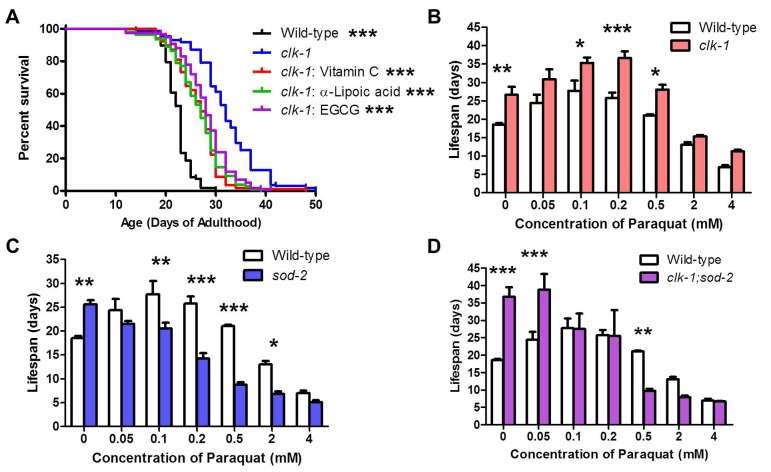
A. Treatment with three difference antioxidants (10 mM Vitamin C, 25 μM α-Lipoic acid or 25 μM epigallocatechin 3-gallate (EGCG) decreases clk-1 lifespan but does not revert it to wild-type. B. Treatment with paraquat increases clk-1 lifespan. The optimum paraquat concentration for clk-1 longevity is not decreased compared to wild-type worms. C,D. In contrast, paraquat treatment only decreases the lifespan of sod-2 worms and clk-1;sod-2 worms, both of which exhibit a decrease in their optimum paraquat concentration for longevity. Significance indicates difference from clk-1 worms. Error bars indicate SEM. *p<0.05, **p<0.01, ***p<0.001.
Figure 8
Figure 8. Mitochondrial superoxide increases the lifespan of worms with a detrimental level of cytoplasmic superoxide.
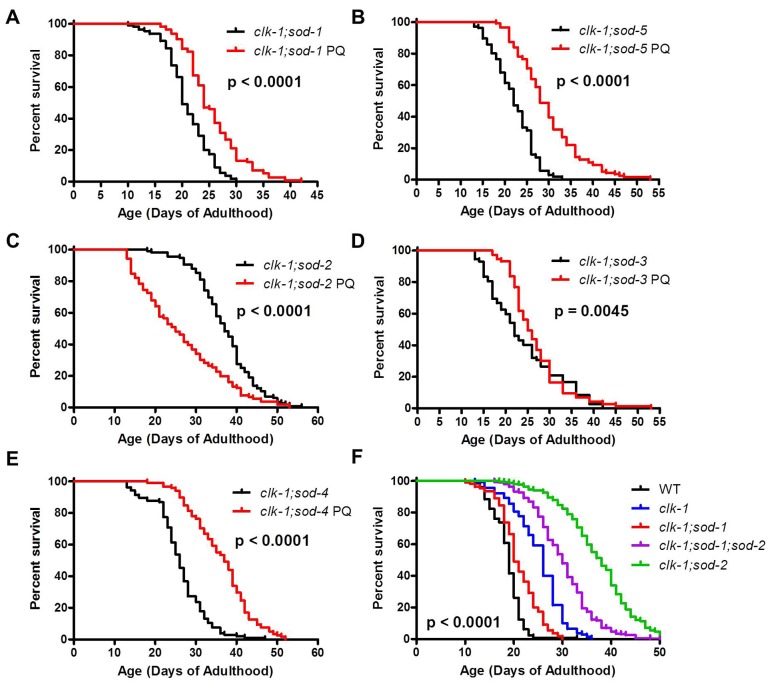
To further test the extent to which superoxide has different effects on lifespan depending on which subcellular compartment it is in, mitochondrial superoxide levels were increased through treatment with 0.1 mM paraquat. A,B. Despite the fact that clk-1;sod-1 and clk-1;sod-5 worms have decreased lifespan compared to clk-1 worms resulting from elevated cytoplasmic superoxde levels, both double mutants showed increased lifespan when treated with paraquat. C. This is in contrast to clk-1;sod-2 worms that exhibit a decrease in lifespan when mitochondrial superoxide levels are further increased. D,E. clk-1;sod-3 worms exhibited a small but significant increase in lifespan when treated with paraquat, while clk-1;sod-4 worms exhibit a robust increase. F. clk-1;sod-1;sod-2 worms show increased lifespan compared to clk-1;sod-1 worms, but decreased lifespan compared to clk-1;sod-2 worms. This indicates that increasing mitochondrial superoxide through the deletion of sod-2 can increase the lifespan of clk-1;sod-1 worms, while increasing cytoplasmic superoxide through the deletion of sod-1 can decrease the lifespan of clk-1;sod-2 worms. This indicates that mitochondrial and cytoplasmic superoxide have opposing effects on lifespan.

References

    1. Harman D (1956) Aging: a theory based on free radical and radiation chemistry. JGerontol 11: 298–300. - PubMed
    1. D'Autreaux B, Toledano MB (2007) ROS as signalling molecules: mechanisms that generate specificity in ROS homeostasis. NatRevMolCell Biol 8: 813–824. - PubMed
    1. Yang W, Hekimi S (2010) A mitochondrial superoxide signal triggers increased longevity in Caenorhabditis elegans. PLoS Biol 8: e1000556 10.1371/journal.pbio.1000556 - DOI - PMC - PubMed
    1. Van Raamsdonk JM, Hekimi S (2012) Superoxide dismutase is dispensable for normal animal lifespan. Proc Natl Acad Sci U S A 109: 5785–5790. 10.1073/pnas.1116158109 - DOI - PMC - PubMed
    1. Lee SJ, Hwang AB, Kenyon C (2010) Inhibition of respiration extends C. elegans life span via reactive oxygen species that increase HIF-1 activity. Curr Biol 20: 2131–2136. 10.1016/j.cub.2010.10.057 - DOI - PMC - PubMed

Publication types