


Ten-year trends in fiber and whole grain intakes and food sources for the United States population: National Health and Nutrition Examination Survey 2001-2010
- PMID: 25671414
- PMCID: PMC4344579
- DOI: 10.3390/nu7021119
Ten-year trends in fiber and whole grain intakes and food sources for the United States population: National Health and Nutrition Examination Survey 2001-2010
Abstract
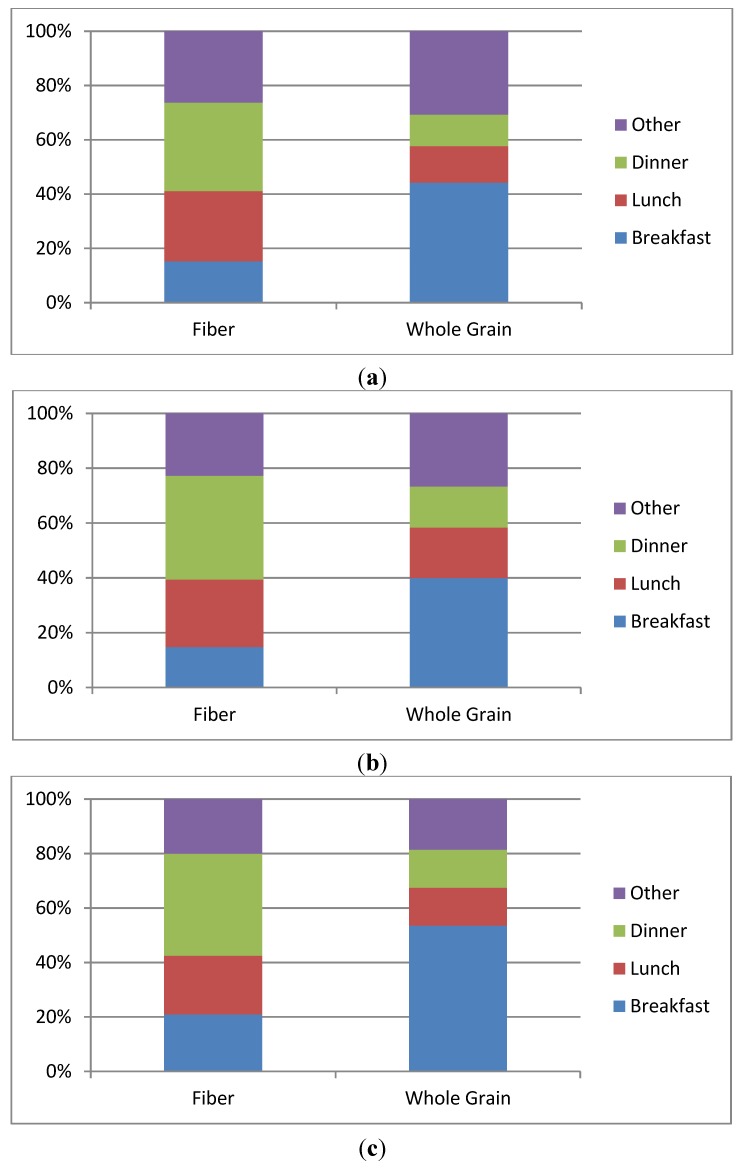
Current U.S. dietary guidance includes recommendations to increase intakes of both dietary fiber and whole grain (WG). This study examines fiber and WG intakes, food sources and trends from 2001 to 2010 based on National Health and Nutrition Examination Survey (NHANES) data for children/adolescents (n=14,973) and adults (n=24,809). Mean fiber intake for children/adolescents was 13.2 (±0.1) g/day. Mean fiber intake for adults 19-50 years (y) was 16.1 (±0.2) g/day and for adults 51+ was 16.1 (±0.2) g/day. There were significant increases in fiber intake from 2001-2010 for children/adolescents and for adults 51+y. Mean WG intake for children/adolescents was 0.52 (±0.01) oz eq/day. Mean WG intake for adults 19-50 y was 0.61 (±0.02) oz eq/day and for adults 51+0.86 (±0.02) oz eq/day. There were no significant changes in WG intake for any age group from 2001-2010. The main food groups contributing to dietary fiber intake for children/adolescents were vegetables (16.6%), grain mixtures (16.3%), other foods (15.8%) and fruits (11.3%). For adults 19+y, the main sources of dietary fiber were vegetables (22.6%), other foods (14.3%), grain mixtures (12.0%) and fruits (11.1%). Major WG sources for children/adolescents included ready-to-eat cereals (RTEC) (31%), yeast breads/rolls (21%) and crackers and salty grain snacks (21%). The main sources of WG for adults 19+ were yeast breads/rolls (27%), RTEC (23%) and pastas/cooked cereals/rice (21%). Recommending cereals, breads and grain mixtures with higher contents of both dietary fiber and WG, along with consumer education, could increase intakes among the United States (U.S.) population.
Figures
References
-
- United States Department of Agriculture. United States Department of Health and Human Services . Dietary Guidelines for Americans, 2010. 7th ed. U.S. Government Printing Office; Washington, DC, USA: 2010. [(accessed on 2 July 2014)]. Available online: http://www.cnpp.usda.gov/DGAs2010-PolicyDocument.htm.
-
- United States Department of Agriculture. Agricultural Research Service What We Eat in America: Dietary Fiber (g): Usual Intakes From Food and Water, 2003–2006, Compared to Adequate Intakes. National Health and Nutrition Examination Survey (NHANES) 2003–2006. [(accessed on 2 July 2014)]; Available online: http://ars.usda.gov/SP2UserFiles/Place/12355000/pdf/0506/usual_nutrient_....
-
- Food and Nutrition Board, Institute of Medicine . Dietary Reference Intakes for Energy, Carbohydrates, Fiber, Fat, Fatty Acids, Cholesterol, Protein, and Amino Acids. National Academies Press; Washington, DC, USA: 2005. Dietary, Functional and Total Fiber; pp. 329–421.
-
- United States Department of Agriculture. United States Department of Health and Human Services . Nutrition and Your Health: Dietary Guidelines for Americans, 2000. 5th ed. U.S. Government Printing Office; Washington, DC, USA: 2000. [(accessed on 1 July 2014)]. Available online: http://www.cnpp.usda.gov/Publications/DietaryGuidelines/2000/2000DGProfe....
Publication types
MeSH terms
LinkOut - more resources
Full Text Sources
Other Literature Sources
Medical
