


Pregnancy after treatment for cervical cancer precursor lesions in a retrospective matched cohort
- PMID: 25671561
- PMCID: PMC4324989
- DOI: 10.1371/journal.pone.0117525
Pregnancy after treatment for cervical cancer precursor lesions in a retrospective matched cohort
Abstract
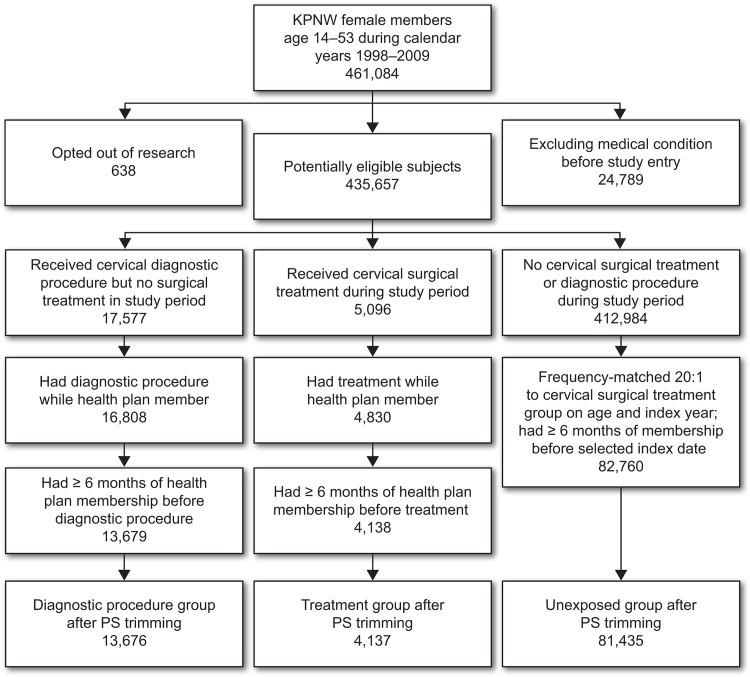
Objective: To determine whether treatments for precancerous cervical lesions were associated with lower pregnancy rates compared to rates in unexposed women and women who had a diagnostic cervical biopsy or colposcopy.
Design: Matched, retrospective cohort study.
Setting: Kaiser Permanente Northwest (KPNW), an integrated healthcare delivery system in Oregon and Washington.
Patients: Women 14 to 53 years old with KPNW enrollment during the period 1998 through 2009.
Main outcome measure: Pregnancy after exposure or index date. Pregnancy was defined using a validated algorithm and electronic medical records data.
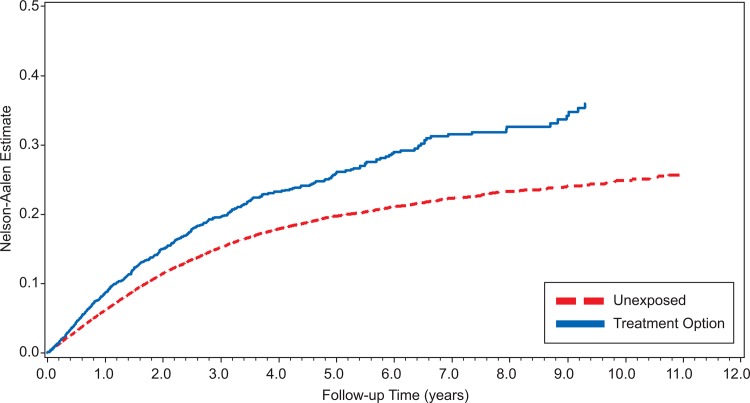
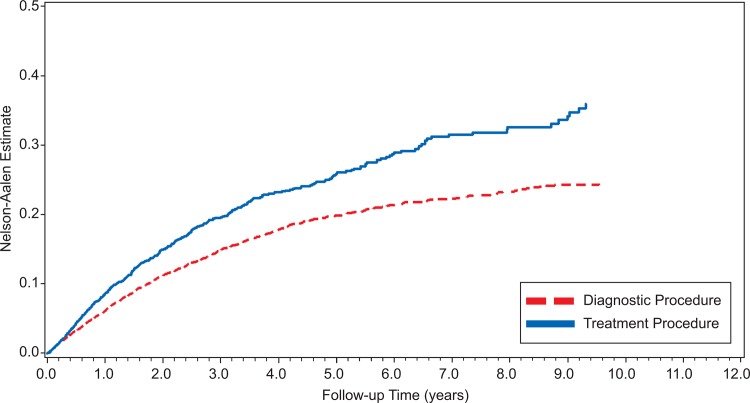
Results: We observed 570 pregnancies following cervical treatment in 4,137 women, 1,533 pregnancies following a diagnostic procedure in 13,767 women, and 7,436 pregnancies in a frequency-matched sample of 81,435 women unexposed to treatment or diagnostic procedures. After adjusting for age and contraceptive use, we observed a higher rate of pregnancies in the treatment group compared to unexposed women (hazard ratio (HR) = 1.42, 95% confidence interval (CI): 1.30-1.55), but no difference in pregnancy rates between the treatment and diagnostic procedure groups (HR = 1.03, 95% CI: 0.93-1.13).
Conclusions: No adverse effects of cervical procedures on subsequent rates of pregnancy were observed in this cohort with up to twelve years of follow-up time.
Conflict of interest statement
Figures
Comment in
-
Procedures for treating precancerous cervical cancer do not reduce fertility, study shows.BMJ. 2015 Feb 18;350:h821. doi: 10.1136/bmj.h821. BMJ. 2015. PMID: 25693963 No abstract available.
References
-
- International Agency for Research on Cancer (2005) Cervix Cancer Screening In IARC Handbook of Cancer Prevention, Volume 10 Lyon: International Agency for Research on Cancer.
-
- Soutter WP, de Barros Lopes A, Fletcher A, Monaghan JM, Duncan ID, et al. (1997) Invasive cervical cancer after conservative therapy for cervical intraepithelial neoplasia. Lancet 349:978–980. - PubMed
-
- Chew GK, Jandial L, Paraskevaidis E, Kitchener HC (1999) Pattern of CIN recurrence following laser ablation treatment: long-term follow-up. Int J Gynecol Cancer 9:487–490. - PubMed
-
- Martin-Hirsch P, Paraskevaidis E, Kitchener H (2000) Surgery for cervical intraepithelial neoplasia. Cochrane Database Syst Rev 2:CD001318 - PubMed
-
- Nuovo J, Melnikow J, Willan AR, Chan BK (2000) Treatment outcomes for squamous intraepithelial lesions. Int J Gynaecol Obstet 68:25–33. - PubMed
Publication types
MeSH terms
LinkOut - more resources
Full Text Sources
Other Literature Sources
Medical
