. 2015 Feb 11;10(2):e0117993.
doi: 10.1371/journal.pone.0117993. eCollection 2015.

Identification of genetic determinants of the sexual dimorphism in CNS autoimmunity

Affiliations

Identification of genetic determinants of the sexual dimorphism in CNS autoimmunity

Frank Bearoff et al. PLoS One. .

Abstract

Multiple sclerosis (MS) is a debilitating chronic inflammatory disease of the nervous system that affects approximately 2.3 million individuals worldwide, with higher prevalence in females, and a strong genetic component. While over 200 MS susceptibility loci have been identified in GWAS, the underlying mechanisms whereby they contribute to disease susceptibility remains ill-defined. Forward genetics approaches using conventional laboratory mouse strains are useful in identifying and functionally dissecting genes controlling disease-relevant phenotypes, but are hindered by the limited genetic diversity represented in such strains. To address this, we have combined the powerful chromosome substitution (consomic) strain approach with the genetic diversity of a wild-derived inbred mouse strain. Using experimental allergic encephalomyelitis (EAE), a mouse model of MS, we evaluated genetic control of disease course among a panel of 26 consomic strains of mice inheriting chromosomes from the wild-derived PWD strain on the C57BL/6J background, which models the genetic diversity seen in human populations. Nineteen linkages on 18 chromosomes were found to harbor loci controlling EAE. Of these 19 linkages, six were male-specific, four were female-specific, and nine were non-sex-specific, consistent with a differential genetic control of disease course between males and females. An MS-GWAS candidate-driven bioinformatic analysis using orthologous genes linked to EAE course identified sex-specific and non-sex-specific gene networks underlying disease pathogenesis. An analysis of sex hormone regulation of genes within these networks identified several key molecules, prominently including the MAP kinase family, known hormone-dependent regulators of sex differences in EAE course. Importantly, our results provide the framework by which consomic mouse strains with overall genome-wide genetic diversity, approximating that seen in humans, can be used as a rapid and powerful tool for modeling the genetic architecture of MS. Moreover, our data represent the first step towards mechanistic dissection of genetic control of sexual dimorphism in CNS autoimmunity.


Conflict of interest statement

Competing Interests: The authors have declared that no competing interests exist.

Figures

Fig 1
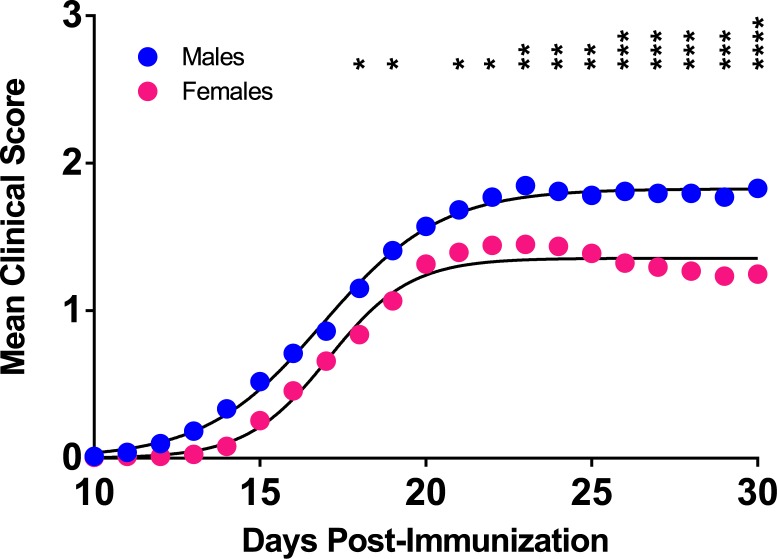
Fig 1. Clinical disease course of MOG-EAE in consomic strains is sexually dimorphic.
A composite female and male clinical disease course for all consomic strains (N≥149 per sex, N≥5 per strain) studied was generated using the mean daily clinical scores. The significance of the observed differences in disease course severity was determined by two-way ANOVA followed by Bonferroni multiple comparison test. A significant effect of sex (p<0.0001), days post-immunization (p<0.0001), and sex-by-days post-immunization interaction term (p<0.0001) were detected with * p<0.05; ** p<0.01; *** p<0.001; **** p<0.0001.
Fig 2
Fig 2. Clinical quantitative traits controlling MOG-EAE in female and male B6-Chr#PWD/PhJ strains.
(A-B) day of onset (DO), (C-D) days affected (DA), (E-F) cumulative disease score (CDS), (G-H) severity index (SI), and (I-J) peak score (PS). Females in left column (pink) and males in right column (blue). The significance of the observed differences in clinical trait variables among female and male strains was determined using the Mann-Whitney U test of each strain against the mean trait variable for all strains by sex. *, p<0.05; * p<0.01; ***, p<0.001; ****, p<0.0001.
Fig 3
Fig 3. Physical mapping of QTL controlling MOG-EAE in female and male B6-Chr#PWD/PhJ strains of mice.
Cohorts of (A) female and (B) male mice were immunized for the induction of EAE using the 2×MOG35–55+CFA protocol. The significance of the observed differences in disease course severity among the strains was determined by two-way ANOVA with post hoc multiple comparisons tests of female and male strains against the composite disease course (C) for all female and male strains respectively. The significance of observed differences in disease course, cumulative disease score (CDS), days affected (DA), severity index (SI), peak score (PS), incidence (I), and day of onset (DO) was determined using the Mann-Whitney U test of female and male strain against the corresponding quantitative trait variables for all female and male strains studied, respectively. Arrows indicate the direction of the change in disease course severity; red symbols for female-specific QTL, blue symbols for male-specific QTL, and black symbols for non-sex-specific QTL are shown.
Fig 4
Fig 4. Influence of sex hormone-dependent signaling pathways on genetic control of the EAE sexual dimorphism.
Gene lists were generated using the polymorphic MS-GWAS orthologues residing within EAE-QTL/BTL that were either male-specific, female-specific, or non-sex-specific. These lists were used to identify the top associated functional gene networks using the core analysis feature in IPA (Table 1). GWAS candidates are dark shaded. Within these networks, we identified genes that were predicted to be regulated by estrogens and/or androgens using the connect tool in IPA’s Pathway Designer. These genes included Rac, Erk, Pkc, Il-1, Akt, Pi3k, and members of the MAPK family, including p38 MAPK. These genes were pulled out from the main non-sex-specific module and displayed at the bottom of the figure to more easily observe their connections to the male- and female-specific modules.

References

    1. Noseworthy JH, Lucchinetti C, Rodriguez M, Weinshenker BG (2000) Multiple sclerosis. N Engl J Med 343: 938–952. - PubMed
    1. Whitacre CC, Reingold SC, O'Looney PA (1999) A gender gap in autoimmunity. Science 283: 1277–1278. - PubMed
    1. Gourraud PA, Harbo HF, Hauser SL, Baranzini SE (2012) The genetics of multiple sclerosis: an up-to-date review. Immunological reviews 248: 87–103. 10.1111/j.1600-065X.2012.01134.x - DOI - PMC - PubMed
    1. Schmidt H, Williamson D, Ashley-Koch A (2007) HLA-DR15 haplotype and multiple sclerosis: a HuGE review. Am J Epidemiol 165: 1097–1109. - PubMed
    1. Hauser SL, Chan JR, Oksenberg JR (2013) Multiple sclerosis: Prospects and promise. Ann Neurol 74: 317–327. 10.1002/ana.24009 - DOI - PubMed

Publication types

MeSH terms

Substances

LinkOut - more resources