Review
. 2015 Apr;42(4):579-96.
doi: 10.1007/s00259-014-2980-7. Epub 2015 Feb 12.

Biomarkers in preclinical cancer imaging

Affiliations
Review

Biomarkers in preclinical cancer imaging

Monique R Bernsen et al. Eur J Nucl Med Mol Imaging. 2015 Apr.

Abstract

In view of the trend towards personalized treatment strategies for (cancer) patients, there is an increasing need to noninvasively determine individual patient characteristics. Such information enables physicians to administer to patients accurate therapy with appropriate timing. For the noninvasive visualization of disease-related features, imaging biomarkers are expected to play a crucial role. Next to the chemical development of imaging probes, this requires preclinical studies in animal tumour models. These studies provide proof-of-concept of imaging biomarkers and help determine the pharmacokinetics and target specificity of relevant imaging probes, features that provide the fundamentals for translation to the clinic. In this review we describe biological processes derived from the "hallmarks of cancer" that may serve as imaging biomarkers for diagnostic, prognostic and treatment response monitoring that are currently being studied in the preclinical setting. A number of these biomarkers are also being used for the initial preclinical assessment of new intervention strategies. Uniquely, noninvasive imaging approaches allow longitudinal assessment of changes in biological processes, providing information on the safety, pharmacokinetic profiles and target specificity of new drugs, and on the antitumour effectiveness of therapeutic interventions. Preclinical biomarker imaging can help guide translation to optimize clinical biomarker imaging and personalize (combination) therapies.


Figures
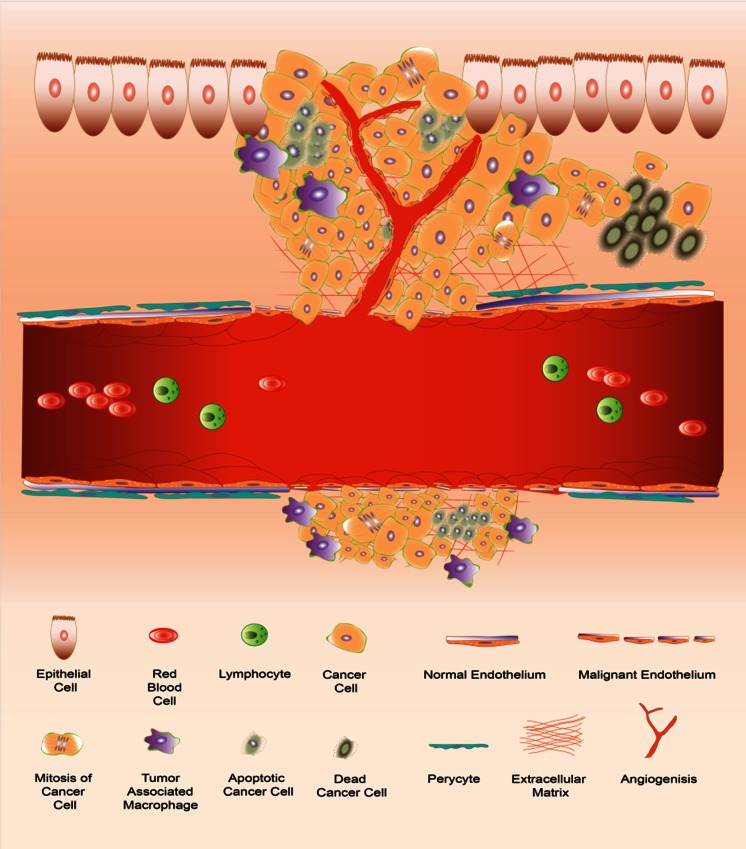
Fig. 1
Fig. 1
Hallmarks of cancer and imaging biomarkers (1 uncontrolled proliferation, 2 angiogenesis, 3 altered metabolism, 4 invasion and metastasis, 5 inflammation and immune cells, 6 cell death)
Fig. 2
Fig. 2
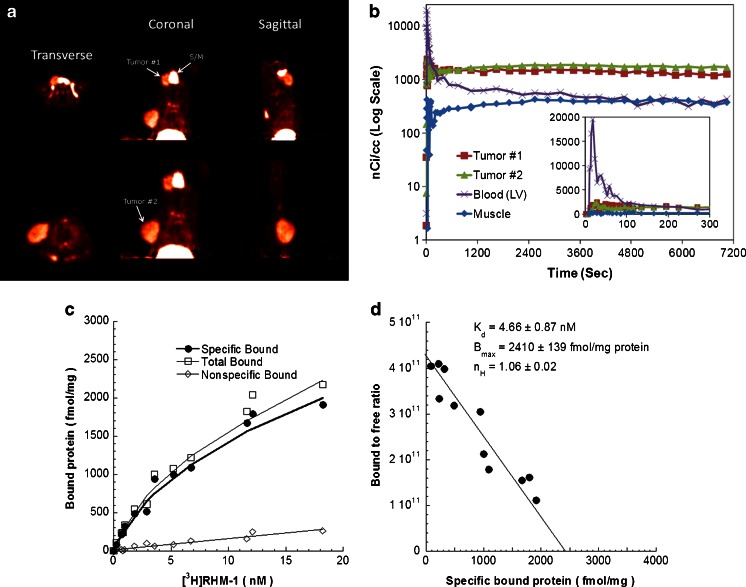
Characterization of the pharmacokinetics of [18F]ISO-1 and in vitro determination of sigma-2 receptor density in a rat model of mammary tumour induced by injection of N-methyl-N-nitrosourea. a Two-hour summed images show two tumours and the submandibular gland (S/M). The liver is evident in the coronal slices. b Time–activity curves of the two tumours, muscle and the left ventricular blood pool (inset shows the kinetics during the initial 5 min). c Representative saturation binding experiments which show the total bound, nonspecific bound and specific bound [18F]ISO-1. d Representative Scatchard plots which were used to determine the equilibrium dissociation constant (K d), the maximum number of binding sites (B max) and the Hill coefficient (n H). Reprinted from Shoghi et al. [57]
Fig. 3
Fig. 3
Ultrasound molecular imaging of tumour angiogenesis. a 3D images of a nonresponding (top) and a responding (bottom) pancreatic tumour in mice on day 0 and day 2 after aurora A kinase inhibitor treatment. The green colour represents the signal from the αvβ3-targeted microbubbles which is overlain on the black and white B-mode ultrasound image. b The group of Willmann has overcome the problem of poor expression of human cancer-specific endothelial markers in murine models by developing a mouse model that expresses human vascular biomarkers. They transfected mouse endothelial cells with the human biomarker of interest and implanted these with the tumour cells of interest. Using this method, Foygel et al. [232] expressed human thymocyte differentiation antigen 1 (Thy 1 or CD90) in pancreatic ductal adenocarcinoma. Left The Thy1-targeted microbubble (MBThy1) signal (colour-coded scale in arbitrary units) overlain on black and white B-mode ultrasound images is strong in Thy1-positive tumour, whilst there is only background signal in both types of control tumour. Centre There is also low signal from control-targeted microbubbles (MBControl; green circles tumour regions). Right Corresponding immunofluorescence micrographs (ex vivo) of merged double-stained sections (red murine CD31, green human Thy1), confirming human Thy1 expression on neovasculature in Thy1-positive tumours (yellow). Scale bars: 5 mm (left and centre), 50 μm (right). Reprinted from Tsurata et al. [233]
Fig. 4
Fig. 4
13C spectroscopic imaging showing the spatial distribution of labelled glucose and lactate in EL4 and LL2 tumour-bearing mice. a Representative 13C MR spectra acquired from subcutaneous EL4 and LL2 tumours, brain, heart, liver and kidneys 15 s after injection of 0.35 mL 100 mM hyperpolarized [U-2H, U-13C]glucose. The lactate spectra are the sum of four transients collected over 1 s, whereas a single transient was acquired for the glucose spectra. Flux of the hyperpolarized 13C label was only observed between [U-2H, U-13C]glucose (63 – 99 ppm) and lactate C1 (doublet at about 185 ppm) in EL4 and LL2 tumours. b Representative chemical shift selective images obtained about 15 s after intravenous injection of 0.4 mL 200 mM hyperpolarized [U-2H, U-13C]glucose into an EL4 tumour-bearing mouse. The spatial distribution of glucose, urea and lactate are shown as voxel intensities relative to their respective maxima. The 1H MR images, shown in grey scale, were used to define the anatomical location of the tumour (outlined in white). A urea phantom was included to serve as a reference. The colour scales represent arbitrary linearly distributed intensities for the hyperpolarized images. Reprinted from Rodrigues et al. [112]

References

    1. European Society of Radiology Medical imaging in personalised medicine: a white paper of the research committee of the European Society of Radiology (ESR) Insights Imaging. 2011;2(6):621–630. doi: 10.1007/s13244-011-0125-0. - DOI - PMC - PubMed
    1. Kessler LG, Barnhart HX, Buckler AJ, et al. The emerging science of quantitative imaging biomarkers terminology and definitions for scientific studies and regulatory submissions. Stat Methods Med Res. 2014. doi:10.1177/0962280214537333. - PubMed
    1. Society of Nuclear Medicine and Molecular Imaging. http://www.snmmi.org/Research/ClinicalTrialsNetwork.aspx?ItemNumber=6831.
    1. Radiological Society of North America. http://www.snmmi.org/Research/ClinicalTrialsNetwork.aspx?ItemNumber=6831.
    1. Biomarkers Definitions Working Group Biomarkers and surrogate endpoints: preferred definitions and conceptual framework. Clin Pharmacol Ther. 2001;69(3):89–95. doi: 10.1067/mcp.2001.113989. - DOI - PubMed