. 2015 May;145(1):98-107.
doi: 10.1093/toxsci/kfv034. Epub 2015 Feb 10.

The effects on bronchial epithelial mucociliary cultures of coarse, fine, and ultrafine particulate matter from an underground railway station

Affiliations

The effects on bronchial epithelial mucociliary cultures of coarse, fine, and ultrafine particulate matter from an underground railway station

Matthew Loxham et al. Toxicol Sci. 2015 May.

Abstract

We have previously shown that underground railway particulate matter (PM) is rich in iron and other transition metals across coarse (PM10-2.5), fine (PM2.5), and quasi-ultrafine (PM0.18) fractions and is able to generate reactive oxygen species (ROS). However, there is little knowledge of whether the metal-rich nature of such particles exerts toxic effects in mucus-covered airway epithelial cell cultures or whether there is an increased risk posed by the ultrafine fraction. Monolayer and mucociliary air-liquid interface (ALI) cultures of primary bronchial epithelial cells (PBECs) were exposed to size-fractionated underground railway PM (1.1-11.1 µg/cm(2)) and release of lactate dehydrogenase and IL-8 was assayed. ROS generation was measured, and the mechanism of generation studied using desferrioxamine (DFX) and N-acetylcysteine (NAC). Expression of heme oxygenase-1 (HO-1) was determined by RT-qPCR. Particle uptake was studied by transmission electron microscopy. Underground PM increased IL-8 release from PBECs, but this was diminished in mucus-secreting ALI cultures. Fine and ultrafine PM generated a greater level of ROS than coarse PM. ROS generation by ultrafine PM was ameliorated by DFX and NAC, suggesting an iron-dependent mechanism. Despite the presence of mucus, ALI cultures displayed increased HO-1 expression. Intracellular PM was observed within vesicles, mitochondria, and free in the cytosol. The results indicate that, although the mucous layer appears to confer some protection against underground PM, ALI PBECs nonetheless detect PM and mount an antioxidant response. The combination of increased ROS-generating ability of the metal-rich ultrafine fraction and ability of PM to penetrate the mucous layer merits further research.

Keywords: bronchial epithelium; environmental exposure; metals; particulate matter; primary cell culture; underground railway.


Figures

FIG. 1.
FIG. 1.
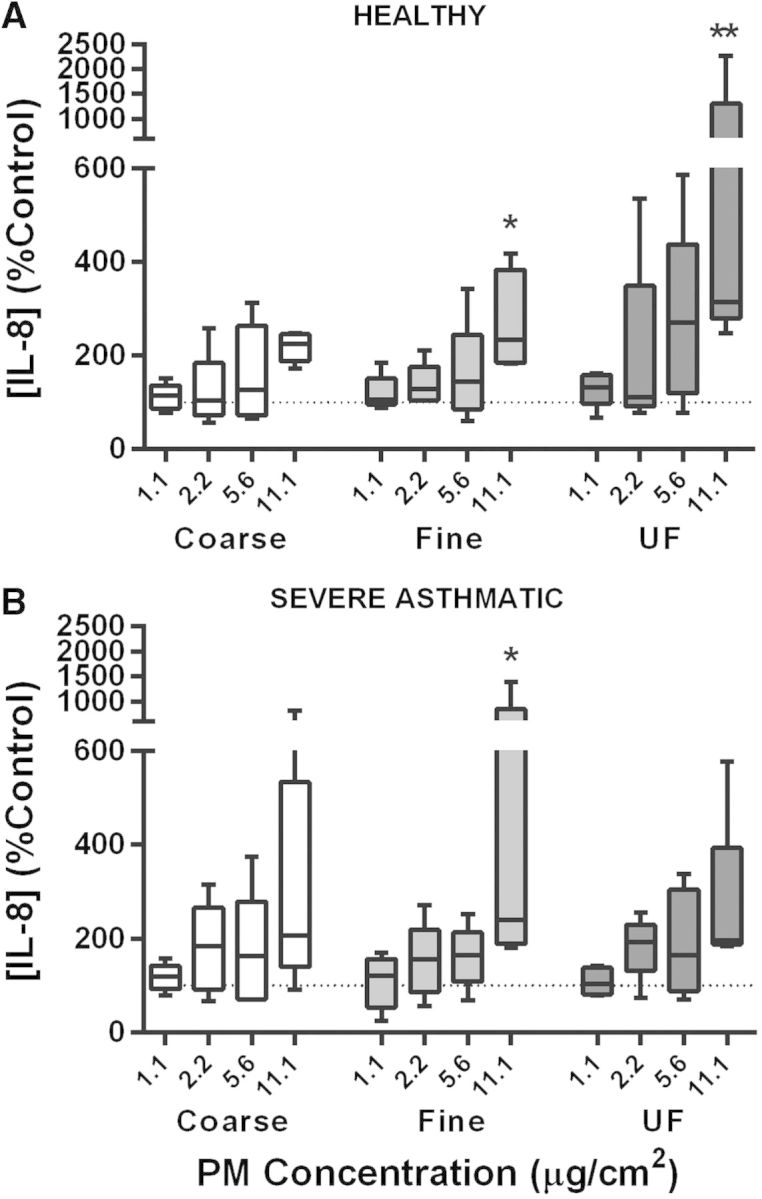
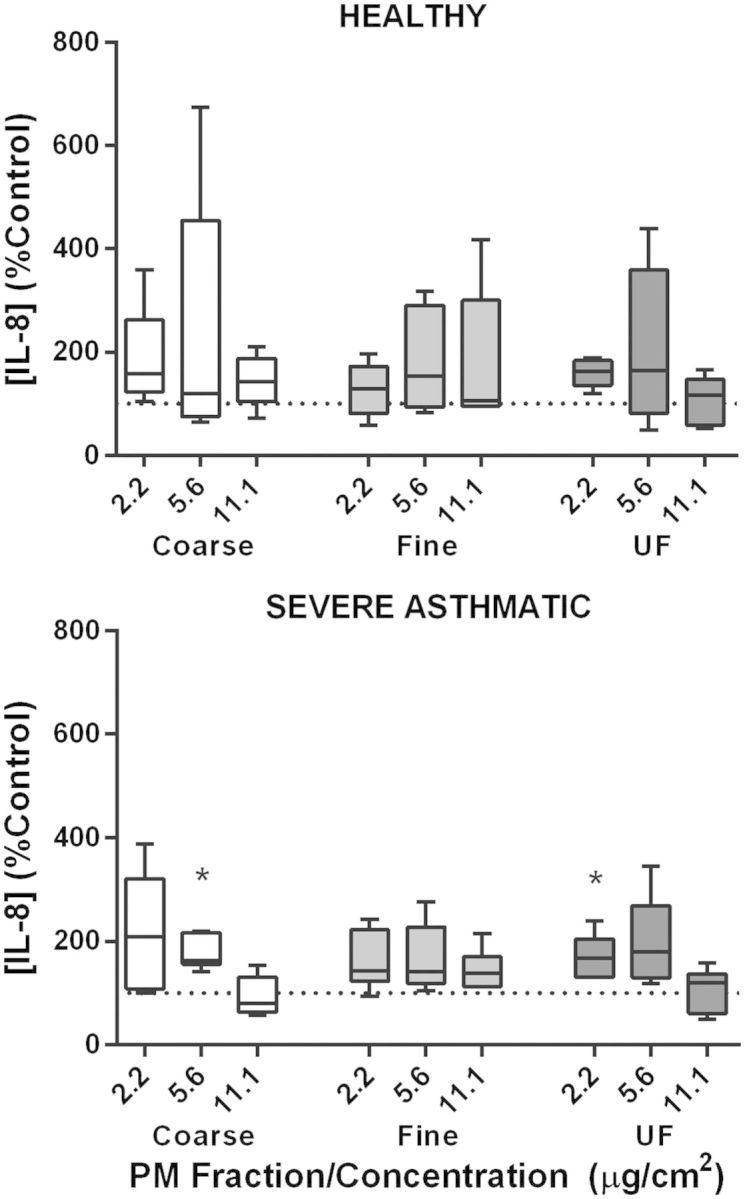
The effect of underground railway particulate matter (PM) on IL-8 release from healthy and severely asthmatic donor primary bronchial epithelial cell (PBEC) monolayers. Epithelial cell monolayers grown from cells of healthy (top) or severely asthmatic (bottom) donors were exposed to varying concentrations of coarse, fine, or ultrafine underground railway PM for 24 h. Basolateral supernatant IL-8 concentration was analyzed by ELISA, with supernatants assayed in duplicate. IL-8 release is expressed as percentage of IL-8 release from cells incubated in control medium for 24 h. Median IL-8 concentration in controls was 732 pg/ml, IQR 475–963 pg/ml (healthy), and 931 pg/ml, IQR 367–1357 pg/ml (severe asthmatic). Results presented as median with 25th and 75th percentile, whiskers represent 10th and 90th percentiles. *P < 0.05 vs. control, **P < 0.01 vs. control, n = 5 healthy donors, five severely asthmatic donors.
FIG. 2.
FIG. 2.
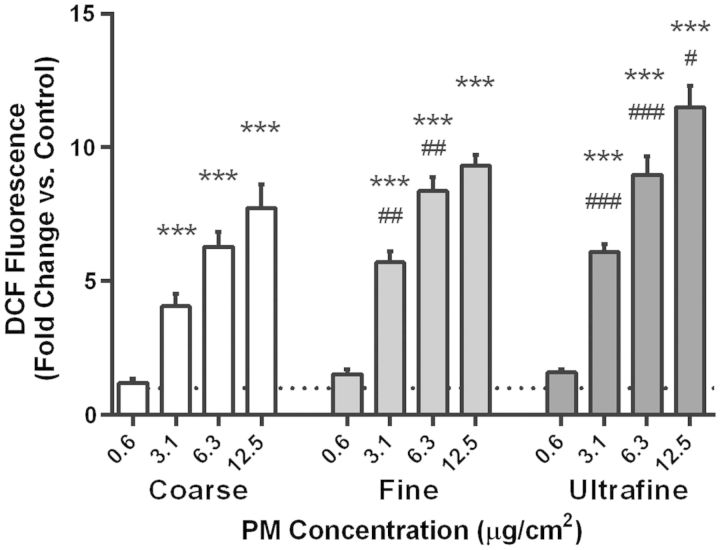
Changes in 2,7-dichlorofluorescein (DCF) fluorescence after 3 h with underground railway particulate matter (PM). Coarse, fine, or ultrafine underground railway PM was applied to primary bronchial epithelial cell (PBEC) monolayers preloaded with DCF. After 3 h, fluorescence of the well was measured (excitation 485 nm/emission 530 nm). Data were calculated as mean fluorescence intensity of PM-challenged wells divided by mean fluorescence intensity of cells exposed to PBS-supplemented culture medium, all in duplicate. Mean control DCF fluorescence was 1.7 ± 0.1 relative fluorescence units (RFU). ***P < 0.001 vs. control. #P < 0.05, ##P < 0.01, ###P < 0.001 vs. respective concentration of coarse PM, n = 3–5 healthy donors.
FIG. 3.
FIG. 3.
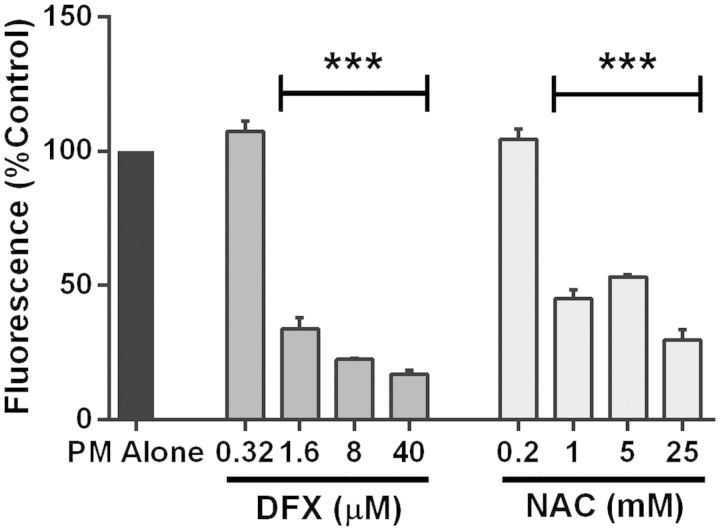
Modulation of reactive oxygen species (ROS) generation by desferrioxamine (DFX) and N-acetylcysteine (NAC). The effect of DFX and NAC on 2,7-dichlorofluorescein (DCF) fluorescence induced by ultrafine underground railway particulate matter (PM) was studied by challenging 16HBE monolayers with 3.1 µg/cm2 ultrafine PM in the presence of varying concentrations of DFX or NAC. DCF fluorescence was measured after 3 h incubation. Data were calculated as for Figure 2, followed by calculation of the percentage fluorescence in DFX/NAC-supplemented wells compared with DFX/NAC-free wells, all in duplicate. Mean ( ± SEM) fold increase in DCF fluorescence vs. control in absence of DFX and NAC was 10.2 ± 0.4. ***P < 0.001 vs. DFX/NAC-free culture, n = 3 for DFX experiments, n = 4 for NAC experiments.
FIG. 4.
FIG. 4.
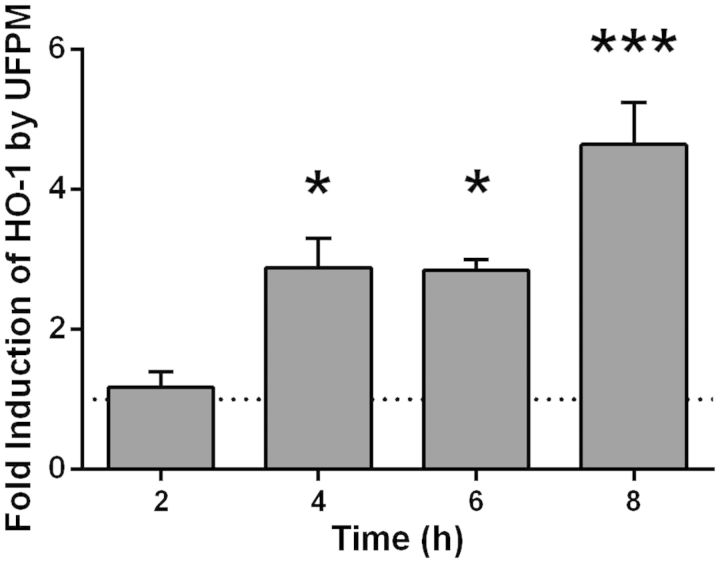
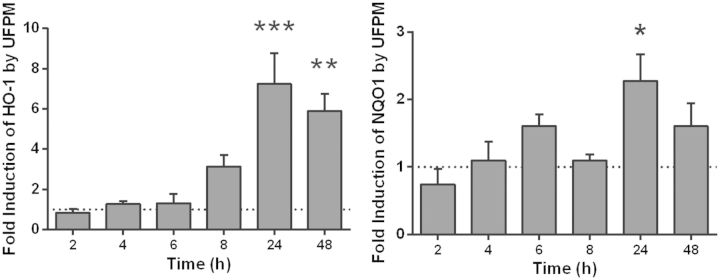
Changes in heme oxygenase-1 (HO-1) gene expression with time in primary bronchial epithelial cell (PBEC) monolayer cultures after challenge with ultrafine underground railway particulate matter (PM). Healthy donor PBEC monolayer cultures were challenged with 5.6 µg/cm2 ultrafine underground railway PM. At various time points, cells were lysed and gene expression determined by RT-qPCR. Data calculated by the ΔΔCt method, normalizing first to housekeeping gene (ubiquitin C [UBC]/glyceraldehyde 3-phosphate dehydrogenase [GAPDH]) expression for ΔCt, and then to expression of control (PM-free) wells for each timepoint for ΔΔCt. *P < 0.05, ***P < 0.001 vs. UF PM-free control at respective timepoint, n = 3 healthy donors.
FIG. 5.
FIG. 5.
The effect of underground railway particulate matter (PM) on IL-8 release from healthy and severely asthmatic donor differentiated primary bronchial epithelial cell (PBEC) cultures at air-liquid interface (ALI). ALI cultures of PBECs from cells of healthy (top) or severely asthmatic (bottom) donors were exposed to varying concentrations of coarse, fine, or ultrafine underground railway PM for 24 h. Basolateral supernatant IL-8 concentration was analyzed by ELISA, with supernatants assayed in duplicate. IL-8 release is expressed as percentage of IL-8 release from cells incubated in control medium for 24 h. Median IL-8 concentration in controls was 7791 pg/ml, IQR 3051–13713 pg/ml (healthy) and 2866 pg/ml, IQR 1312–4419 pg/ml (severe asthmatic). Results presented as median with 25th and 75th percentile, whiskers represent 10th and 90th percentiles. *P < 0.05 vs. control, n = 5 healthy donors, 6 severely asthmatic donors.
FIG. 6.
FIG. 6.
Changes in antioxidant gene expression with time in air-liquid interface (ALI) cultures after challenge with ultrafine underground railway particulate matter (PM). Healthy donor primary bronchial epithelial cell (PBEC) ALI cultures were challenged with 5.6 µg/cm2 ultrafine underground railway PM. At various time points, cells were lysed and gene expression determined by RT-qPCR. Data calculated by the ΔΔCt method, normalizing first to housekeeping gene (ubiquitin C [UBC]/glyceraldehyde 3-phosphate dehydrogenase [GAPDH]) expression for ΔCt, and then to expression of control (PM-free) wells for each timepoint for ΔΔCt. Data presented as mean ± SEM. *P < 0.05, **P < 0.01, ***P < 0.001 vs. UF PM-free control at respective timepoint, n = 3 healthy donors.
FIG. 7.
FIG. 7.
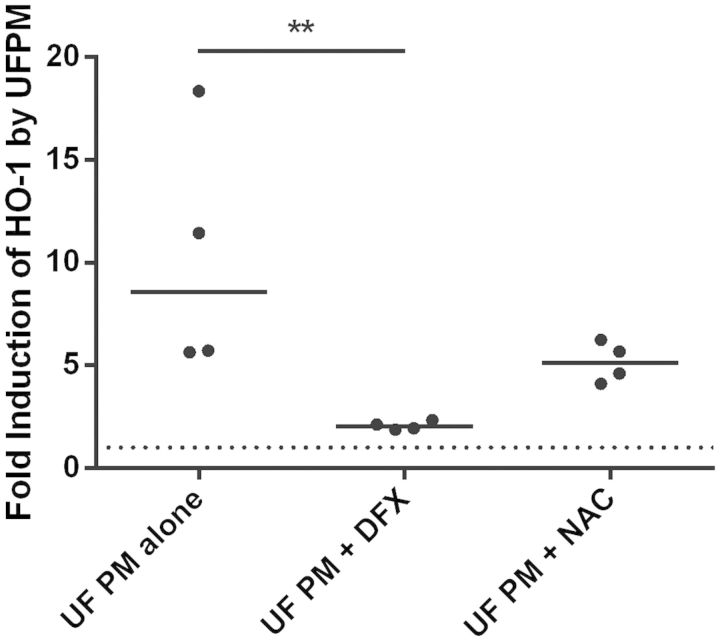
The effect of an iron chelator (DFX) and a free radical scavenger (N-acetylcysteine [NAC]) on heme oxygenase-1 (HO-1) induction by ultrafine underground particulate matter (PM). Healthy donor air-liquid interface (ALI) cultures were incubated for 24 h with 5.6 µg/cm2 ultrafine underground PM, after which time RNA was harvested. HO-1 expression was determined by RT-qPCR in duplicate and normalized to PM-free incubations (with DFX, NAC, or neither) by the ΔΔCt method. Individual data points are shown, line represents median value. **P < 0.01, n = 4 healthy donors.
FIG. 8.
FIG. 8.
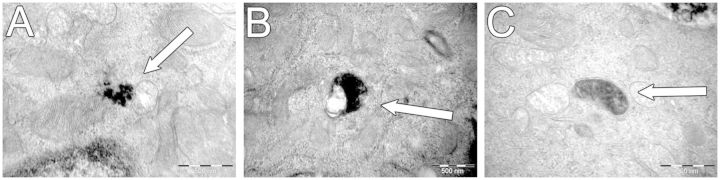
Intracellular localization of underground railway particulate matter (PM) in primary bronchial epithelial cell (PBEC) air-liquid interface (ALI) cultures after 24 h incubation. Healthy donor ALI cultures were incubated with coarse, fine, or ultrafine underground railway PM for 24 h, after which time they were washed, fixed, and embedded for transmission electron microscopy. At least eight ultrafine sections were viewed for each of two areas per culture, with areas at least 100 µm apart. No obvious differences were noted in quantity or localization of between PM size fractions. PM is shown free in the cytosol in proximity to a mitochondrion (A, treated with 3 µg/cm2 coarse PM), within a membrane-bound vesicle (B, treated with 12 µg/cm2 ultrafine PM), and apparently within a mitochondrion (C, treated with 3 µg/cm2 coarse PM). No PM was observed within cell nuclei. Scale bar represents 500 nm.

References

    1. Bachoual R., Boczkowski J., Goven D., Amara N., Tabet L., On D., Lecon-Malas V., Aubier M., Lanone S. (2007). Biological effects of particles from the Paris subway system. Chem. Res. Toxicol. 20, 1426–1433. - PubMed
    1. Baulig A., Garlatti M., Bonvallot V., Marchand A., Barouki R., Marano F., Baeza-Squiban A. (2003). Involvement of reactive oxygen species in the metabolic pathways triggered by diesel exhaust particles in human airway epithelial cells. Am. J. Physiol. Lung Cell Mol. Physiol. 285, L671–L679. - PubMed
    1. Belade E., Armand L., Martinon L., Kheuang L., Fleury-Feith J., Baeza-Squiban A., Lanone S., Billon-Galland M. A., Pairon J. C., Boczkowski J. (2012). A comparative transmission electron microscopy study of titanium dioxide and carbon black nanoparticles uptake in human lung epithelial and fibroblast cell lines. Toxicol. in vitro 26, 57-66. - PubMed
    1. Bigert C., Alderling M., Svartengren M., Plato N., de Faire U., Gustavsson P. (2008). Blood markers of inflammation and coagulation and exposure to airborne particles in employees in the Stockholm underground. Occup. Environ. Med. 65, 655-658. - PubMed
    1. Bigert C., Alderling M., Svartengren M., Plato N., Gustavsson P. (2011). No short-term respiratory effects among particle-exposed employees in the Stockholm subway. Scand. J. Work. Environ. Health 37, 129-135. - PubMed

Publication types

Substances