


Mercury Reduces the Enzymatic Activity of Neprilysin in Differentiated SH-SY5Y Cells
- PMID: 25673500
- PMCID: PMC4833038
- DOI: 10.1093/toxsci/kfv037
Mercury Reduces the Enzymatic Activity of Neprilysin in Differentiated SH-SY5Y Cells
Abstract
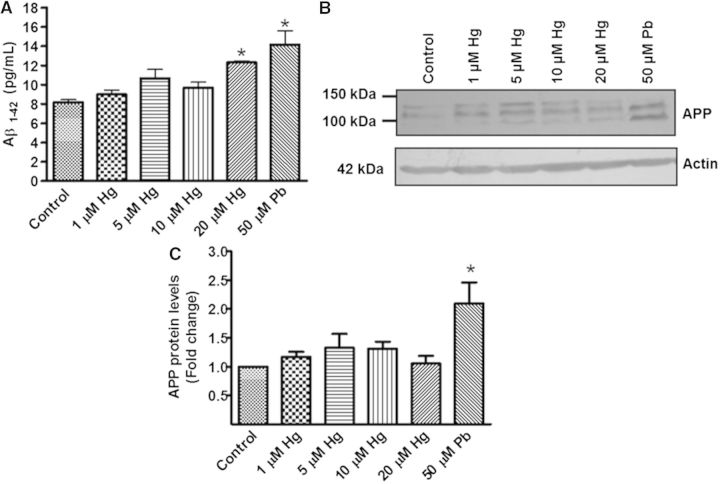
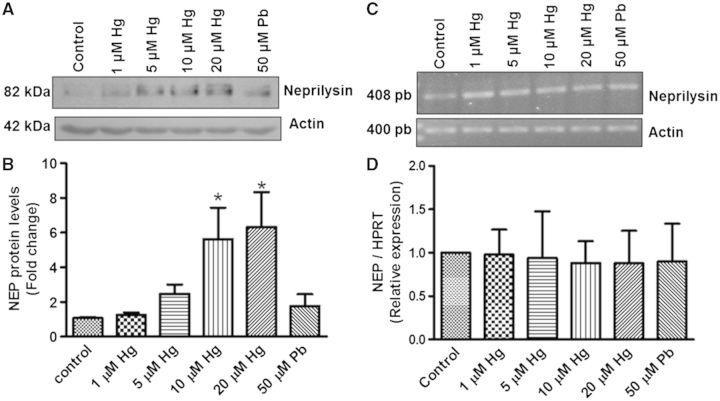
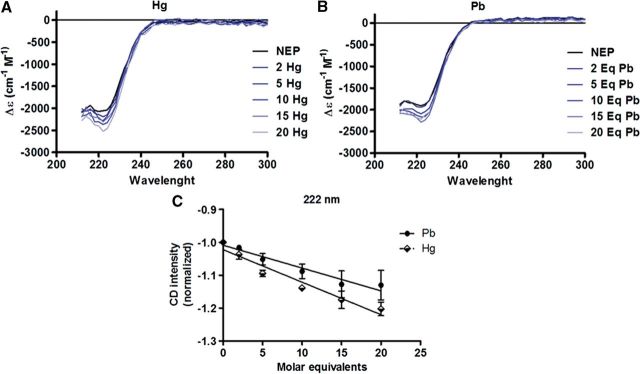
Levels of amyloid beta (Aβ) in the central nervous system are regulated by the balance between its synthesis and degradation. Neprilysin (NEP) is associated with Alzheimer's disease (AD) by its ability to degrade Aβ. Some studies have involved the exposure to mercury (Hg) in AD pathogenesis; therefore, our aim was to investigate the effects on the anabolism and catabolism of Aβ in differentiated SH-SY5Y cells incubated with 1-20 μM of Hg. Exposure to 20 µM of Hg induced an increase in Aβ-42 secretion, but did not increase the expression of the amyloid precursor protein (APP). Hg incubation (10 and 20 µM) increased NEP protein levels; however, it did not change NEP mRNA levels nor the levels of the amyloid intracellular domain peptide, a protein fragment with transcriptional activity. Interestingly, Hg reduced NEP activity at 10 and 20 µM, and circular dichroism analysis using human recombinant NEP showed conformational changes after incubation with molar equivalents of Hg. This suggests that the Hg-induced inhibition of NEP activity may be mediated by a conformational change resulting in reduced Aβ-42 degradation. Finally, the comparative effects of lead (Pb, 50 μM) were evaluated. We found a significant increase in Aβ-42 levels and a dramatic increase in APP protein levels; however, no alteration in NEP levels was observed nor in the enzymatic activity of this metalloprotease, despite the fact that Pb slightly modified the rhNEP conformation. Overall, our data suggest that Hg and Pb increase Aβ levels by different mechanisms.
Keywords: Alzheimer’s disease; amyloid precursor protein; beta-amyloid peptide; lead; mercury; neprilysin; retinoic acid.
© The Author 2015. Published by Oxford University Press on behalf of the Society of Toxicology. All rights reserved. For Permissions, please e-mail: journals.permissions@oup.com.
Figures
References
-
- Alattia J. R., Kuraishi T., Dimitrov M., Chang I., Lemaitre B., Fraering P. C. (2011). Mercury is a direct and potent gamma-secretase inhibitor affecting Notch processing and development in Drosophila. FASEB J. 25, 2287–2295. - PubMed
-
- Arima J., Uesugi Y., Hatanaka T. (2009). Bacillus d-stereospecific metallo-amidohydrolase: active-site metal-ion substitution changes substrate specificity. Biochimie 91, 568–576. - PubMed
-
- Armstrong R. A. (1994). Differences in beta-amyloid (beta/A4) deposition in human patients with Down's syndrome and sporadic Alzheimer's disease. Neurosci. Lett. 169, 133–136. - PubMed
-
- Atwood C. S., Moir R. D., Huang X., Scarpa R. C., Bacarra N. M., Romano D. M., Hartshorn M. A., Tanzi R. E., Bush A. I. (1998). Dramatic aggregation of Alzheimer abeta by Cu(II) is induced by conditions representing physiological acidosis. J. Biol. Chem. 273, 12817–12826. - PubMed
-
- Beckman M., Iverfeldt K. (1997). Increased gene expression of beta-amyloid precursor protein and its homologues APLP1 and APLP2 in human neuroblastoma cells in response to retinoic acid. Neurosci. Lett. 221, 73–76. - PubMed
Publication types
MeSH terms
Substances
LinkOut - more resources
Full Text Sources
Other Literature Sources
Medical
