


13C-MR Spectroscopic Imaging with Hyperpolarized [1-13C]pyruvate Detects Early Response to Radiotherapy in SCC Tumors and HT-29 Tumors
- PMID: 25673698
- PMCID: PMC8363083
- DOI: 10.1158/1078-0432.CCR-14-1717
13C-MR Spectroscopic Imaging with Hyperpolarized [1-13C]pyruvate Detects Early Response to Radiotherapy in SCC Tumors and HT-29 Tumors
Abstract
Purpose: X-ray irradiation of tumors causes diverse effects on the tumor microenvironment, including metabolism. Recent developments of hyperpolarized (13)C-MRI enabled detecting metabolic changes in tumors using a tracer [1-(13)C]pyruvate, which participates in important bioenergetic processes that are altered in cancers. Here, we investigated the effects of X-ray irradiation on pyruvate metabolism in squamous cell carcinoma (SCCVII) and colon cancer (HT-29) using hyperpolarized (13)C-MRI.
Experimental design: SCCVII and HT-29 tumors were grown by injecting tumor cells into the hind legs of mice. [1-(13)C]pyruvate was hyperpolarized and injected intravenously into tumor-bearing mice, and (13)C-MR signals were acquired using a 4.7 T scanner.
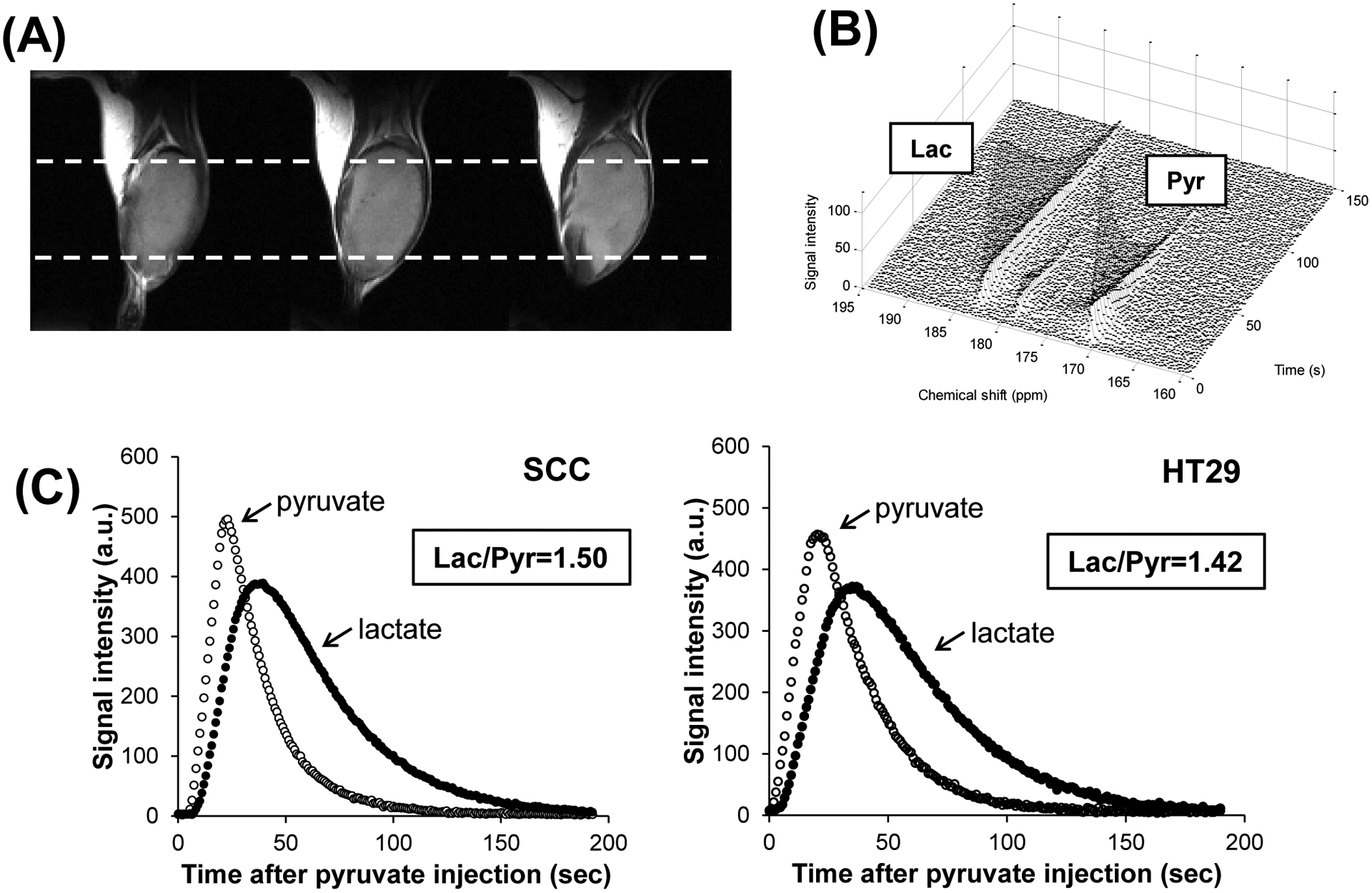
Results: [1-(13)C]pyruvate and [1-(13)C]lactate were detected in the tumor-bearing legs immediately after hyperpolarized [1-(13)C]pyruvate administration. The [1-(13)C]lactate to [1-(13)C]pyruvate ratio (Lac/Pyr) increased as the tumors grew in nonirradiated SCCVII tumors. The increase in Lac/Pyr was suppressed modestly with a single 10 Gy of irradiation, but it significantly decreased by further irradiation (10 Gy × 3). Similar results were obtained in HT-29; Lac/Pyr significantly dropped with fractionated 30 Gy irradiation. Independent ex vivo measurements revealed that the lactate dehydrogenase (LDH) activity and protein level were significantly smaller in the irradiated SCCVII tumors compared with the nonirradiated tumors, indicating that a decrease in LDH activity was one of the main factors responsible for the decrease of Lac/Pyr observed on (13)C-MRI.
Conclusions: Robust changes of Lac/Pyr observed in the HT-29 after the radiation suggested that lactate conversion from pyruvate monitored with hyperpolarized (13)C-MRI could be useful for the evaluation of early response to radiotherapy. See related commentary by Lai et al., p. 4996.
©2015 American Association for Cancer Research.
Conflict of interest statement
The authors declare that there are no potential conflicts of interest.
Figures



Comment in
-
Metabolic Imaging as a Biomarker of Early Radiation Response in Tumors.Clin Cancer Res. 2015 Nov 15;21(22):4996-8. doi: 10.1158/1078-0432.CCR-15-1214. Epub 2015 Jul 31. Clin Cancer Res. 2015. PMID: 26232369 Free PMC article.
References
-
- Brindle K New approaches for imaging tumour responses to treatment. Nat Rev Cancer. 2008;8:94–107. - PubMed
-
- Koutcher JA, Alfieri AA, Devitt ML, Rhee JG, Kornblith AB, Mahmood U, et al. Quantitative changes in tumor metabolism, partial pressure of oxygen, and radiobiological oxygenation status postradiation. Cancer Res. 1992;52:4620–7. - PubMed
-
- Kobayashi H, Reijnders K, English S, Yordanov AT, Milenic DE, Sowers AL, et al. Application of a macromolecular contrast agent for detection of alterations of tumor vessel permeability induced by radiation. Clin Cancer Res. 2004;10:7712–20. - PubMed
-
- Fokas E, Hänze J, Kamlah F, Eul BG, Lang N, Keil B, et al. Irradiation-dependent effects on tumor perfusion and endogenous and exogenous hypoxia markers in an A549 xenograft model. Int J Radiat Oncol Biol Phys. 2010;77:1500–8. - PubMed
Publication types
MeSH terms
Substances
Grants and funding
LinkOut - more resources
Full Text Sources
Research Materials
