


Acute air pollution exposure and risk of suicide completion
- PMID: 25673816
- PMCID: PMC4339389
- DOI: 10.1093/aje/kwu341
Acute air pollution exposure and risk of suicide completion
Abstract
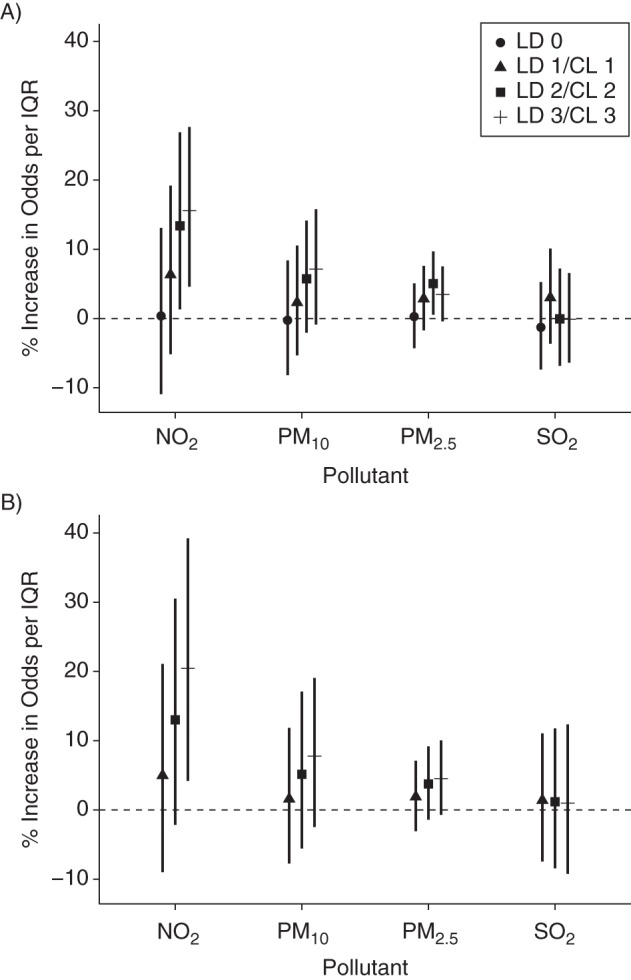
Research into environmental factors associated with suicide has historically focused on meteorological variables. Recently, a heightened risk of suicide related to short-term exposure to airborne particulate matter was reported. Here, we examined the associations between short-term exposure to nitrogen dioxide, particulate matter, and sulfur dioxide and completed suicide in Salt Lake County, Utah (n = 1,546) from 2000 to 2010. We used a time-stratified case-crossover design to estimate adjusted odds ratios for the relationship between suicide and exposure to air pollutants on the day of the suicide and during the days preceding the suicide. We observed maximum heightened odds of suicide associated with interquartile-range increases in nitrogen dioxide during cumulative lag 3 (average of the 3 days preceding suicide; odds ratio (OR) = 1.20, 95% confidence interval (CI): 1.04, 1.39) and fine particulate matter (diameter ≤2.5 μm) on lag day 2 (day 2 before suicide; OR = 1.05, 95% CI: 1.01, 1.10). Following stratification by season, an increased suicide risk was associated with exposure to nitrogen dioxide during the spring/fall transition period (OR = 1.35, 95% CI: 1.09, 1.66) and fine particulate matter in the spring (OR = 1.28, 95% CI: 1.01, 1.61) during cumulative lag 3. Findings of positive associations between air pollution and suicide appear to be consistent across study locations with vastly different meteorological, geographical, and cultural characteristics.
Keywords: air pollution; case-crossover studies; environmental exposure; nitrogen dioxide; particulate matter; risk factors; suicide.
© The Author 2015. Published by Oxford University Press on behalf of the Johns Hopkins Bloomberg School of Public Health. All rights reserved. For permissions, please e-mail: journals.permissions@oup.com.
Figures
Comment in
-
Bakian et al. respond to "Assessing air pollution and suicide risk".Am J Epidemiol. 2015 Mar 1;181(5):309-10. doi: 10.1093/aje/kwu343. Epub 2015 Feb 10. Am J Epidemiol. 2015. PMID: 25673815 Free PMC article. No abstract available.
-
Invited commentary: Assessment of air pollution and suicide risk.Am J Epidemiol. 2015 Mar 1;181(5):304-8. doi: 10.1093/aje/kwu342. Epub 2015 Feb 10. Am J Epidemiol. 2015. PMID: 25673818
References
-
- Utah Department of Health. Utah Health Status Update: Leading Causes of Mortality and Morbidity in Utah. Salt Lake City, UT: Utah Department of Health; 2010. http://health.utah.gov/opha/publications/hsu/10Oct_LCMM.pdf . Accessed July 29, 2014.
-
- Petridou E, Papadopoulos FC, Frangakis CE, et al. A role of sunshine in the triggering of suicide. Epidemiology. 2002;13(1):106–109. - PubMed
-
- Nicholls N, Butler CD, Hanigan I. Inter-annual rainfall variations and suicide in New South Wales, Australia, 1964–2001. Int J Biometeorol. 2006;50(3):139–143. - PubMed
-
- Kim C, Jung SH, Kang DR, et al. Ambient particulate matter as a risk factor for suicide. Am J Psychiatry. 2010;167(9):1100–1107. - PubMed
Publication types
MeSH terms
Substances
Grants and funding
LinkOut - more resources
Full Text Sources
Other Literature Sources
Medical
