. 2014 Dec;25(4):474-80.
doi: 10.1007/s13337-014-0228-6. Epub 2014 Oct 1.

In vitro anti-canine distemper virus activity of fucoidan extracted from the brown alga Cladosiphon okamuranus

Affiliations

In vitro anti-canine distemper virus activity of fucoidan extracted from the brown alga Cladosiphon okamuranus

Laura M Trejo-Avila et al. Virusdisease. 2014 Dec.

Abstract

Canine distemper virus (CDV) is a morbillivirus related to measles virus that infects dogs and other carnivores. CDV has a significant global impact on animal health; however, there is no current antiviral treatment for CDV infection. In recent years, it has been demonstrated that sulfated polysaccharides exhibit antiviral properties both in vivo and in vitro, despite their low cytotoxicity to host cells. Fucoidan is a sulfated polysaccharide found in the cell wall matrix of brown algae. In this study, we evaluated in vitro anti-CDV activity of fucoidan, which was derived from Cladosiphon okamuranus. Fucoidan actively inhibited CDV replication in Vero cells at a 50 % inhibitory concentration (IC50) of 0.1 µg/ml. The derived selectivity index (SI50) was >20,000. This polysaccharide likely inhibits viral infection by interference in the early steps and by inhibiting CDV-mediated cell fusion. Fucoidan may be useful in development of pharmacological strategies to treat and control CDV infection.

Keywords: Antiviral; CDV; Cladosiphon okamuranus; Fucoidan; Morbillivirus.


Figures
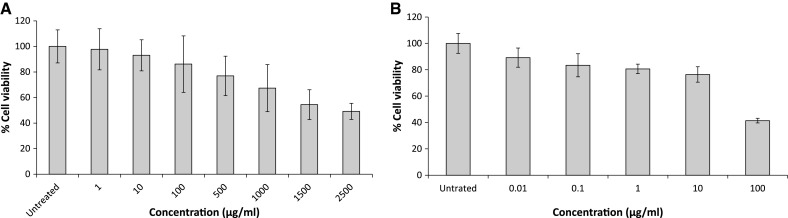
Fig. 1
Fig. 1
Evaluation of fucoidan (A) and ribavirin (B) cytotoxicity to Vero cells using the MTT assay. Control: cells without treatment. Bars represent means, with vertical lines indicating standard deviations, n = 9, *p ≤ 0.05
Fig. 2
Fig. 2
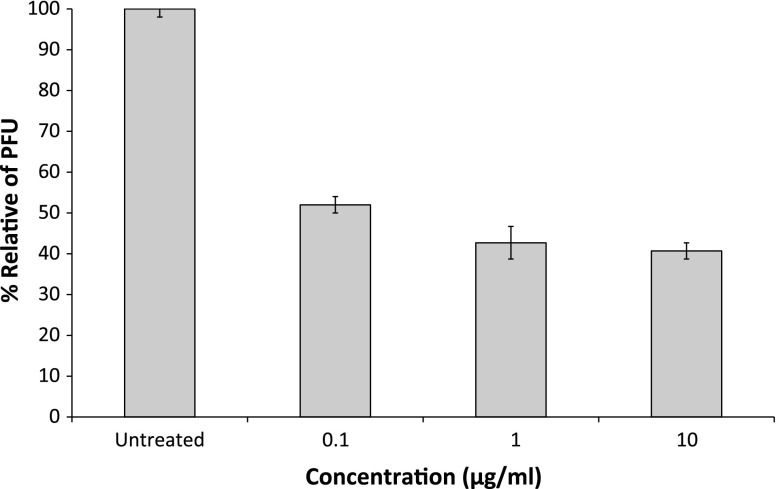
Evaluation of antiviral activity of fucoidan against canine distemper virus in Vero cells by plaque reduction. Infected cells were cultured in the absence of drug, or with the indicated concentration of fucoidan. Bars represent mean values and vertical lines represent the standard deviations from the mean (n = 9, *p < 0.05)
Fig. 3
Fig. 3
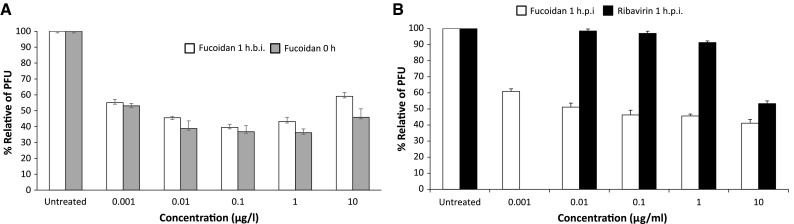
Effect of fucoidan on adsorption and entry of canine distemper virus (CDV). The fucoidan was added to and incubated for 1 h with cells either “before infection (1 h b.i.)” or “during infection (0 h)” of cell infection with CDV (100 PFU) (A). The fucoidan or ribavirin was added and incubated for 1 h with cells after 1 h period of cell infection with CDV (100 PFU) “post-infection (1 h p.i.)” (B), following 72 h incubation. Control cells were infected with CDV (100 PFU), but not treated with fucoidan. Bars represent mean values and vertical lines represent the standard error from the mean (n = 9, *p < 0.05)
Fig. 4
Fig. 4
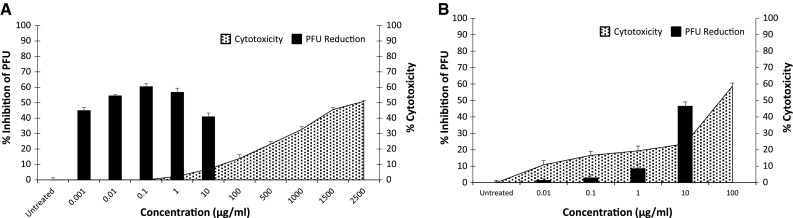
Fucoidan and ribavirin antiviral efficacy. Percent inhibition of plaque forming units versus percent cytotoxicity. Test results based on treatment with fucoidan, concurrent with infection (A) and test results based on ribavirin treatment after adsorption (B). Bars represent mean values and vertical lines represent the standard error from the mean (n = 9, *p < 0.05)
Fig. 5
Fig. 5
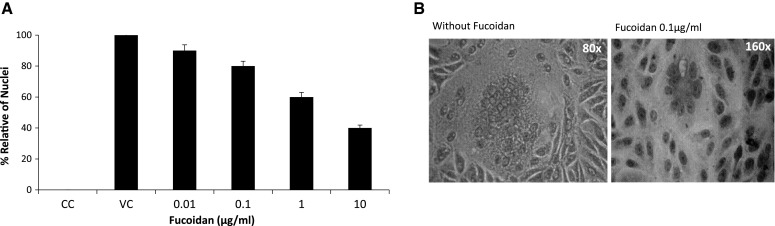
Effect of fucoidan on syncytium formation. (A) Circles represent mean values and vertical lines represent standard deviation from the mean. The mean ± standard deviation (%) for 20 syncytia per well was determined in three different experiments (*p < 0.05). (B) The effect of fucoidan on syncytium size (i.e., the number of nuclei per syncytium)

References

    1. Baba M, Snoeck R, Pauwels R, de Clercq E. Sulfated polysaccharides are potent and selective inhibitors of various enveloped viruses, including herpes simplex virus, cytomegalovirus, vesicular stomatitis virus, and human immunodeficiency virus. Antimicrob Agents Chemother. 1988;32:1742–1745. doi: 10.1128/AAC.32.11.1742. - DOI - PMC - PubMed
    1. Berteau O, Mulloy B. Sulfated fucans, fresh perspectives: structures, functions, and biological properties of sulfated fucans and an overview of enzymes active toward this class of polysaccharide. Glycobiology. 2003;13:29R–40R. doi: 10.1093/glycob/cwg058. - DOI - PubMed
    1. Chen MZ, Xie HG, Yang LW, Liao ZH, Yu J. In vitro anti-influenza virus activities of sulfated polysaccharide fractions from Gracilaria lemaneiformis. Virol Sin. 2010;25:35–341. - PMC - PubMed
    1. Cumashi A, Ushakova NA, Preobrazhenskaya ME, D’Incecco A, Piccoli A, Totani L, Tinari N, Morozevich GE, Berman AE, Bilan MI, Usov AI, Ustyuzhanina NE, Grachev AA, Sanderson CJ, Kelly M, Rabinovich GA, Lacobelli S, Nifantiev NE, Consorzio Interuniversitario Nazionale per la Bio-Oncologia, Ital A comparative study of the anti-inflammatory, anticoagulant, antiangiogenic, and antiadhesive activities of nine different fucoidans from brown seaweeds. Glycobiology. 2007;17:541–552. doi: 10.1093/glycob/cwm014. - DOI - PubMed
    1. Damonte EB, Matulewicz MC, Cerezo AS. Sulfated seaweed polysaccharides as antiviral agents. Curr Med Chem. 2004;11:2399–2419. doi: 10.2174/0929867043364504. - DOI - PubMed

LinkOut - more resources