Intentional and Reactive Inhibition During Spoken-Word Stroop Task Performance in People With Aphasia
- PMID: 25674773
- PMCID: PMC4610288
- DOI: 10.1044/2015_JSLHR-L-14-0063
Intentional and Reactive Inhibition During Spoken-Word Stroop Task Performance in People With Aphasia
Abstract
Purpose: The integrity of selective attention in people with aphasia (PWA) is currently unknown. Selective attention is essential for everyday communication, and inhibition is an important part of selective attention. This study explored components of inhibition-both intentional and reactive inhibition-during spoken-word production in PWA and in controls who were neurologically healthy (HC). Intentional inhibition is the ability to suppress a response to interference, and reactive inhibition is the delayed reactivation of a previously suppressed item.
Method: Nineteen PWA and 20 age- and education-matched HC participated in a Stroop spoken-word production task. This task allowed the examination of intentional and reactive inhibition by evoking and comparing interference, facilitation, and negative priming effects in different contexts.
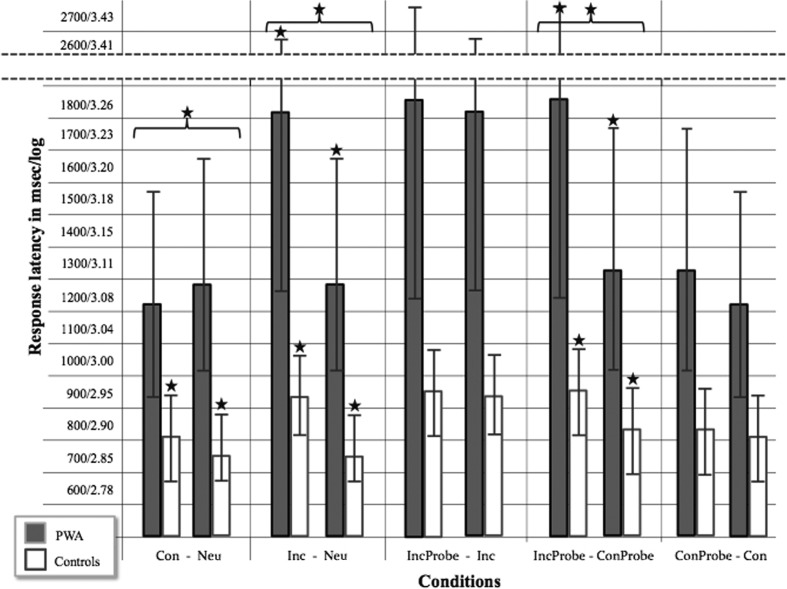
Results: Although both groups demonstrated intentional inhibition, PWA demonstrated significantly more interference effects. PWA demonstrated no significant facilitation effects. HC demonstrated significant reverse facilitation effects. Neither group showed significant evidence of reactive inhibition, though both groups showed similar individual variability.
Conclusions: These results underscore the challenge interference presents for PWA during spoken-word production, indicating diminished intentional inhibition. Although reactive inhibition was not different between PWA and HC, PWA showed difficulty integrating and adapting to contextual information during language tasks.
Figures
References
-
- Andrés P., Guerrini C., Phillips L. H., & Perfect T. J. (2008). Differential effects of aging on executive and automatic inhibition. Developmental Neuropsychology, 33, 101–123. - PubMed
-
- Baddeley A. D. (1993). Working memory or working attention. In Baddeley A. D., & Weiskrantz L. (Eds.), Attention: Selection, awareness and control; A tribute to Donald Broadbent (pp. 152–170). Oxford, United Kingdom: Oxford University Press.
-
- Botvinick M. M., Braver T. S., Barch D. M., Carter C. S., & Cohen J. D. (2001). Conflict monitoring and cognitive control. Psychological Review, 108, 624–652. - PubMed
-
- Catena A., Fuentes L. J., & Tudela P. (2002). Priming and interference effects can be disassociated in the Stroop task: New evidence in favor of automaticity of word recognition. Psychonomic Bulletin and Review, 9, 113–118. - PubMed
-
- Cohen J. D., Dunbar K., & McClelland J. L. (1990). On the control of automatic processes: A parallel distributed processing account of the Stroop effect. Psychological Review, 97, 332–361. - PubMed
Publication types
MeSH terms
Grants and funding
LinkOut - more resources
Full Text Sources
Medical