


DNA double strand break repair pathway choice: a chromatin based decision?
- PMID: 25675367
- PMCID: PMC4615830
- DOI: 10.1080/19491034.2015.1010946
DNA double strand break repair pathway choice: a chromatin based decision?
Abstract
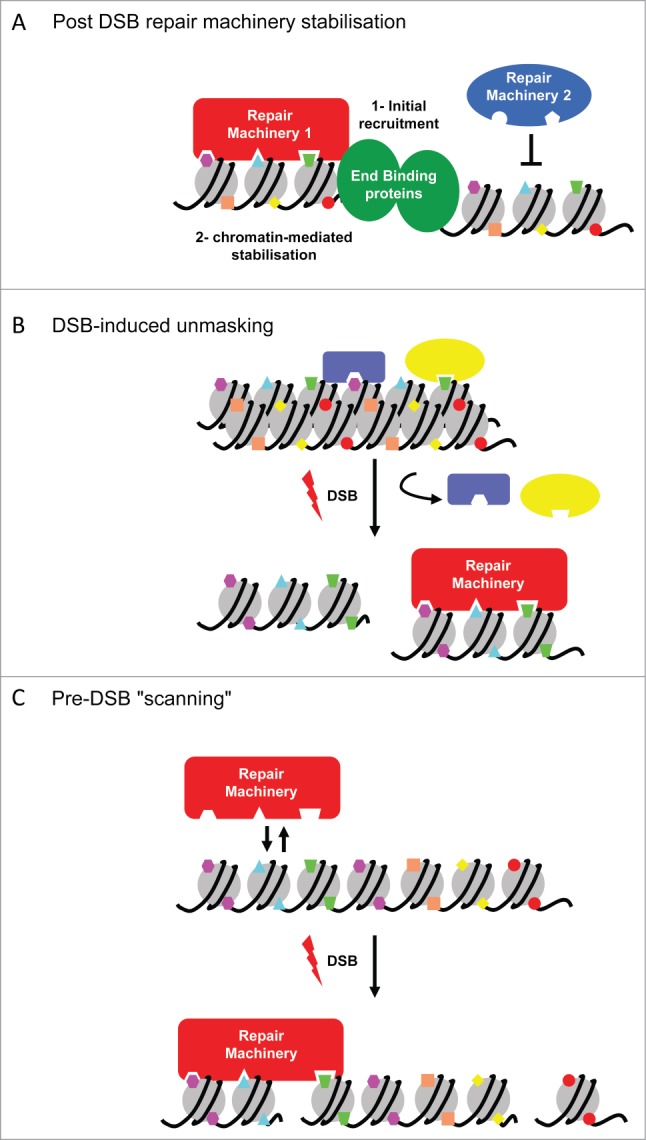
DNA double-strand breaks (DSBs) are highly toxic lesions that can be rapidly repaired by 2 main pathways, namely Homologous Recombination (HR) and Non Homologous End Joining (NHEJ). The choice between these pathways is a critical, yet not completely understood, aspect of DSB repair. We recently found that distinct DSBs induced across the genome are not repaired by the same pathway. Indeed, DSBs induced in active genes, naturally enriched in the trimethyl form of histone H3 lysine 36 (H3K36me3), are channeled to repair by HR, in a manner depending on SETD2, the major H3K36 trimethyltransferase. Here, we propose that these findings may be generalized to other types of histone modifications and repair machineries thus defining a "DSB repair choice histone code". This "decision making" function of preexisting chromatin structure in DSB repair could connect the repair pathway used to the type and function of the damaged region, not only contributing to genome stability but also to its diversity.
Keywords: DNA double strand breaks; DSB pathway choice; chromatin, trimethyl H3K36; homologous recombination.
Figures

References
-
- Ciccia A, Elledge SJ. The DNA damage response: making it safe to play with knives. Mol Cell 2010; 40:179-204; PMID:20965415; http://dx.doi.org/ 10.1016/j.molcel.2010.09.019 - DOI - PMC - PubMed
-
- Betermier M, Bertrand P, Lopez BS. Is non-homologous end-joining really an inherently error-prone process? PLoS Genetics 2014; 10:e1004086; PMID:24453986; http://dx.doi.org/ 10.1371/journal.pgen.1004086 - DOI - PMC - PubMed
-
- Simsek D, Jasin M. Alternative end-joining is suppressed by the canonical NHEJ component Xrcc4-ligase IV during chromosomal translocation formation. Nat Struct Mol Biol 2010; 17:410-6; PMID:20208544; http://dx.doi.org/ 10.1038/nsmb.1773 - DOI - PMC - PubMed
-
- Ghezraoui H, Piganeau M, Renouf B, Renaud JB, Sallmyr A, Ruis B, Oh S, Tomkinson AE, Hendrickson EA, Giovannangeli C, et al. Chromosomal translocations in human cells are generated by canonical nonhomologous end-joining. Mol Cell 2014; 55:829-42; PMID:25201414; http://dx.doi.org/ 10.1016/j.molcel.2014.08.002 - DOI - PMC - PubMed
-
- Rai R, Zheng H, He H, Luo Y, Multani A, Carpenter PB, Chang S. The function of classical and alternative non-homologous end-joining pathways in the fusion of dysfunctional telomeres. EMBO J 2010; 29:2598-610; PMID:20588252; http://dx.doi.org/ 10.1038/emboj.2010.142 - DOI - PMC - PubMed
Publication types
MeSH terms
Substances
LinkOut - more resources
Full Text Sources
Other Literature Sources
