


Comprehensive profiling of plasma fatty acid concentrations in young healthy Canadian adults
- PMID: 25675440
- PMCID: PMC4326172
- DOI: 10.1371/journal.pone.0116195
Comprehensive profiling of plasma fatty acid concentrations in young healthy Canadian adults
Erratum in
-
Correction: Comprehensive profiling of plasma fatty acid concentrations in young healthy Canadian adults.PLoS One. 2015 May 13;10(5):e0128167. doi: 10.1371/journal.pone.0128167. eCollection 2015. PLoS One. 2015. PMID: 25970331 Free PMC article. No abstract available.
-
Correction: Comprehensive Profiling of Plasma Fatty Acid Concentrations in Young Healthy Canadian Adults.PLoS One. 2024 Dec 3;19(12):e0315115. doi: 10.1371/journal.pone.0315115. eCollection 2024. PLoS One. 2024. PMID: 39625952 Free PMC article.
Abstract
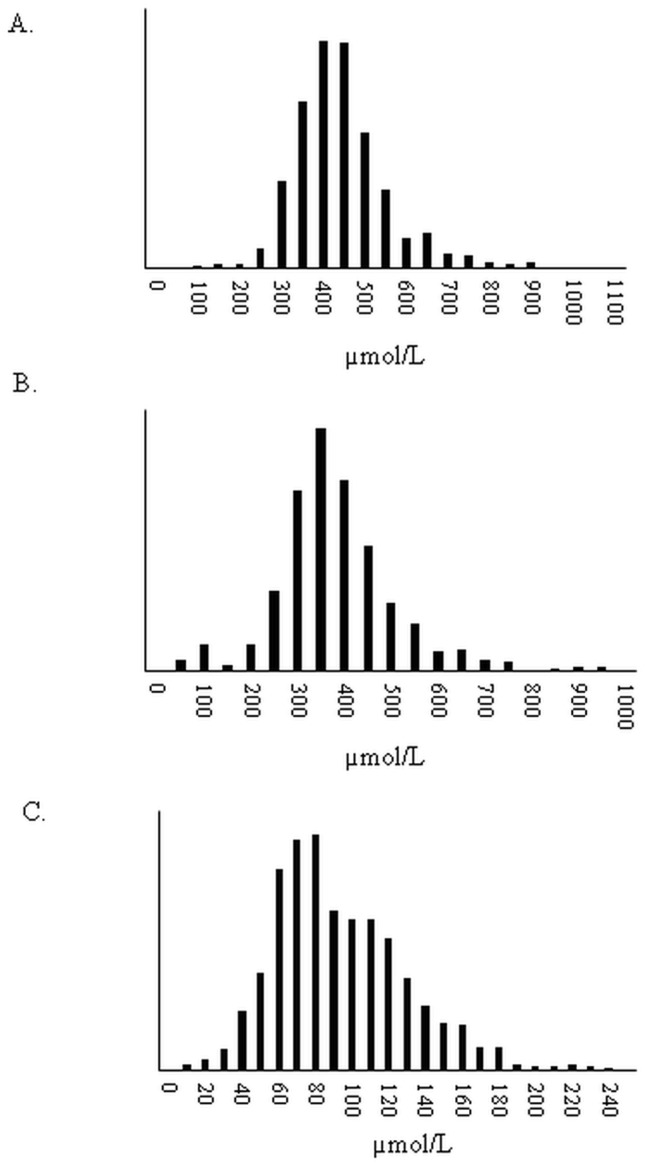
Circulating fatty acids (FA) are associated with a multitude of chronic diseases. However, a major gap in establishing such relationships is the lack of accepted fatty acid reference ranges representing healthy individuals. Data on validated FA reference ranges would provide a better understanding of study baseline measures and aid in the evaluation and interpretation of pharmaceutical or dietary interventions. Reference ranges for plasma FA levels have been reported in a few small studies and on a limited number of FA. Therefore, we determined the average and percentiles of a broad set of 61 FA (C14 - C24:1) from plasma total lipids from an ethnically diverse population of healthy young Canadian males and females (Total n = 826). Plasma concentrations of some of the major FA ranged from 0.3 to 4.1 mmol/L for palmitic acid, 0.1 to 1.0 mmol/L for stearic acid, 0.03 to 3.2 mmol/L for oleic acid, 0.2 to 5.0 mmol/L for linoleic acid (LA), 12.0 to 186.9 μmol/L for α-linolenic acid, and 7.2 to 237.5 μmol/L for docosahexaenoic acid (DHA). Males had significantly higher plasma concentrations of γ-linolenic acid (GLA) and n-3 docosapentaenoic acid and lower concentrations of palmitoleic acid, LA and DHA than females. Comparison of FA concentrations between Caucasians, East Asians and South Asians revealed that South Asians had significantly lower levels of palmitoleic acid (p < 0.01) and oleic acid (p = 0.01) while East Asians had lower levels of GLA (p = 0.02) and dihomo-γ-linolenic acid (p = 0.03). Overall, these data provide a comprehensive set of quantitative values that profiles a small cohort of Canadians which highlights the utility of establishing validated FA reference ranges that may be used to understand how deficient, suboptimal, or excess amounts of a given FA may be associated with chronic disease.
Conflict of interest statement
Figures
References
-
- Kris-Etherton PM (1999) AHA Science Advisory. Monounsaturated fatty acids and risk of cardiovascular disease. American Heart Association. Nutrition Committee. Circulation 100: 1253–1258. - PubMed
-
- Simopoulos AP (1999) Essential fatty acids in health and chronic disease. Am J Clin Nutr 70: 560S–569S. - PubMed
-
- Mozaffarian D, Katan MB, Ascherio A, Stampfer MJ, Willett WC (2006) Trans fatty acids and cardiovascular disease. N Engl J Med 354: 1601–1613. - PubMed
Publication types
MeSH terms
Substances
LinkOut - more resources
Full Text Sources
Other Literature Sources
Miscellaneous
