


Massively expedited genome-wide heritability analysis (MEGHA)
- PMID: 25675487
- PMCID: PMC4345618
- DOI: 10.1073/pnas.1415603112
Massively expedited genome-wide heritability analysis (MEGHA)
Abstract
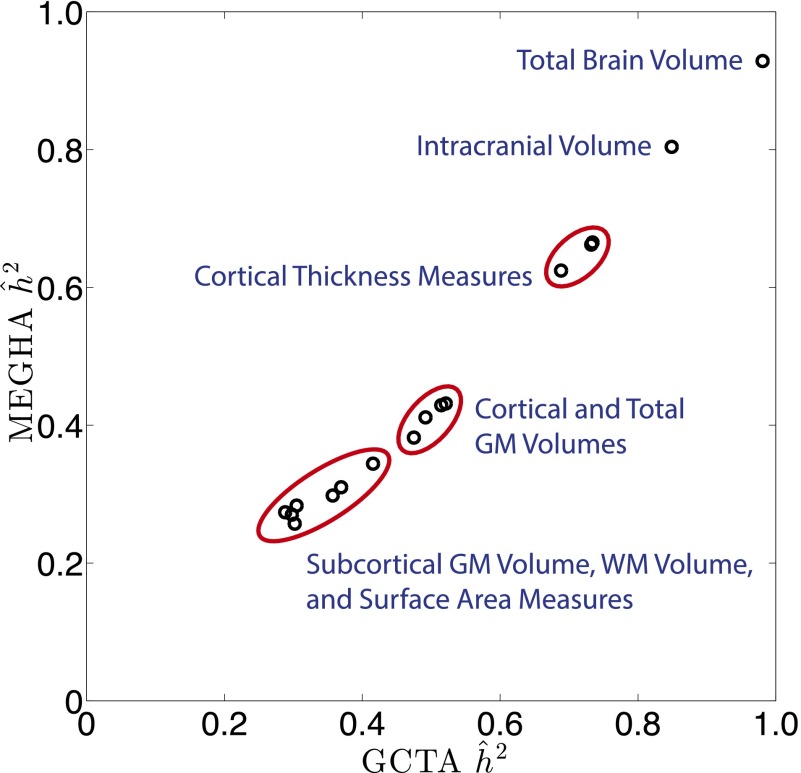
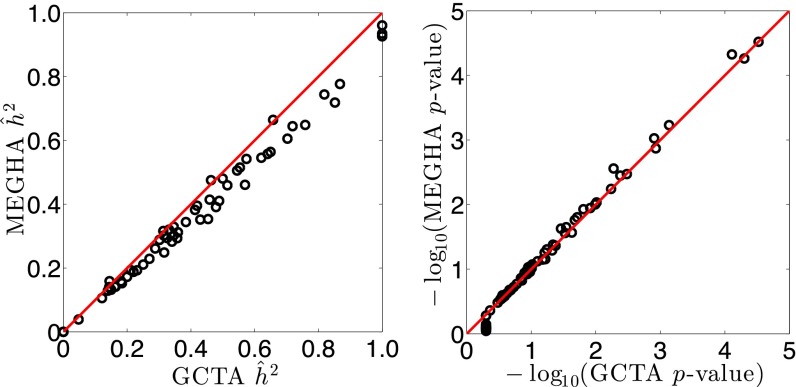
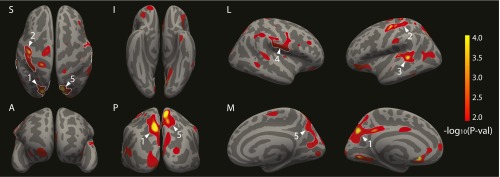
The discovery and prioritization of heritable phenotypes is a computational challenge in a variety of settings, including neuroimaging genetics and analyses of the vast phenotypic repositories in electronic health record systems and population-based biobanks. Classical estimates of heritability require twin or pedigree data, which can be costly and difficult to acquire. Genome-wide complex trait analysis is an alternative tool to compute heritability estimates from unrelated individuals, using genome-wide data that are increasingly ubiquitous, but is computationally demanding and becomes difficult to apply in evaluating very large numbers of phenotypes. Here we present a fast and accurate statistical method for high-dimensional heritability analysis using genome-wide SNP data from unrelated individuals, termed massively expedited genome-wide heritability analysis (MEGHA) and accompanying nonparametric sampling techniques that enable flexible inferences for arbitrary statistics of interest. MEGHA produces estimates and significance measures of heritability with several orders of magnitude less computational time than existing methods, making heritability-based prioritization of millions of phenotypes based on data from unrelated individuals tractable for the first time to our knowledge. As a demonstration of application, we conducted heritability analyses on global and local morphometric measurements derived from brain structural MRI scans, using genome-wide SNP data from 1,320 unrelated young healthy adults of non-Hispanic European ancestry. We also computed surface maps of heritability for cortical thickness measures and empirically localized cortical regions where thickness measures were significantly heritable. Our analyses demonstrate the unique capability of MEGHA for large-scale heritability-based screening and high-dimensional heritability profile construction.
Keywords: endophenotype; genome-wide complex trait analysis; heritability; imaging genetics; phenomics.
Conflict of interest statement
The authors declare no conflict of interest.
Figures
References
-
- Falconer D. Introduction to Quantitative Genetics. Oliver and Boyd; Edinburgh, Scotland: 1960.
-
- Neale M, Cardon L. Methodology for Genetic Studies of Twins and Families. Springer; New York: 1992.
Publication types
MeSH terms
Grants and funding
- 098369/Z/12/Z/WT_/Wellcome Trust/United Kingdom
- R01 EB015611/EB/NIBIB NIH HHS/United States
- R01NS083534/NS/NINDS NIH HHS/United States
- R01 EB015611-01/EB/NIBIB NIH HHS/United States
- K24MH094614/MH/NIMH NIH HHS/United States
- U54 MH091657-03/MH/NIMH NIH HHS/United States
- 1K25EB013649-01/EB/NIBIB NIH HHS/United States
- K01MH099232/MH/NIMH NIH HHS/United States
- K99MH101367/MH/NIMH NIH HHS/United States
- 100309/Z/12/Z/WT_/Wellcome Trust/United Kingdom
- R01 MH101486/MH/NIMH NIH HHS/United States
- R01 NS070963/NS/NINDS NIH HHS/United States
- K25 EB013649/EB/NIBIB NIH HHS/United States
- K24 MH094614/MH/NIMH NIH HHS/United States
- K99 MH101367/MH/NIMH NIH HHS/United States
- 100309/WT_/Wellcome Trust/United Kingdom
- P41EB015896/EB/NIBIB NIH HHS/United States
- U54 MH091657/MH/NIMH NIH HHS/United States
- K01 MH099232/MH/NIMH NIH HHS/United States
- P41 EB015896/EB/NIBIB NIH HHS/United States
- R01 NS083534/NS/NINDS NIH HHS/United States
LinkOut - more resources
Full Text Sources
Other Literature Sources
Research Materials
