. 2015 Oct;86(4):663-73.
doi: 10.1111/cbdd.12534. Epub 2015 Mar 13.

Targeting Influenza A Virus RNA Promoter

Affiliations

Targeting Influenza A Virus RNA Promoter

Angel Bottini et al. Chem Biol Drug Des. 2015 Oct.

Abstract

The emergence of drug-resistant strains of influenza virus makes exploring new classes of inhibitors that target universally conserved viral targets a highly important goal. The influenza A viral genome is made up of eight single-stranded RNA-negative segments. The RNA promoter, consisting of the conserved sequences at the 3' and 5' end of each RNA genomic segment, is universally conserved among influenza A virus strains and in all segments. Previously, we reported on the identification and NMR structure of DPQ (6,7-dimethoxy-2-(1-piperazinyl)-4-quinazolinamine) (compound 1) in complex with the RNA promoter. Here, we report on additional screening and SAR studies with compound 1, including ex vivo anti-influenza activity assays, resulted in improved cellular activity against influenza A virus in the micromolar range.

Keywords: chemical biology; drug design; drug discovery.


Conflict of interest statement

Conflict of interest

The authors declare no financial/commercial conflicts of interest.

Figures
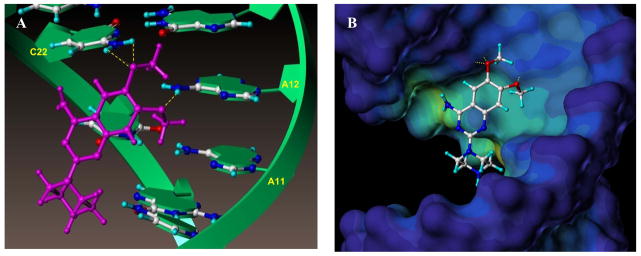
Figure 1
Figure 1. Influenza RNA promoter in complex with compound 1
(A) Detail of the interactions between compound 1 and the RNA promoter from the NMR structure of the complex (PDB ID 2LWK).(10) The RNA helix is shown as a green ribbon and the nucleoside atoms and compound 1 are shown as balls and sticks. The yellow dotted lines indicated hydrogen bonds between the adenine 12 H61/H62 hydrogens and 6-methoxy oxygen atom of compound 1, and between cytosine 22 H41/H42 hydrogens and the 7-methoxy oxygen of compound 1. (B) The RNA promoter was depicted in surface representation and color coded according to cavity depth (blue indicates the most outer surface and yellow indicated a deeper cavity relative to the surface). Compound 1 binds in the major groove of the RNA helix and the amine on the piperazine ring extents toward the cavity but does not interact significantly with the RNA.
Figure 2
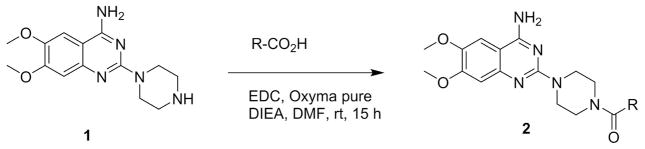
Figure 2. Synthesis of 4-amino-6,7-dimethoxy-2-(piperazin-1-yl)quinazoline derivatives (compounds 6 to 16)
Compounds 6 to 16 were synthesized from commercially available compound 1 using standard coupling conditions (EDC, oxyma pure, DIEA in DMF incubated at rt for 15h) with different starting materials as detailed in Figure 2. 6) R = Et; (7) R = i-Pr; (8) R = Pr; (9) R = 2-Hydroxyethyl; (10) R = Cyclopropyl; (11) R = 1-Methoxyethyl; (12) R = 1-adamantyl; (13) R = tetrahydrofuran; (14) R = Furan; (15) R = thiophene; (16) R = Phenyl.
Figure 3
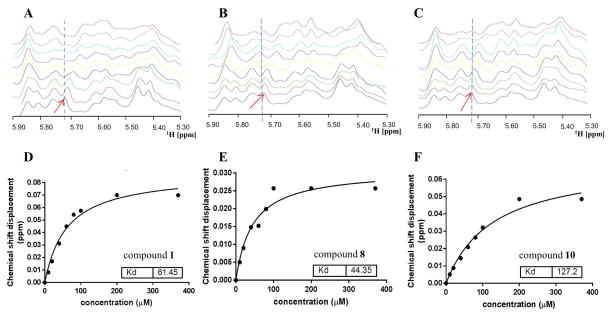
Figure 3. NMR based Kd determination for compounds 1, 8 and 10
(A), (B) and (C) reports 1D 1H NMR spectra in the ribose region of the influenza RNA promoter (50 μM) titrated with 0, 10, 20, 40, 60, 80, 100, 200 and 370 μM of compounds 1, 8 and 10, respectively. Chemical shift perturbations at 5.714 ppm (red arrow, corresponding to the H1′ of adenosine 12) were monitored and the displacement of distance (δ ppm) used to calculate the Kd values in GraphPad PRISM 6 shown in (D), (E) and (F) for compounds 1, 8 and 10, respectively.
Figure 4
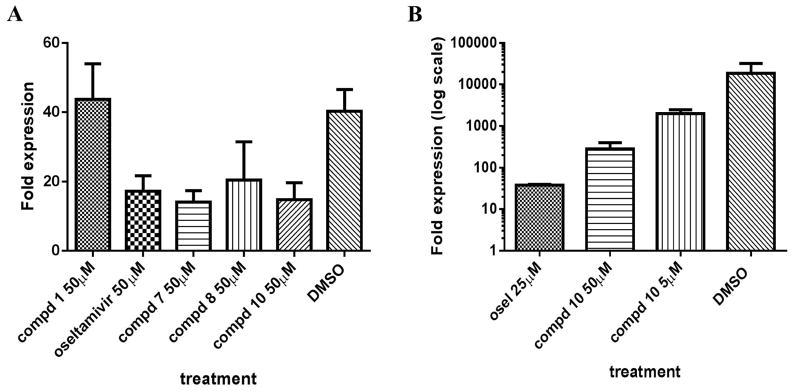
Figure 4. Viral replication assay measured by RT-PCR
(A) MDCK-HA cells were treated with control or compounds at 50 μM and then were infected with WSN-Ren luciferase virus in the same condition as the WSN-Ren luciferase assay. The mRNA level of WSN nucleoprotein was measured and standardized against beta-actin. The fold expression indicated that compounds 7, 8, and 10 at 50 μM showed similar inhibitory effect as oseltamivir phosphate at the same concentration while compound 1 did not showed significant inhibitory activity at 50 μM. The P value is < 0.0001 analyzed by one-way ANOVA test. (B) MDCK cells were treated with controls (oseltamivir phosphate or DMSO) or compound and then infected with wild-type influenza A/PR/8/35 virus at MOI= 0.2. Influenza A/PR8 Nucleoprotein mRNA was measured and standardize against beta-actin mRNA level. The fold expressed is shown in log10 scale. Oseltamivir phosphate at 25 μM and compound 10 at 50 μM and 5 μM showed inhibitory effects as the mRNA levels were reduced compared to DMSO treated cells. The P value was analyzed with one-way ANOVA analysis to be P = 0.0111.

References

    1. Sharma M, Li C, Busath DD, Zhou HX, Cross TA. Drug sensitivity, drug-resistant mutations, and structures of three conductance domains of viral porins. Biochimica et biophysica acta. 2011;1808:538–46. - PMC - PubMed
    1. De Clercq E. Antiviral agents active against influenza A viruses. Nature reviews Drug discovery. 2006;5:1015–25. - PMC - PubMed
    1. Yoneda M, Okayama A, Kitahori Y. Oseltamivir-resistant seasonal A(H1N1) and A(H1N1)pdm09 influenza viruses from the 2007/2008 to 2012/2013 season in Nara Prefecture, Japan. Japanese journal of infectious diseases. 2014;67:385–8. - PubMed
    1. Boivin G. Detection and management of antiviral resistance for influenza viruses. Influenza and other respiratory viruses. 2013;7(Suppl 3):18–23. - PMC - PubMed
    1. Boltz DA, Aldridge JR, Jr, Webster RG, Govorkova EA. Drugs in development for influenza. Drugs. 2010;70:1349–62. - PMC - PubMed

Publication types

MeSH terms