. 2015 Jun;14(3):491-5.
doi: 10.1111/acel.12325. Epub 2015 Feb 9.

Accelerated epigenetic aging in Down syndrome

Affiliations

Accelerated epigenetic aging in Down syndrome

Steve Horvath et al. Aging Cell. 2015 Jun.

Abstract

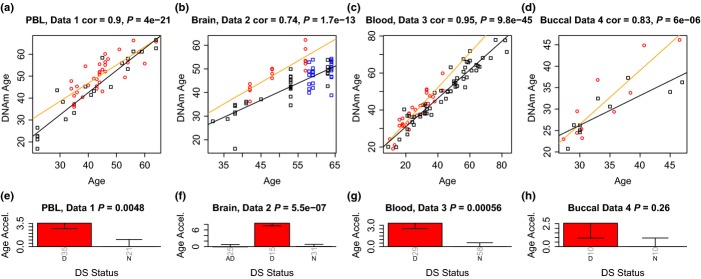
Down Syndrome (DS) entails an increased risk of many chronic diseases that are typically associated with older age. The clinical manifestations of accelerated aging suggest that trisomy 21 increases the biological age of tissues, but molecular evidence for this hypothesis has been sparse. Here, we utilize a quantitative molecular marker of aging (known as the epigenetic clock) to demonstrate that trisomy 21 significantly increases the age of blood and brain tissue (on average by 6.6 years, P = 7.0 × 10(-14)).

Keywords: DNA methylation; Down syndrome; biomarker of aging; epigenetics.


Figures

Fig 1
Fig 1
Analysis of 4 independent Down syndrome data sets. Each column corresponds to a different data set. The top row (a–d) shows scatter plots between chronological age (x-axis) and DNAm age (y-axis) in the 4 independent data sets. Red circles indicate DS, blue circles indicate Alzheimer's disease, and black squares denote control subjects. The orange line corresponds to a regression line through DS subjects. The black line in the upper panels indicates the regression line through the remaining (control) samples. The age acceleration effect for each subject (point) corresponds to the vertical distance to the black regression line. While DNAm age is highly correlated with chronological age, red points tend to lie above the black line, which indicates that DS subjects exhibit accelerated aging effects. The bottom row (e–h) show how mean age acceleration (y-axis) relates to DS status. By definition, the mean age acceleration measure in controls is zero. The title of the bar plots also reports a P-value from a nonparametric group comparison test (Kruskal Wallis test). Each bar plot reports 1 SE.
Fig 2
Fig 2
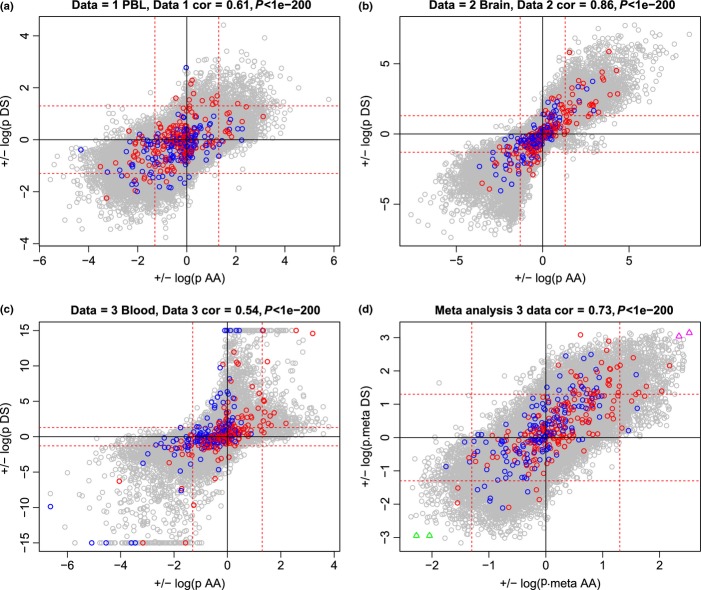
CpGs that relate to DS status tend to be correlated with age acceleration. (a–c) Results for data sets 1–3, respectively. d) Results of a meta-analysis (Supplementary Information). Each x-axis reports the marginal association with epigenetic age acceleration (as detailed in Supplementary Information and Fig. s7). The sign of the log (base 10) transformed P-value was chosen so that a positive (negative) value indicates that the CpG has a positive (negative) correlation with age acceleration. Each y-axis reports the marginal association with DS status (as detailed in Fig. s8). The sign of the log-transformed P-value was defined such that a positive value indicates that the CpG is hypermethylated in DS subjects. The 353 clock CpGs are colored according to their age correlation in the original training data set from (Horvath, 2013): red and blue for clock CpGs that have a positive and negative age correlation, respectively. The red horizontal and vertical lines correspond to an uncorrected P-value threshold of 0.05.

References

    1. Costa V, Angelini C, D'Apice L, Mutarelli M, Casamassimi A, Sommese L, Gallo MA, Aprile M, Esposito R, Leone L, Donizetti A, Crispi S, Rienzo M, Sarubbi B, Calabrò R, Picardi M, Salvatore P, Infante T, DeBerardinis P, Napoli Cl, Ciccodicola A. Massive-Scale RNA-Seq analysis of non ribosomal transcriptome in human trisomy 21. PLoS ONE. 2011;6:e18493. - PMC - PubMed
    1. Cuadrado E, Barrena MJ. Immune dysfunction in Down's syndrome: primary immune deficiency or early senescence of the immune system? Clin. Immunol. Immunopathol. 1996;78:209–214. - PubMed
    1. Devenny DA, Wegiel J, Schupf N, Jenkins E, Zigman W, Krinsky-McHale SJ, Silverman WP. Dementia of the Alzheimer's type and accelerated aging in Down syndrome. Sci. Aging Knowledge Environ. 2005;(14) ):dn1. - PubMed
    1. Esposito G, Imitola J, Lu J, De Filippis D, Scuderi C, Ganesh VS, Folkerth R, Hecht J, Shin S, Iuvone T, et al. Genomic and functional profiling of human Down syndrome neural progenitors implicates S100B and aquaporin 4 in cell injury. Hum. Mol. Genet. 2008;17:440–457. - PubMed
    1. Hannum G, Guinney J, Zhao L, Zhang L, Hughes G, Sadda S, Klotzle B, Bibikova M, Fan J-B, Gao Y, et al. Genome-wide methylation profiles reveal quantitative views of human aging rates. Mol. Cell. 2013;49:359–367. - PMC - PubMed

Publication types