


Fibrates and cholestasis
- PMID: 25678132
- PMCID: PMC4515188
- DOI: 10.1002/hep.27744
Fibrates and cholestasis
Abstract
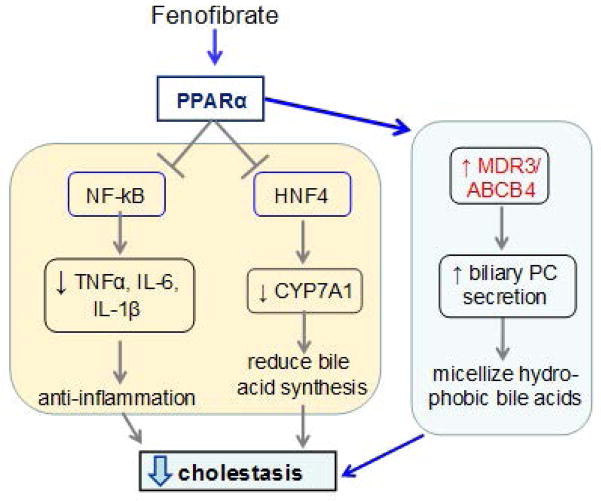
Cholestasis, including primary biliary cirrhosis (PBC) and primary sclerosing cholangitis (PSC), results from an impairment or disruption of bile production and causes intracellular retention of toxic bile constituents, including bile salts. If left untreated, cholestasis leads to liver fibrosis and cirrhosis, which eventually results in liver failure and the need for liver transplantation. Currently, the only therapeutic option available for these patients is ursodeoxycholic acid (UDCA), which slows the progression of PBC, particularly in stage I and II of the disease. However, some patients have an incomplete response to UDCA therapy, whereas other, more advanced cases often remain unresponsive. For PSC, UDCA therapy does not improve survival, and recommendations for its use remain controversial. These considerations emphasize the need for alternative therapies. Hepatic transporters, located along basolateral (sinusoidal) and apical (canalicular) membranes of hepatocytes, are integral determinants of bile formation and secretion. Nuclear receptors (NRs) are critically involved in the regulation of these hepatic transporters and are natural targets for therapy of cholestatic liver diseases. One of these NRs is peroxisome proliferator-activated receptor alpha (PPARα), which plays a central role in maintaining cholesterol, lipid, and bile acid homeostasis by regulating genes responsible for bile acid synthesis and transport in humans, including cytochrome P450 (CYP) isoform 7A1 (CYP7A1), CYP27A1, CYP8B1, uridine 5'-diphospho-glucuronosyltransferase 1A1, 1A3, 1A4, 1A6, hydroxysteroid sulfotransferase enzyme 2A1, multidrug resistance protein 3, and apical sodium-dependent bile salt transporter. Expression of many of these genes is altered in cholestatic liver diseases, but few have been extensively studied or had the mechanism of PPARα effect identified. In this review, we examine what is known about these mechanisms and consider the rationale for the use of PPARα ligand therapy, such as fenofibrate, in various cholestatic liver disorders.
© 2015 by the American Association for the Study of Liver Diseases.
Figures

References
-
- Hirschfield GM, Heathcote EJ, Gershwin ME. Pathogenesis of cholestatic liver disease and therapeutic approaches. Gastroenterology. 2010;139:1481–1496. - PubMed
-
- Trauner M, Boyer JL. Bile salt transporters: molecular characterization, function, and regulation. Physiol Rev. 2003;83:633–671. - PubMed
-
- Nathanson MH, Boyer JL. Mechanisms and regulation of bile secretion. Hepatology. 1991;14:551–566. - PubMed
-
- Childs S, Yeh RL, Georges E, Ling V. Identification of a sister gene to P-glycoprotein. Cancer Res. 1995;55:2029–2034. - PubMed
Publication types
MeSH terms
Substances
Grants and funding
LinkOut - more resources
Full Text Sources
Other Literature Sources
Medical