Review
. 2015 Jan 20;12(3):201-13.
doi: 10.7150/ijms.11047. eCollection 2015.

New developments in the pathogenesis and therapeutic targeting of the IDH1 mutation in glioma

Affiliations
Review

New developments in the pathogenesis and therapeutic targeting of the IDH1 mutation in glioma

Lilia Dimitrov et al. Int J Med Sci. .

Abstract

In the last five years, IDH1 mutations in human malignancies have significantly shaped the diagnosis and management of cancer patients. Ongoing intense research efforts continue to alter our understanding of the role of the IDH1 mutation in tumor formation. Currently, evidence suggests the IDH1 mutation to be an early event in tumorigenesis with multiple downstream oncogenic consequences including maintenance of a hypermethylator phenotype, alterations in HIF signalling, and disruption of collagen maturation contributing to a cancer-promoting extracellular matrix. The most recent reports elucidating these mechanisms is described in this review with an emphasis on the pathogenesis of the IDH1 mutation in glioma. Conflicting findings from various studies are discussed, in order to highlight areas warranting further research. Finally, the latest progress in developing novel therapies against the IDH1 mutation is presented, including recent findings from ongoing phase 1 clinical trials and the exciting prospect of vaccine immunotherapy targeting the IDH1 mutant protein.

Keywords: DNA methylation; HIF1A protein; IDH1 protein; glioma; molecular targeted therapy; review.


Conflict of interest statement

Competing Interests: The authors have declared that no competing interest exists.

Figures
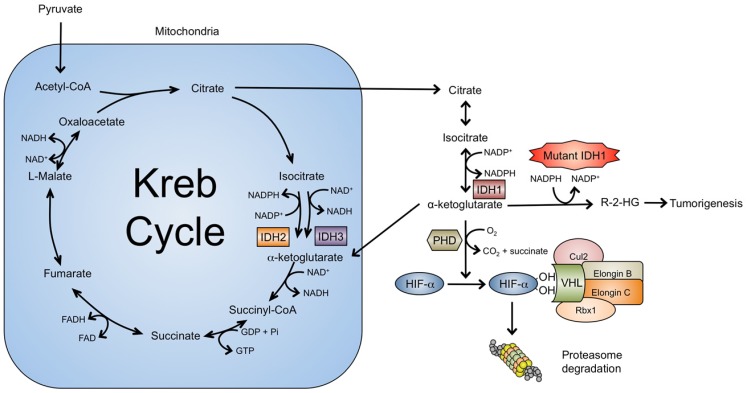
Figure 1
Figure 1
Of the three IDH isozymes, only IDH1 exists in the cytosol while IDH2 and IDH3 function within the mitochondria. Under normal conditions, cytosolic isocitrate is converted into a-KG by the wild type IDH1 enzyme with concurrent reduction of NADP+. Subsequently, a-KG can re-enter Kreb's cycle within the mitochondria or remain in the cytosol as an essential substrate for PHD. Among its many functions, in conditions of normoxia, PHD utilizes oxygen as a co-substrate and hydroxylates proline residues on HIF1-a, initiating proteasomal degradation via the VHL ubiquitin-ligase protein complex. Unlike its wild type counterpart, the mutant IDH1 protein exhibits neo-morphic activity and catalyzes conversion of a-KG into R-2-HG an “onco-metabolite” that promotes tumorigenesis through multiple pathways.
Figure 2
Figure 2
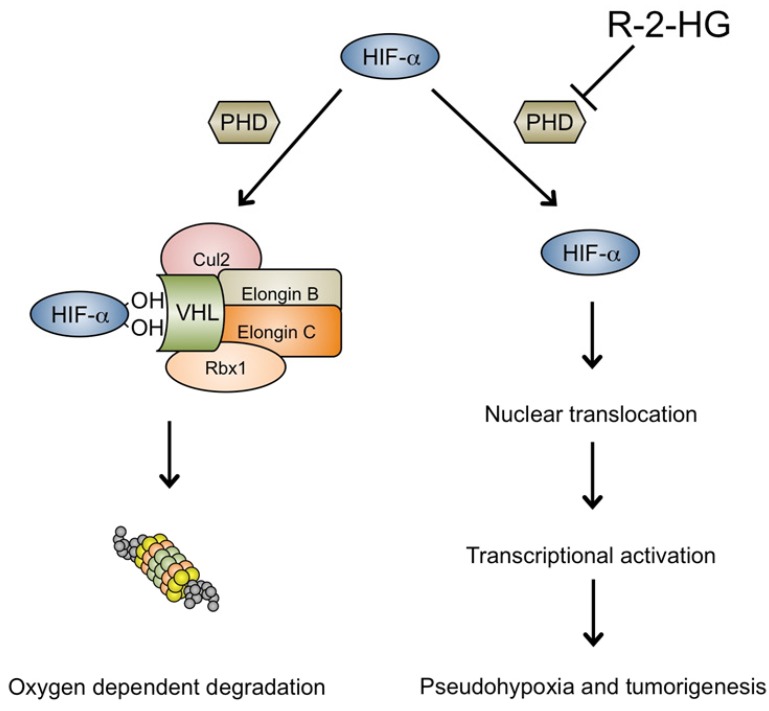
High levels of R-2-HG produced by the mutant IDH1 protein inhibit hydroxylation of HIF1-a by PHD. As such, HIF1-a persists, combines with the beta subunit, and translocates to the nucleus, where it induces transcription of hypoxia-related genes that may also promote oncogenic transformation and cell survival.
Figure 3
Figure 3
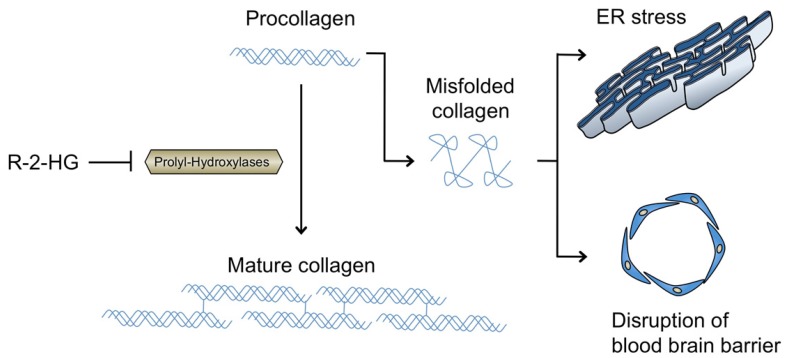
The hydroxylation of proline residues on pre-collagen fibrils by PHD is required for proper triple helix formation and maturation of type IV collagen. Disruption of PHD by R-2-HG produced by mutant IDH1 leads to accumulation of misfolded collagen, triggering a pro-apoptotic endoplasmic reticulum (ER) stress response. Additionally, as type IV collagen is found in the perivascular spaces of the brain, abnormal collagen build-up may contribute to breakdown of the blood brain barrier (BBB) in IDH1 mutated glioma.
Figure 4
Figure 4
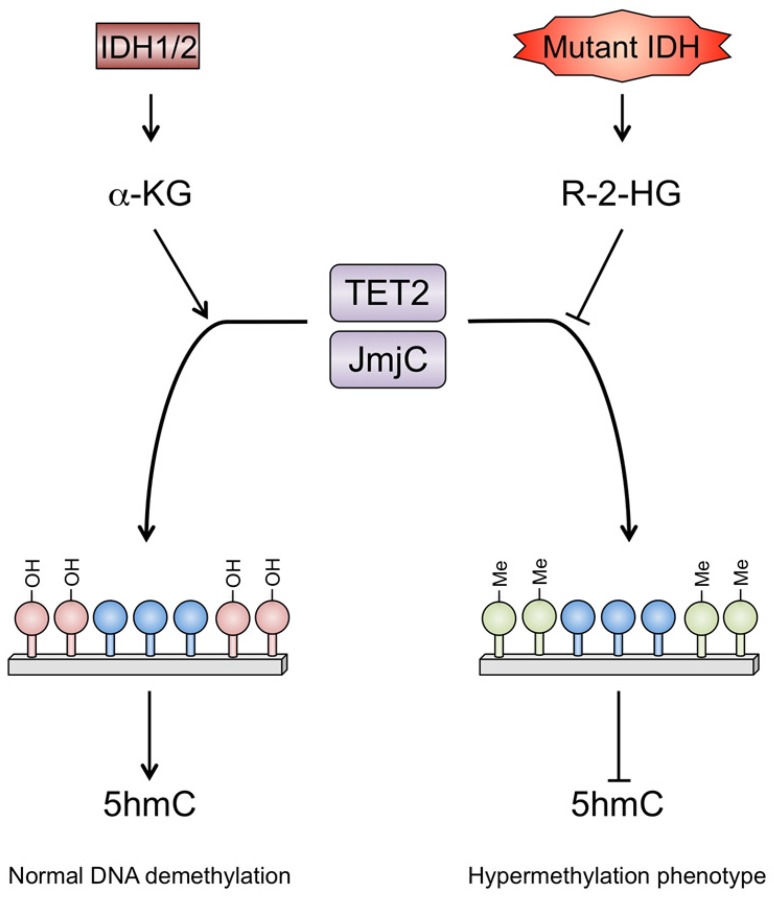
Under normal conditions, TET2 utilizes a-KG as a substrate to hydroxylate 5-methylcytosine (5mc) to 5-hydroxymethylcytosine (5hmc) during DNA demethylation. a-KG also binds to the JmjC domain of histone demethylases, which function to demethylate lysine residues on histone tails and subsequently regulate gene transcriptional activity. R-2-HG produced by the mutant IDH1 protein acts as a competitive inhibitor of TET2 and JmjC, promoting a hypermethylator phenotype that maintains an undifferentiated tumor state.

References

    1. Dolecek TA, Propp JM, Stroup NE, Kruchko C. CBTRUS statistical report: primary brain and central nervous system tumors diagnosed in the United States in 2005-2009. Neuro-oncology. 2012;14(Suppl 5):v1–49. doi:10.1093/neuonc/nos218. - PMC - PubMed
    1. Walker MD, Alexander E Jr, Hunt WE, MacCarty CS, Mahaley MS Jr, Mealey J Jr. et al. Evaluation of BCNU and/or radiotherapy in the treatment of anaplastic gliomas. A cooperative clinical trial. Journal of neurosurgery. 1978;49:333–43. doi:10.3171/jns.1978.49.3.0333. - PubMed
    1. Stupp R, Mason WP, van den Bent MJ, Weller M, Fisher B, Taphoorn MJ. et al. Radiotherapy plus concomitant and adjuvant temozolomide for glioblastoma. The New England journal of medicine. 2005;352:987–96. doi:10.1056/NEJMoa043330. - PubMed
    1. Cancer Genome Atlas Research N. Comprehensive genomic characterization defines human glioblastoma genes and core pathways. Nature. 2008;455:1061–8. doi:10.1038/nature07385. - PMC - PubMed
    1. Frezza C, Gottlieb E. Mitochondria in cancer: not just innocent bystanders. Seminars in cancer biology. 2009;19:4–11. doi:10.1016/j.semcancer.2008.11.008. - PubMed

Publication types